
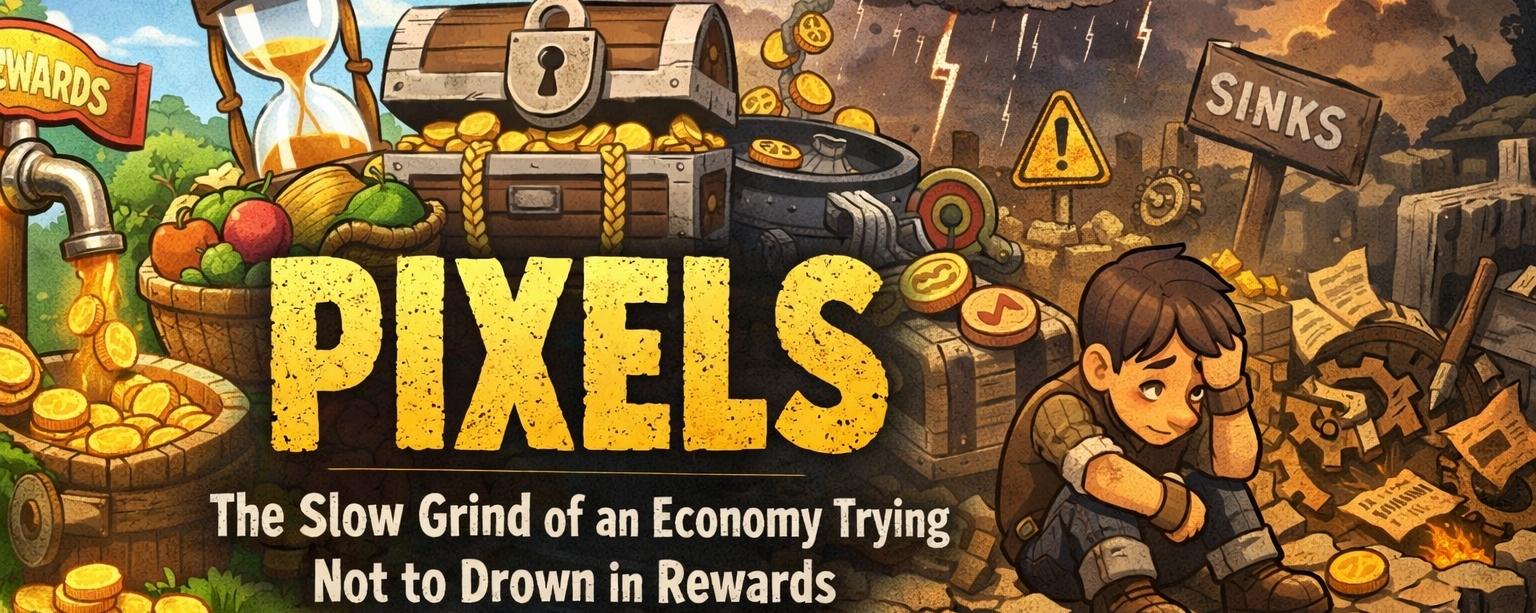

Pixels is the kind of project that makes more sense when I stop pretending it is just a game with a token attached and start looking at it for what it really is: an economy trying not to choke on its own output.
I have seen this setup too many times. A project finds a reward loop that works just well enough to attract attention, then spends the next year trying to stop that same loop from hollowing everything out. More users. More incentives. More activity. More recycling. Then the grind sets in. Then the noise gets louder. Then everyone starts calling basic survival a comeback.
Pixels is interesting to me because it feels like it already knows where that road goes.
That does not make it safe.
What I keep watching for in projects like this is the point where value starts losing weight inside the system. Not price. Weight. The point where rewards still exist, items still move, players still show up, but none of it feels scarce in a way that matters. Effort turns into routine. Progress turns into repetition. The whole thing keeps moving, but with that dead mechanical rhythm you see in economies that have been overfed for too long.
Pixels looks like it is trying to resist that. You can feel it in the way the project keeps adding friction around progression. Not friction in the lazy sense, where a team just makes things slower and calls it design. I mean the kind of friction that forces decisions. The kind that asks whether players are actually building anything meaningful or just stacking output until the system starts drowning in its own leftovers.
That part, I respect.
Because most projects never get there. They stay addicted to easy distribution. They keep the faucet open because shutting it feels dangerous, and by the time they realize the economy is getting soft, it is already too late. Everything has been rewarded into meaninglessness. The token becomes background dust. The gameplay becomes a wrapper around extraction. The community keeps talking, but mostly out of habit.
Pixels, at least, seems aware of the trap. It is trying to make progress feel costly again. That matters more than people think. If a world never asks you to give anything up, then nothing inside it has any real shape. It is just accumulation. Just more stuff. More loops. More output. More clutter.
What catches my attention is the way Pixels seems to be building around circulation instead of endless creation. That is a much harder thing to do. Anyone can keep adding content, adding emissions, adding reasons to click. That is the easy part. The harder part is building a system that can absorb what it produces without turning every reward into loose inventory and every player into a silent seller.
That is where the project starts to feel like it has at least learned from the wreckage around it.
Still, learning from failure and escaping it are not the same thing.
The doubt I keep coming back to is simple. Is Pixels actually making its economy healthier, or is it just getting better at managing the appearance of health? Those are very different things, and crypto is full of projects that survive longer than they should because they become skilled at staging balance. A bit more control here. A bit more scarcity there. Some extra pacing. Some new sink. Some reshuffled incentive structure. Enough movement to keep people thinking the system is tightening up, even if the underlying pressure never really leaves.
That is the real test, though. Not whether the world feels busy. Busy is easy. Not whether the team keeps shipping. Plenty of teams ship their way straight into irrelevance. I am looking for the moment this actually breaks, or proves it will not.
Pixels seems to understand that an economy cannot live on generosity forever. Good. Because most of them try anyway. They hand out too much, too early, to too many people, then act surprised when the whole structure starts sagging under the weight of its own rewards. By then the language changes. Nobody says inflation. Nobody says extraction. They start saying engagement. Retention. Ecosystem activity. Same problem. Cleaner packaging.
I do not think Pixels is that naive anymore. The project feels more controlled than that. More deliberate. More willing to slow people down, reroute value, make progression heavier. And honestly, it should. A project at this stage does not need more speed. It needs shape. It needs resistance. It needs to know where value is supposed to collect, where it is supposed to disappear, and where it should never have been emitted in the first place.
But here’s the thing.
Control has its own cost. A system can become more disciplined and still drift into something narrow, top-heavy, and overmanaged. I see that risk here too. The more structure a project adds, the easier it becomes for the strongest positions to matter even more. Access starts concentrating. Productive power starts clustering. The economy looks cleaner, but it may only be cleaner because fewer people are really in a position to pressure it.
That is not always obvious from the outside. It can look like maturity. It can sound like better design. Sometimes it is. Sometimes it is just hierarchy wearing a nicer suit.
And I keep circling that point because it matters. Pixels might be building a stronger internal logic. It might also be building a world where the best forms of participation are increasingly reserved for those already anchored inside the system. If that is true, then the stability people are praising may partly come from controlled access, not broad economic strength. That distinction is not small. It is the difference between a living economy and a managed one.
I do not say that as a cheap criticism. Managed economies can last longer. Sometimes they have to. Crypto has this bad habit of treating all restraint like betrayal, when in reality most of these projects die because nobody wanted to put real limits on anything. Too many rewards. Too many expectations. Too much fantasy about what demand will eventually absorb. Then the grind hits. Then the recycling starts. Then everyone is staring at the same tired loops, pretending the next update will magically make the numbers feel alive again.
Pixels feels like it is trying not to end up there. I think that is real. I think the project has moved past the more childish version of this model, where users are just bribed to stay and the token is expected to carry the emotional and economic burden of the whole ecosystem. That kind of design always burns out. Always. Maybe not immediately, but eventually.
So when I look at Pixels now, I do not really care about the easy talking points. I do not care whether the timeline is active. I do not care whether the community can still manufacture excitement on cue. I care about whether the system can keep forcing meaningful choices. I care about whether the economy can handle its own output without collapsing into sludge. I care about whether value still has edges inside the world, or whether everything is slowly getting sanded down into routine.
That is why I find Pixels hard to dismiss and hard to trust at the same time.
There is real effort here to build something with more discipline. I can see that. The project does not feel asleep. It does not feel careless. It feels like a team that knows abundance can kill just as easily as neglect. That alone puts it ahead of a lot of dead projects still being dragged around by old branding and thinner liquidity.
But I also know how this usually goes. Systems do not fail only when they are chaotic. They fail when they become too smooth. Too optimized. Too good at routing around visible pain. They fail when the friction is just enough to look healthy but not enough to clean out the deeper weakness. They fail when everyone starts mistaking management for resilience.
So I keep watching Pixels with that in mind. Not for a clean narrative. Not for redemption. Just for the strain. For the points where the economy has to prove it is not simply redistributing pressure in more sophisticated ways. For the moment where the grind either produces real structure or just another round of prettier recycling.
Maybe Pixels is building something durable in the middle of all that noise.
Maybe it is just getting better at hiding where the noise comes from.
And after watching this market chew through one polished system after another, I am not sure that question gets answered quickly, or cleanly, or in a way anyone will agree on.