
I keep catching myself thinking about Pixels at random moments not because of the farming or the tokens, but because of a simple question: what are players actually trusting here?
On the surface, it feels easy to explain. Pixels is this relaxed, open-world farming game built on the Ronin Network, where you plant crops, explore, craft, and interact with others. You earn PIXEL tokens, own your land and items, and everything sits in your wallet instead of being locked inside a game server.
That’s the story most people tell and honestly, it sounds great.
But when you spend more time around it, the story starts to feel… a bit too neat.
Because owning something doesn’t automatically mean it matters.
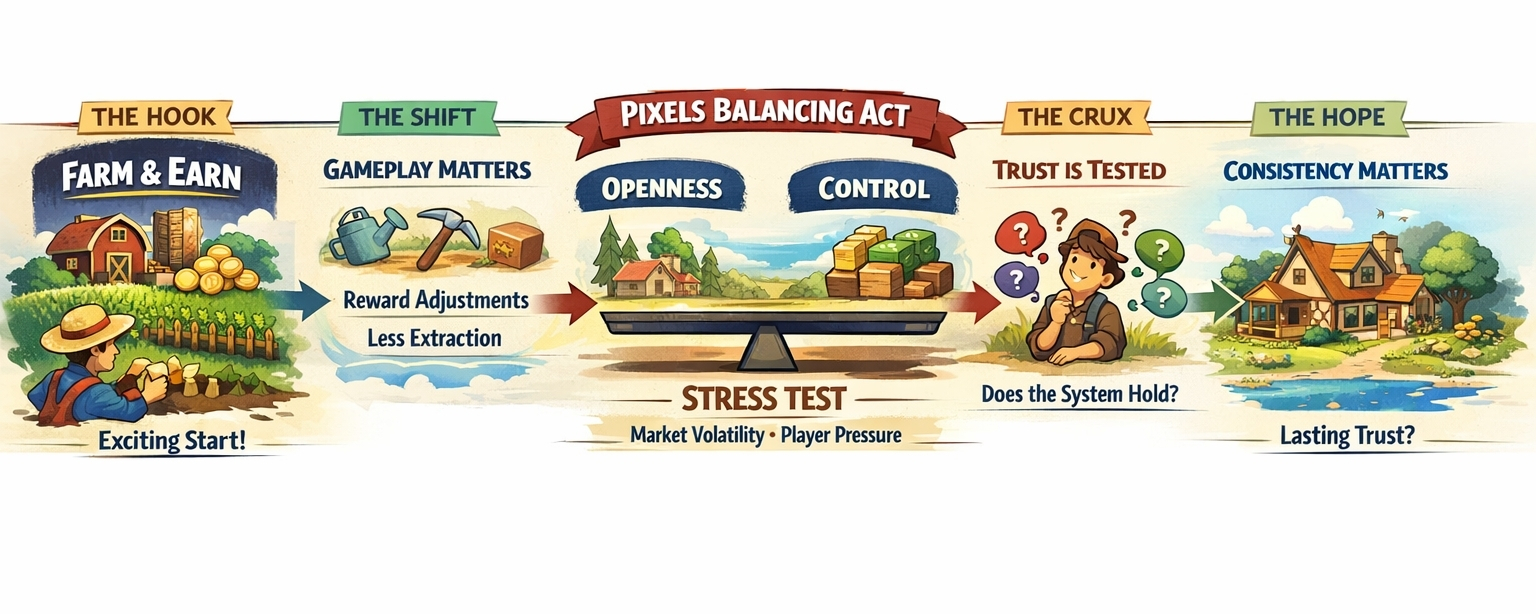
I’ve seen players jump into Pixels with that early excitement I can finally earn while playing.” And for a while, it works. You farm, you trade, you optimize your land. Some even treat it like a routine, logging in daily like it’s a job. It reminds me of those early days in Web3 games where people weren’t really playing they were calculating.
And that’s where things get interesting.
Pixels itself seems to have realized this. Instead of letting the economy run wild, the team started tightening things adjusting rewards, adding more sinks, and pushing gameplay to matter more than just extraction. It’s like they quietly shifted the message from “earn as much as you can” to “stay because it’s worth your time.”
That shift sounds small, but it changes everything.
Because now the system is balancing two very different forces.
On one side, you have openness the idea that anyone can come in, earn, and benefit. On the other, you have control the need to stop the whole thing from turning into a farm-and-dump cycle. If you lean too far into openness, players drain value faster than it’s created. But if you control too much, it stops feeling like Web3 at all.
Pixels lives right in the middle of that tension.
And you can actually see it play out in real time.
When the game gets more attention, activity spikes. New players come in, token demand rises, and suddenly everything feels alive. But that’s also when pressure builds. Prices move faster than gameplay can justify. Some players start focusing less on the world and more on timing the market.
It becomes less of a game and more of a system to “figure out.”
That’s not a Pixels problem specifically. It’s a Web3 pattern. But Pixels is interesting because it doesn’t ignore it. It keeps adjusting, almost like it knows the system isn’t something you “solve” once it’s something you keep tuning.
And that’s where I think the deeper insight is.
The real value here isn’t in the farming mechanics or even the token itself. It’s in how well the system holds together when people push it. When players try to optimize it, stress it, even exploit it that’s when you find out if it actually works.
Because trust doesn’t come from features.
It comes from consistency.
If a player logs in every day, not just because they might earn, but because the experience still feels stable, fair, and worth it that’s when something real starts forming. That’s when the game stops being an experiment and starts becoming a place.
Pixels isn’t fully there yet. And maybe it never will be in a perfect sense.
But what stands out is that it’s evolving in the open. It’s not pretending the balance between fun and finance is easy. It’s actively adjusting it, sometimes awkwardly, sometimes effectively.
And maybe that’s the point.
Because the real question isn’t whether Pixels is a great Web3 game.
It’s whether a system like this can keep earning trust over time even when the excitement fades, even when the numbers fluctuate, even when players stop looking for shortcuts and start looking for reasons to stay.
I don’t think there’s a final answer yet.
But watching how it handles that tension that’s where things start to get genuinely interesting.
