

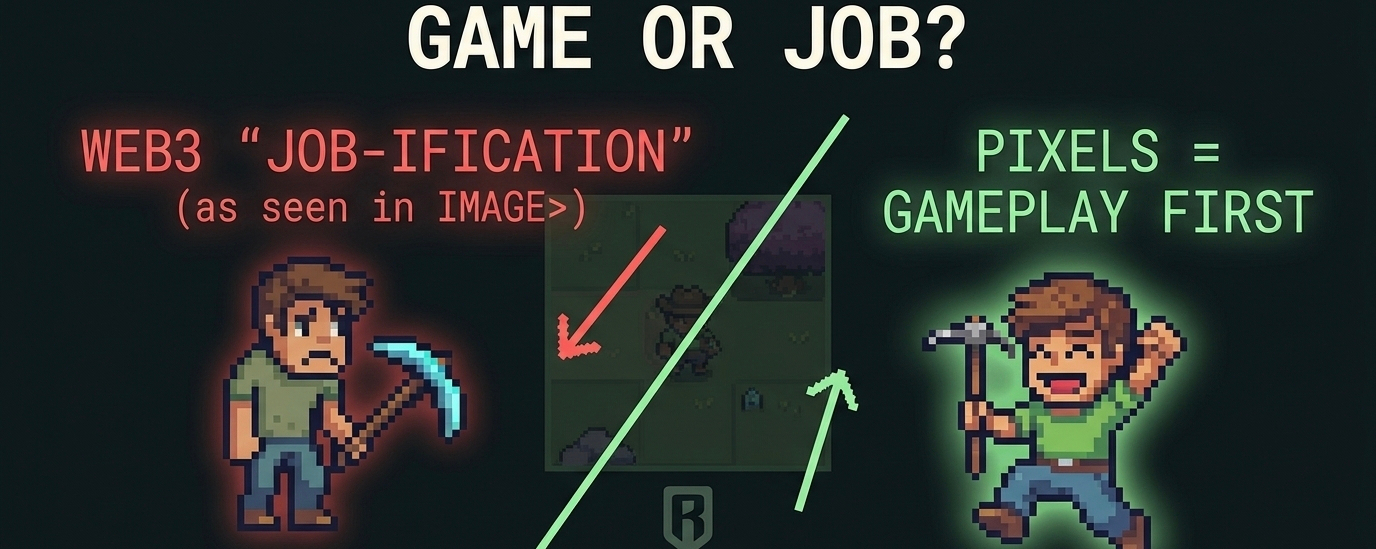
I'll be honest with you. When someone first pitched me on "play-to-earn," I rolled my eyes so hard I nearly pulled something. We'd seen this movie before — flashy whitepapers, token inflation spirals, Discord servers that went from 80,000 members to ghost towns in ninety days. Web3 gaming promised ownership. What it delivered, mostly, was speculation dressed in a farmer's hat.
But then I actually spent time with Pixels (@pixelsxyz, $PIXEL). And something shifted.
---
Here's the thing about digital ownership most people get wrong.
When traditional games sell you a sword, a skin, or a plot of virtual land — they're selling you a license. A revocable, server-dependent, company-controlled license. The moment that studio shuts down, pivots, or decides your item is "unbalanced," it's gone. You never owned it. You rented it without knowing.
Web3 gaming was supposed to fix that. Wallets instead of accounts. On-chain items instead of database entries. A world where your avatar, your land, your crafted tools — they belong to *you* regardless of what the developer decides tomorrow. That vision was correct. The execution was almost universally catastrophic.
Most projects confused ownership with speculation. They built economic systems where extraction was the only real mechanic. Nobody was actually *playing* — they were farming tokens and looking for the exit.
Pixels took a different road.
---
What makes Pixels genuinely different is where it starts: with the game.
It's a farming and adventure RPG at its core — deceptively simple pixel art, open-world exploration, crafting systems, seasonal events, social mechanics. The kind of loop that keeps you engaged not because a spreadsheet tells you to, but because you actually want to see what's around the next corner. This matters more than people realize. Fun first. Everything else second.
Now layer the ownership model on top of that.
Land in Pixels isn't decoration. It's infrastructure. Landowners can build farms, set up shops, host crafting stations, attract visitors — creating genuine micro-economies within the broader world. Each plot is an NFT with real utility. And here's what nobody tells you about land-based economies in games: scarcity only works if people actually *want* to be on your land. Pixels earns that want by making the world worth inhabiting.
Items and avatars follow the same logic. Your tools, your crops, your character customizations — they're on-chain. You can trade them, hold them, use them across supported integrations. Not because the whitepaper says so. Because the systems are actually built that way.
$PIXEL is the governance and utility token threading all of it together — used in crafting, progression, land interactions, and broader ecosystem decisions. It's not a reward token disguised as a product. It's the currency of a functioning world.
---
What struck me digging deeper was the retention data.
Pixels has consistently maintained one of the highest daily active user counts in Web3 gaming — not spiking during token launches and vanishing, but holding. That stickiness is the real signal. It means people are coming back because the game pulls them back, not because a yield calculator does.
I'll admit I was skeptical about whether pixel art aesthetics could carry a serious Web3 economy. What I underestimated was how that visual simplicity lowers the barrier to entry dramatically — onboarding players who might never touch a complex DeFi protocol but are absolutely happy to harvest crops and sell them at someone's roadside stall.
That's mass adoption hiding in plain sight.
---
Where does this go?
My honest take: Pixels represents the template that Web3 gaming needed to find five years ago. Not financialization with a game bolted on — but a genuine game with ownership as a native feature rather than a marketing pitch. The open-world structure gives it room to grow, season by season, parcel by parcel.
Land will matter more as the world fills. Items will carry real history. Avatars will become identities.
True digital ownership was always the right idea. Pixels — $PIXEL — might finally be the right execution.
The pixels were always promising. Now they're delivering.