
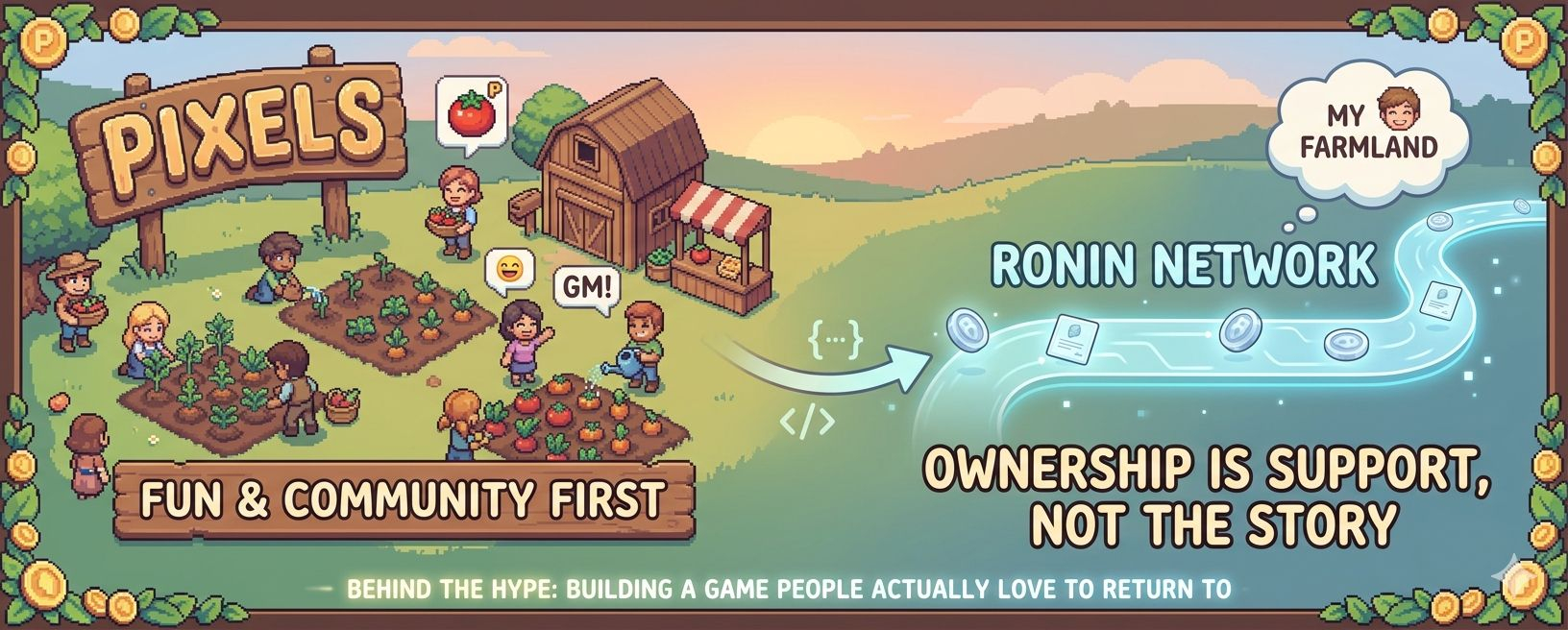

Most people still misunderstand Web3 gaming because they keep looking at the wrong layer first. They look at the token, the NFT, the speculation, the noise around price, and then they try to judge the entire project from there. But that is rarely where the real story lives. The real story is usually much quieter. It sits inside user behavior, retention, design choices, and one very basic question that almost every project eventually has to face: if the financial incentive disappeared for a moment, would people still come back?
That is one of the main reasons I keep paying attention to Pixels.
From my perspective, Pixels is not interesting simply because it is a Web3 game. A lot of projects can claim that. What makes it worth watching is the way it approached the category. Instead of trying to force blockchain to become the center of the experience, it built around something much more grounded and human. It leaned into farming, progression, exploration, community, and a soft, familiar style that people can understand almost instantly. That choice matters more than many people realize.
Pixels did not try to introduce itself like a complicated crypto product disguised as a game. It tried to feel like a game first. A place first. An experience first. And I think that was the smart move.
Because the truth is simple. Most players do not care about infrastructure in the way crypto people care about infrastructure. They do not wake up wanting to interact with wallets, chains, asset rails, or transaction mechanics. They want to enjoy themselves. They want to feel progress. They want to build something, collect something, improve something, maybe share that experience with other people, and then feel a reason to return the next day. If a project cannot satisfy those emotional and behavioral needs, no amount of Web3 language will save it.
This is where Pixels becomes more meaningful.
On the surface, it is easy to describe. It is a social casual farming game. There is exploration, resource gathering, upgrading, digital ownership, community interaction, and a world designed to keep players engaged through familiar loops. But beneath that surface, I think there is a sharper strategic understanding at work. Pixels seems to understand that blockchain works best in games when it is not treated like the star of the show. It works better when it sits underneath the experience and quietly improves the structure around ownership, progression, economy, and identity.
That is a very different philosophy from the one that shaped a lot of early Web3 games.
Too many of those projects felt as if the game existed only to justify the token. The economy was loud. The gameplay was thin. The product felt more like a financial wrapper than a living world. Players could sense that, even when they could not describe it clearly. And when players sense that a game is really trying to extract from them before it has earned their attention, the relationship becomes weak very quickly.
Pixels took a different route. It chose a genre that already has strong emotional logic behind it.
Farming games work for a reason. They are repetitive, yes, but in a satisfying way. They are built around routine. They reward patience. They make progress visible. They let people shape a space over time. There is something very natural about planting, collecting, upgrading, organizing, and slowly improving your own environment. These mechanics may look simple from the outside, but they are powerful because they connect to habits people actually enjoy. They create a rhythm.
And rhythm is one of the most underrated assets in gaming.
When a player starts returning not because they are being aggressively pushed, but because the world has quietly become part of their routine, that is when the product begins to matter. That is when retention stops being just a metric and starts becoming proof that the experience has found a place in the player’s life. I am watching this closely because that kind of behavioral stickiness is worth far more than temporary hype.
Ronin plays a major role in this story too, and not just as a technical detail in the background. I think that would be too shallow a reading. The choice of infrastructure here says a lot about the maturity of the project. Ronin is a gaming-focused blockchain, and that distinction matters. Not every chain is naturally suited for gaming behavior, even if many claim they are. Gaming has its own demands. It needs speed, low friction, high frequency interaction, familiarity, and an environment where ownership and transactions do not feel like interruptions.
A good gaming chain does more than process activity. It reduces resistance.
That part is important. Sometimes people hear words like scalability or low fees and treat them as generic selling points, but in gaming those details shape the emotional quality of the experience. A transaction that feels slow, a wallet flow that feels clumsy, an ecosystem that feels disconnected, a market layer that feels forced outside the product — these things may sound small on their own, but together they create fatigue. And fatigue kills momentum faster than most teams expect.
Pixels moving onto Ronin made sense because the fit feels natural. Ronin already carries a gaming identity. It is not just infrastructure sitting in an empty technical space. It is an environment built with gaming behavior in mind. That gives Pixels something valuable: context. It places the game inside a chain ecosystem where player-owned economies, game-related assets, and wallet-based participation are already more culturally normal. That reduces educational burden. It reduces psychological friction. It lets the product feel less isolated.
I think this is one of the hidden dynamics people often miss.
They talk about games as if they succeed or fail entirely on their own, but ecosystems matter. Neighborhood matters. A game may have solid mechanics, but if the surrounding infrastructure does not support how players naturally behave, adoption becomes heavier than it needs to be. On the other hand, when the infrastructure and the product speak the same language, the whole thing starts to feel smoother. Less forced. More intuitive.
Pixels benefits from that alignment.
And then there is the social side, which in my view is one of the most important parts of the project. A lot of people still underestimate how much social gravity determines the future of online games. Features can be copied. Art direction can be copied. Economies can be imitated. Even reward structures can be cloned with surprising speed. But habit inside a community is much harder to steal. A world that people return to together has a different kind of staying power.
Pixels was not just trying to make a farming loop addictive. It was trying to make the world feel inhabited. Shared. Alive.
That changes everything.
Because once players stop seeing the game as a simple reward machine and begin seeing it as a place where they spend time, where they recognize others, where they build identity, where they participate in a visible social rhythm, then the product becomes much stronger. The attachment becomes emotional, not purely transactional. And emotional attachment is far more durable than economic curiosity.
This is exactly where many outsiders make the wrong call.
They reduce Pixels to a simplistic label like “another crypto farming game,” and by doing that they miss the actual design intelligence behind it. The casual style is not a weakness. It is not something to apologize for. It is part of the onboarding logic. It lowers intimidation. It lowers the mental barrier to entry. It gives people something they already understand, and that familiarity makes it easier for them to accept the deeper layers of ownership and onchain participation without feeling overwhelmed by them.
That is smart design.
There is another misunderstanding too, and I think it is even more common. Many people still assume that success in Web3 gaming comes mainly from token excitement. They assume the market will be won by the project that generates the loudest financial energy. I do not see it that way. Tokens can bring attention, of course. They can increase velocity. They can produce powerful early narratives. But attention is not the same thing as affection, and velocity is not the same thing as retention.
The stronger projects are usually the ones that understand the difference.
Real staying power comes from loop quality, clarity, emotional familiarity, social relevance, and a world that can hold attention even after the initial excitement cools. That is what I pay attention to. Not just who can trend, but who can keep people returning in a quieter phase, after the noise fades and only product truth remains.
That is where Pixels becomes more interesting than it first appears.
Behind the scenes, what is really happening here is the alignment of several different systems that often fail when handled separately. There is the game design itself, which has to be simple enough to welcome people in but deep enough to keep them engaged. There is the economic layer, which has to support behavior without overwhelming it. Then there is the infrastructure layer, which has to stay efficient enough that players feel continuity instead of friction. And around all of this sits the community layer, which gives meaning to routine and turns individual actions into shared momentum.
When these pieces are misaligned, the project feels unstable. You can feel it even as a user. Something always feels slightly off. The economy feels louder than the gameplay. The gameplay feels disconnected from ownership. The ownership feels disconnected from social meaning. The infrastructure feels like a hurdle instead of support.
But when these pieces start aligning, the experience gains coherence.
That coherence is one of the hardest things to build in Web3 gaming, and I think Pixels deserves attention because it clearly understands that challenge. It is not trying to sell one feature. It is trying to create a world where all the important systems reinforce each other.
The farming loop supports routine. Routine supports retention. Retention supports community. Community supports identity. Identity supports digital ownership. Ownership supports economy. And Ronin gives that whole structure a gaming-first environment where the technical layer is less likely to interrupt the emotional one.
That chain of reinforcement is where real value starts to emerge.
From my perspective, one of the biggest lessons here is that Web3 gaming does not need to feel more complicated in order to feel more advanced. In fact, the opposite is often true. The projects that are actually moving in the right direction are usually becoming more human on the surface, not more technical. More intuitive. More emotionally legible. More behaviorally grounded.
That matters because players do not fall in love with architecture diagrams. They fall in love with experiences.
They fall in love with a world that feels good to return to. A loop that fits naturally into their day. A sense of growth that feels earned. A place where ownership means something because the underlying world already means something. Without that emotional base, digital ownership is thin. With it, ownership becomes an extension of genuine engagement rather than an artificial layer pasted on top.
I think this is exactly why Pixels matters beyond its own niche.
It shows a possible direction for the broader category. Not a direction built on louder promises, but one built on stronger design instincts. It suggests that the future of Web3 gaming may belong less to projects that obsess over looking crypto-native and more to projects that know how to make blockchain disappear into the background while keeping its benefits intact underneath.
That is a subtle shift, but it is a very important one.
Because once the player is mostly thinking about the game, the people, the progress, the world, and their place inside it, then the technology is finally doing its job properly. At that point the chain stops being the product and starts being what it should have been all along: support.
I am watching this closely because that is where the category starts becoming credible.
Not when it becomes louder. When it becomes smoother.
Not when it talks more about ownership. When it gives ownership a meaningful context.
Not when it asks users to admire the infrastructure. When it uses the infrastructure so well that the player barely has to think about it.
That, to me, is the real signal in the Pixels and Ronin story.
It is not just about a farming game launching on a gaming-focused blockchain. It is about a project recognizing that if Web3 wants to work in gaming, it has to respect how players actually behave. It has to meet them where they are. It has to give them familiar rhythms, visible progress, social attachment, and low-friction participation before expecting them to care about deeper technical layers.
And honestly, that is how it should be.
The strongest technology products usually win not when they demand constant attention for their complexity, but when they quietly remove complexity from the user’s life. I think Pixels understands that. I think Ronin, as a gaming-first infrastructure layer, strengthens that strategy. And I think that combination is exactly why this project says something larger about where Web3 gaming may actually be headed.
In the end, what stands out to me is not just that Pixels built a social casual Web3 farming game. It is how it built it, where it built it, and what that says about the next stage of the industry.
It says that fun still matters most. It says that routine is stronger than hype. It says that community is a real moat. It says that infrastructure only becomes powerful when it stops feeling like a burden. And it says that the future of Web3 gaming will probably not arrive through products that constantly remind users they are on a blockchain.
It will arrive through games that simply feel alive.
And when that happens, the projects that win will not be the ones that shouted the loudest about the future. They will be the ones that quietly built something people wanted to return to, again and again, until the technology underneath became almost invisible and the experience itself became the reason to stay.
