

I used to think a token moving to a new chain was mostly a fee story. Cheaper transactions, faster clicks, better game flow, done. Watching Pixels move onto Ronin made that view harder to keep, because the visible change was smoother play, but the deeper change was where liquidity sat, who carried custody risk, and which market had to absorb the token afterward. Ronin announced the migration in 2023 as part of Pixels’ full move from Polygon, with gameplay continuing through Ronin wallets rather than the old setup.
The common misreading is that migration automatically strengthens a token because the app feels closer to its users. I think the stronger claim is narrower: a chain move only helps if it also improves settlement. Settlement sounds technical, but here it just means where trades actually clear, where stable money waits, and where sellers can exit without tearing the price. Without that, “new chain” is often just a new routing path.
The PIXEL market itself shows the tension. As of April 18, CoinGecko lists roughly $6.74 million in market cap, about $29.9 million in 24-hour volume, and 770 million tokens circulating, while the fully diluted valuation the value implied if all 5 billion tokens were already loose — sits near $43.7 million. It also shows another 91.18 million PIXEL scheduled to unlock on April 19. That combination matters more than the migration headline: turnover is many times larger than the equity the market is assigning today, and dilution pressure has not disappeared just because the token lives in a friendlier game chain.
Then there is Ronin itself. DefiLlama currently shows about $14.7 million in DeFi TVL, meaning capital parked inside its apps, and about $23.5 million in bridged TVL, meaning assets represented on Ronin after being carried over from elsewhere. But the same page shows only about $1.04 million in stablecoins on the chain and roughly $268,889 in 24-hour DEX volume. In plain terms, the destination may be optimized for play, yet local settlement depth still looks thin. So the game can migrate faster than the balance sheet does.
That is where migration economics stop being promotional and start becoming accounting. A bridge looks like portability on the surface. Underneath, it is a custody handoff: one system locks value, another issues a claim to it somewhere else. That structure enables lower-friction gameplay and chain-specific incentives, but it also creates another layer where trust has to hold. DefiLlama’s exploits database puts cumulative bridge losses across crypto at about $2.907 billion, which is a useful reminder that movement is never free just because it is cheap. 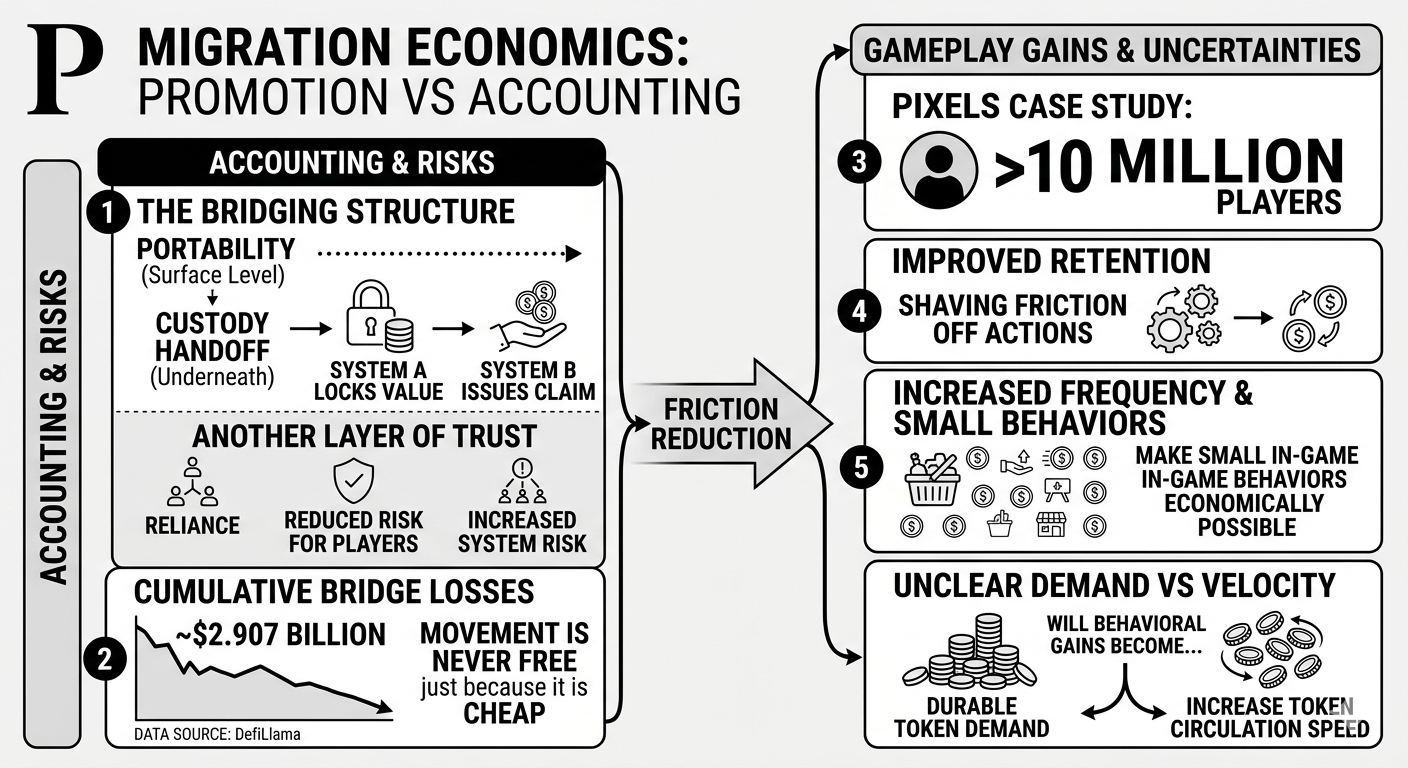
There is a fair counterpoint. Pixels says it has over 10 million players, and for a game at that scale, shaving friction off routine actions is not cosmetic. It can improve retention, raise transaction frequency, and make very small in-game behaviors economically possible. That part is real. What remains unclear is whether those behavioral gains become durable token demand, or whether they mostly increase token circulation speed.
The wider market makes that distinction harder, not easier. Global stablecoin supply is about $315.5 billion right now, which means crypto has plenty of settlement capital in aggregate. The problem is distribution. Small chains do not just compete for users anymore; they compete for where liquid dollars choose to stay. When pixel tokens move to new chains, the real question is not whether the interface improved. It is whether trust, liquidity, and exit capacity moved with them.#pixel @Pixels $PIXEL
