

I’ve spent enough time around crypto projects to recognize when something feels immediately familiar, even if it’s dressed in a different aesthetic. When I first came across Pixels, described as a social, casual Web3 game built on the Ronin Network, my initial reaction wasn’t excitement it was curiosity mixed with a kind of cautious déjà vu. Farming, exploration, creation… these are comforting ideas. They’re also concepts the industry has leaned on repeatedly, especially when trying to bridge the gap between traditional gamers and blockchain-native systems.
So I decided to sit with it for a while. Not just skim the surface, but actually try to understand what Pixels is attempting to build and more importantly, what it thinks is broken in the current landscape.
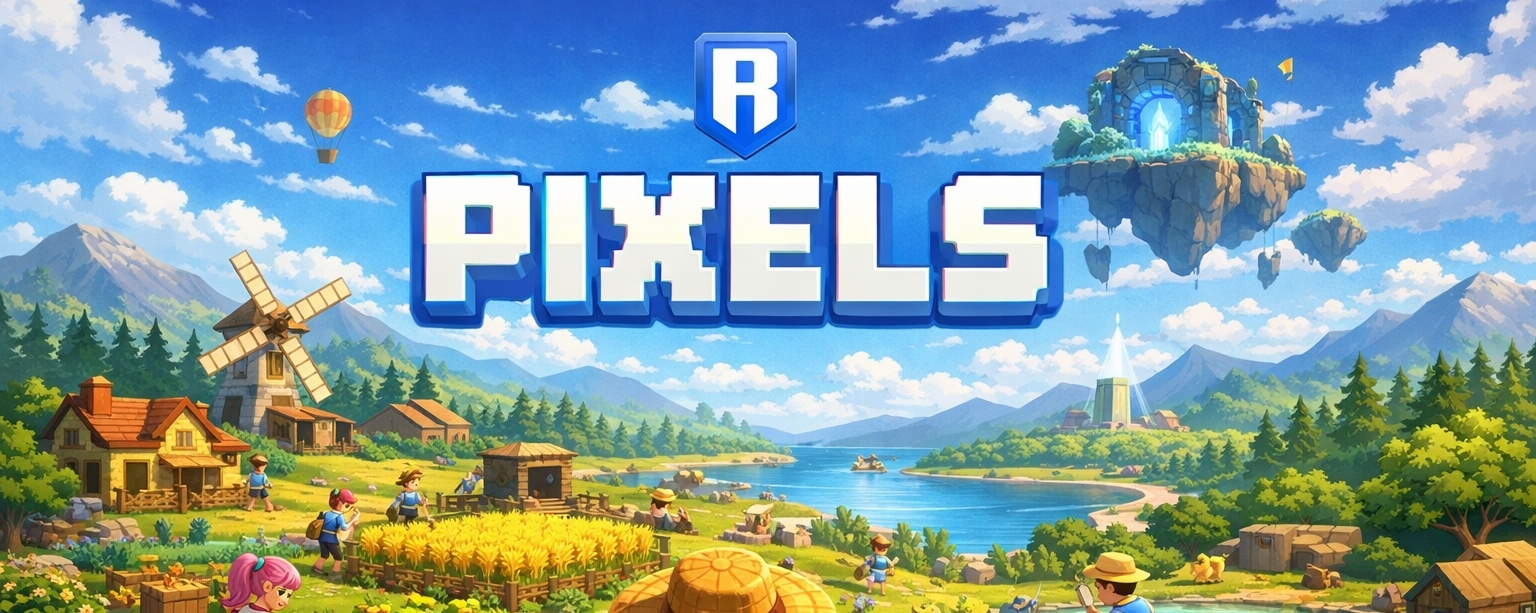
At its core, Pixels presents itself as an open-world environment where players can farm, gather resources, interact socially, and build within a shared ecosystem. On paper, that sounds almost indistinguishable from countless browser-based or indie simulation games. The difference, of course, is the underlying infrastructure: blockchain ownership, tokenized economies, and the promise of player-driven value.
But that’s where things get interesting and also where I start to question things more carefully.
The idea that players should “own” their in-game assets isn’t new anymore. We’ve heard it so many times that it’s almost lost its original meaning. Ownership in Web3 gaming is often framed as liberation from centralized control, but in practice, it tends to shift the focus from playing to optimizing. The moment assets become financial instruments, behavior changes. People stop asking, “Is this fun?” and start asking, “Is this profitable?”
Pixels seems aware of this tension, at least to some extent. The design leans into a slower, more casual experience farming crops, interacting with others, building routines. It’s less about high-stakes competition and more about persistence and participation. That’s a subtle but meaningful shift. Instead of pushing players toward speculation-heavy mechanics, it tries to anchor them in something closer to habit formation.
Still, I can’t help but wonder if that’s enough.
Because the real problem Pixels claims to solve isn’t just about ownership it’s about sustainability. Web3 games have historically struggled to maintain active user bases once the initial incentives fade. Early participants extract value, token emissions inflate, and eventually the system collapses under its own weight. It’s a pattern we’ve seen over and over again, almost like a reflex.
Pixels appears to be attempting a different approach by emphasizing social interaction and long-term engagement rather than short-term rewards. The idea is that if players genuinely enjoy spending time in the world, the economy might stabilize organically. It’s a compelling thought, but also a difficult one to execute.
Designing for “fun” is already hard in traditional games. Doing it in an environment where financial incentives are baked into the system makes it even more complex. Every mechanic has to balance two competing forces: engagement and extraction. If rewards are too generous, the economy inflates. If they’re too scarce, players lose interest. Finding that equilibrium is less a science and more an ongoing negotiation.
What I find genuinely interesting about Pixels is how it leans into simplicity. There’s no overwhelming complexity in the mechanics. No intricate DeFi layers disguised as gameplay. Just farming, crafting, and interacting. In a space that often equates complexity with innovation, this restraint stands out.
But simplicity can also be deceptive.
It’s easy to build a system that looks approachable on the surface while hiding economic fragility underneath. The question isn’t whether players can understand the game it’s whether the game can sustain itself once those players start behaving like rational actors in a tokenized environment.
And this is where my skepticism creeps back in.
The broader crypto gaming space has a tendency to repeat certain narratives. “Play-to-earn” evolves into “play and earn,” which then becomes “fun-first gaming with optional ownership.” The language shifts, but the underlying challenge remains the same: how do you create a system where value flows in without relying on constant new entrants
Pixels doesn’t fully escape this question. No project really does. But it does attempt to soften the edges by focusing on community and routine rather than extraction. It’s less about making money quickly and more about participating over time. Whether that’s enough to break the cycle is still unclear.
Another aspect that caught my attention is its choice of infrastructure. Building on Ronin suggests a deliberate alignment with a gaming focused ecosystem, one that has already seen both explosive growth and painful contraction. There’s a certain pragmatism in that decision. Instead of trying to reinvent the wheel, Pixels is plugging into an existing network that understands the unique demands of blockchain gaming.
But that also comes with baggage.
Ronin’s history is tied to both success and controversy. It represents a kind of experimental phase in Web3 gaming where rapid growth exposed underlying vulnerabilities. Choosing that environment signals confidence, but also a willingness to operate within a system that has already been tested and, at times, broken.
As I think about Pixels in the broader context of crypto, I keep coming back to a simple question: who is this really for?
If it’s for traditional gamers, the blockchain elements might feel unnecessary or even intrusive. If it’s for crypto-native users, the slower, more casual gameplay might not provide enough financial upside to keep them engaged. Bridging that gap is the holy grail of Web3 gaming, but it’s also where most projects stumble.
Pixels seems to be walking a narrow path between those two audiences. It doesn’t fully commit to either extreme, which could be a strength or a weakness depending on how it evolves. Sometimes being in the middle allows for flexibility. Other times it leads to a lack of clear identity.
There’s also the question of longevity.
Open-world games rely heavily on content and community. Without continuous updates and meaningful interactions, even the most well-designed systems can start to feel empty. In traditional gaming, developers control this through expansions and live services. In Web3, there’s an added layer of unpredictability because the economy itself becomes part of the content.
If the economy stagnates, the world can feel stagnant too.
Pixels attempts to address this by encouraging player-driven activity farming, trading, collaborating. The idea is that the world remains alive as long as players continue to participate. It’s a decentralized approach to content creation, in a sense. But it also places a lot of responsibility on the community to sustain momentum.
And communities are fickle.
They’re influenced by trends, incentives, and external market conditions. A downturn in the broader crypto market can impact engagement just as much as any in game mechanic. That’s something many projects underestimate. They design systems in isolation, forgetting that they exist within a larger, highly volatile ecosystem.
What I appreciate about Pixels is that it doesn’t try too hard to appear revolutionary. It’s not claiming to reinvent gaming or redefine ownership in some grand, sweeping way. Instead, it feels more like an incremental experiment an attempt to refine existing ideas and see if they can be made to work more sustainably.
There’s a humility in that approach, whether intentional or not.
At the same time, I remain cautious.
Because I’ve seen how quickly optimism can turn into disillusionment in this space. Projects that start with thoughtful design can still fall into familiar traps once growth pressures kick in. Token economies can distort priorities. Communities can shift from collaboration to competition. And slowly, almost imperceptibly, the original vision gets diluted.
Pixels isn’t immune to those risks.
But it does feel like it’s asking slightly better questions than many of its predecessors. Instead of focusing purely on financial incentives, it’s exploring how routine, social interaction, and simplicity can contribute to a more stable system. Whether those elements are strong enough to counterbalance the inherent challenges of Web3 gaming is still an open question.
As I step back and look at the bigger picture, I don’t see Pixels as a definitive answer. It’s not a breakthrough or a paradigm shift. It’s something more modest and perhaps more realistic.
It’s an iteration.
And maybe that’s what the space needs right now. Not bold promises or grand visions, but small, thoughtful experiments that gradually refine what works and discard what doesn’t.
I’m not fully convinced it will succeed. But I’m also not dismissing it outright.
For now, I’m just watching, farming a few virtual crops, and paying attention to what happens next.
