
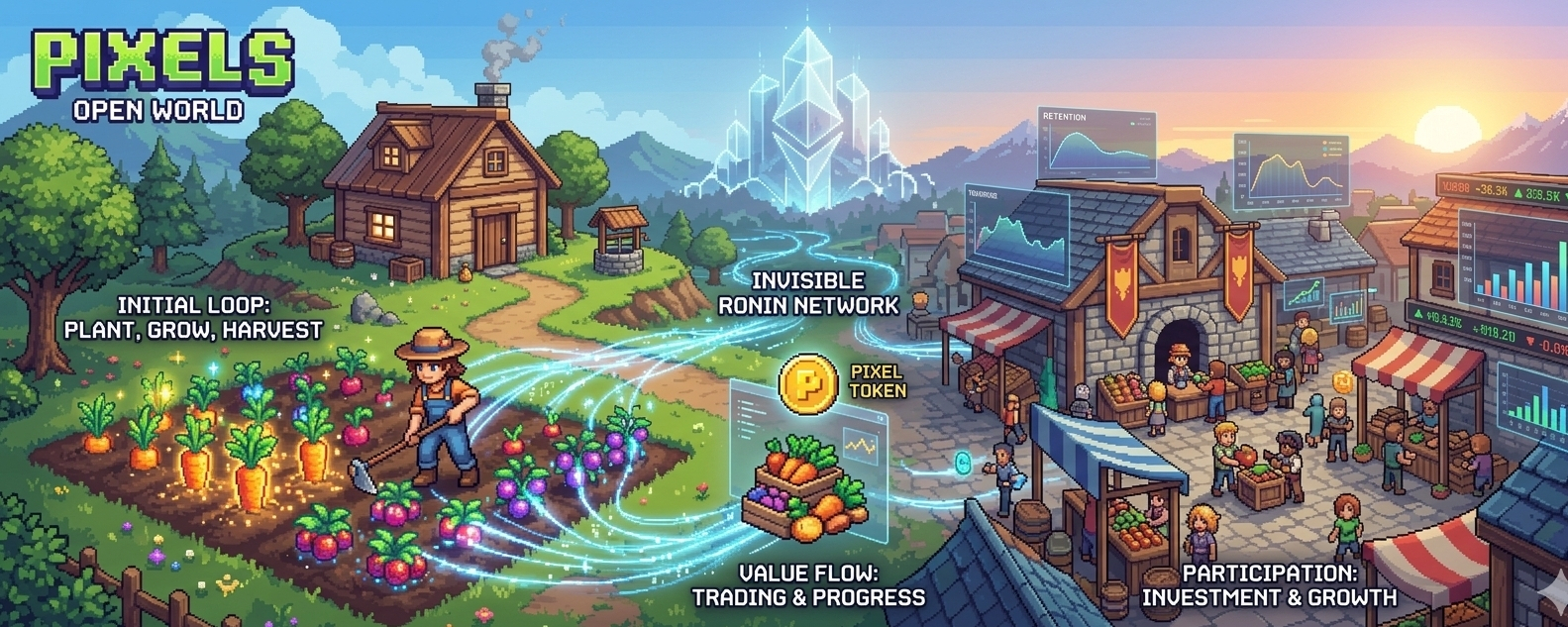
Pixels didn’t arrive like something trying to change the world. It began in a much softer way, almost like a quiet experiment hidden inside a familiar idea. A farming game. A simple open world. A place where you plant, explore, upgrade, and repeat. Nothing about it screamed revolution at first glance.
But the strange part is how quickly that simplicity starts to change once you spend time inside it.
At the beginning, everything feels light. You log in, you do a few tasks, you move on with your day. It feels like just another casual game loop you might forget after a week. But then something subtle happens. You come back the next day. And the next. Not because you have to, but because it starts to feel like something is waiting for you there. Something you left unfinished.
That’s usually where Pixels quietly begins to shift from being “a game you try” into “a world you return to.”
The foundation underneath all of this is the Ronin Network, a blockchain built specifically for gaming. That choice matters more than it first appears. Most traditional blockchain systems struggle with speed and cost, especially when actions happen frequently like in games. Ronin removes a lot of that friction, so when you interact inside Pixels, it doesn’t feel like you’re dealing with crypto systems. It feels instant. Natural. Almost invisible.
And that invisibility is important.
Because if players constantly feel like they are interacting with blockchain mechanics, the experience breaks. But when those systems disappear into the background, something else takes their place: immersion.
Inside that immersion sits the PIXEL token, quietly shaping how the entire world behaves. It’s not just a reward system. It is a flow of value that connects farming, crafting, upgrading, and trading. Every action starts to carry a second meaning. Not just what it does in the game, but what it represents in the economy behind it.
And slowly, without anyone explicitly noticing, behavior begins to change.
Players start thinking differently. Not just “what should I do next in the game,” but “what makes sense right now in terms of progress and value.” That shift is subtle, but powerful. It turns casual play into something closer to participation in a living system.
We’re seeing a pattern like this across Web3 gaming, where engagement is no longer only emotional or recreational. It becomes partially strategic. And that blend creates a strange tension that feels exciting for some players and overwhelming for others.
Because once value is attached to actions, even small decisions start to feel heavier.
A simple harvest is no longer just routine. It becomes a choice about timing.
An upgrade is no longer just improvement. It becomes an investment.
Even waiting starts to feel like part of a strategy rather than inactivity.
That’s where the emotional layer of Pixels becomes more noticeable.
There’s a kind of attachment that forms when repetition meets ownership. When you return daily not because a system forces you, but because your progress feels like it belongs to you. That feeling is difficult to describe, but easy to recognize once it appears.
At the same time, the system underneath is constantly balancing itself. Economies like this are sensitive. If rewards are too generous, value weakens. If rewards are too strict, engagement drops. So the design has to constantly sit between attraction and sustainability.
This is where metrics matter, even if players don’t think about them directly. Things like daily active users, retention rates, token circulation, and player activity patterns become signals of whether the world is stable or drifting.
But numbers alone don’t tell the full story.
Because inside the game, there is emotion layered over all of it. Excitement when updates arrive. Frustration when rewards change. Curiosity when new mechanics appear. And uncertainty whenever the economy shifts. These feelings move through the community just as strongly as any market chart.
That emotional cycle is part of what makes Web3 games unique, but also fragile. Because people are not just interacting with systems—they are reacting to them.
On the technical side, Pixels uses a hybrid structure. Gameplay runs in a smooth, responsive environment so it feels like a traditional game. Meanwhile, blockchain handles ownership, asset security, and economic settlement in the background. This separation is intentional. If everything was on-chain, it would feel slow and broken. If everything was off-chain, ownership would lose meaning. So the system lives in between.
That balance is what allows the game to feel simple on the surface while being complex underneath.
Still, there are risks sitting quietly inside this design. One of the biggest is dependency on continuous engagement. Many Web3 systems rely on ongoing player activity to maintain economic stability. If interest slows, the system feels pressure. If too many players sell rewards instead of reinvesting them, token flow becomes unstable.
There is also the emotional risk. When every action becomes tied to value, the game can stop feeling like a break from reality and start feeling like an extension of it. For some players, that is exciting. For others, it becomes exhausting over time.
And yet, despite all of this complexity, something interesting keeps happening.
People stay.
Not everyone. Not always consistently. But enough to suggest that something inside the experience is working beyond just economics. There is a sense of continuity in Pixels. A feeling that even if you step away, the world doesn’t disappear. It continues without you. And when you return, it still remembers what you built.
That feeling is powerful in a quiet way.
Looking forward, the future of Pixels depends on whether it can evolve beyond incentives and become something players value even without financial motivation. If it succeeds, it could move into a new phase where gameplay, social interaction, and digital ownership blend into something more persistent and meaningful.
We may eventually see systems where progress carries forward in deeper ways, where player identity becomes more stable, and where the world feels less like a game session and more like an ongoing place people inhabit.
But even now, in its current form, Pixels represents something important. It is part of a broader experiment in how digital worlds are changing. Not just visually or technically, but emotionally.
Because the real shift is not about tokens or blockchains or even gaming mechanics.
It is about what happens when time spent in a virtual world starts to feel like it has weight. When actions feel remembered. When effort feels stored. When participation feels like building something that does not vanish the moment you log out.
And maybe that is the quiet truth behind Pixels.
It is not just a game asking for your attention.
It is a world asking what you want your time to mean