

I used to look at projects like Pixels and think I understood the value immediately. Open world, farming, player ownership, on-chain assets — it all sounded like the natural evolution of gaming. Oh, it felt obvious: if you let players own what they create, value would follow. I was buying into the surface narrative that creation alone is enough to sustain a system.
Yeah… that view turned out to be incomplete.
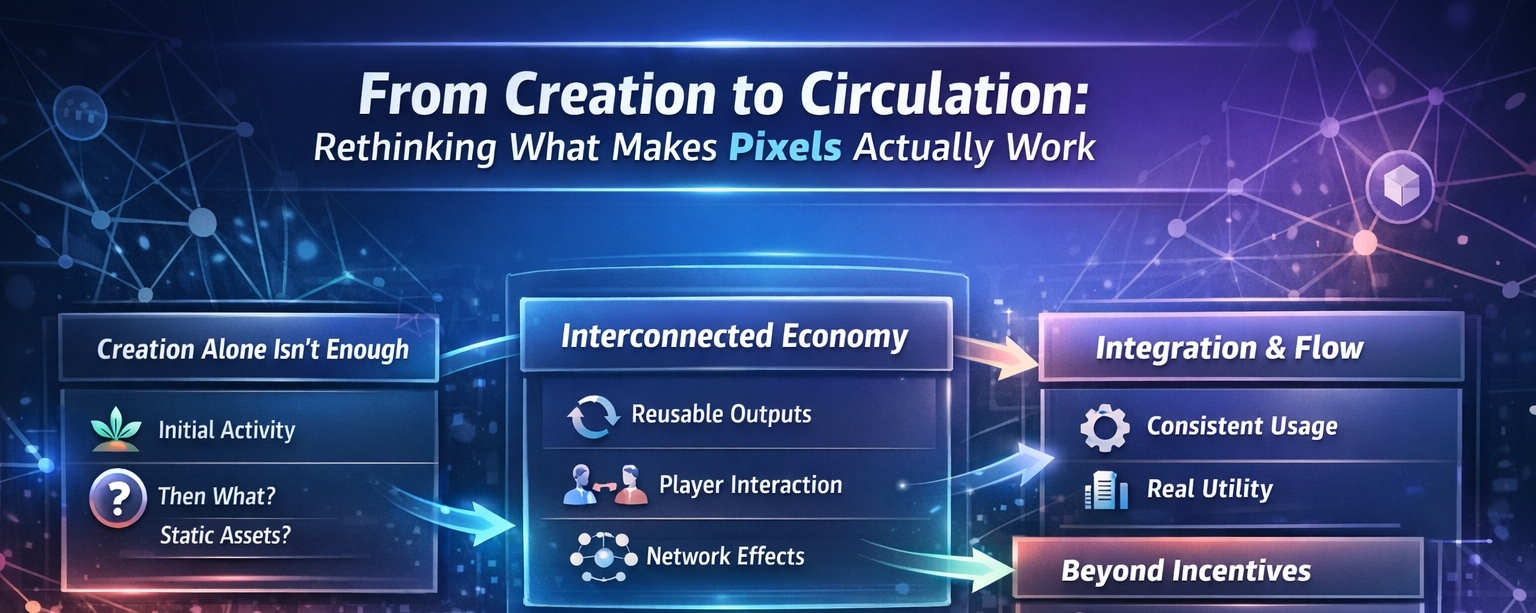
What changed for me was a simple question: what happens after something is created? Not in theory, but in practice. A crop gets harvested, an item gets crafted, land gets developed — then what? Does it move? Does someone else need it? Does it re-enter the system in a way that keeps activity alive? Or does it just sit there, like a tool left on a shelf after the first use?
That’s where most systems quietly fail. Not at creation, but at continuation.
Pixels, running on Ronin Network, is interesting because it tries to simulate a loop that mirrors real-world economic behavior. Farming isn’t just about producing crops — it’s about producing something that other participants might need. Exploration isn’t just movement — it’s discovery tied to resources and opportunities. Creation isn’t just expression — it’s output that can, ideally, circulate.
But the gap between design and reality is where things get tested.
Think of it like a marketplace in a small town. You can build shops, stock goods, and invite people in. But if nobody actually needs what’s being sold, or if transactions only happen during special events, the town never becomes a real economy. It becomes a set piece — something that looks alive but isn’t truly functioning.
So I started looking at Pixels less as a game, and more as a system of flows. How do players interact beyond just being present? Are they dependent on each other, or mostly self-sufficient? If I grow something, does someone else rely on it, or am I just completing a loop for my own progression?
That distinction matters.
Because real systems — the ones that last — create interdependence. They make outputs reusable. One player’s action becomes another player’s input. Over time, that creates network effects, not because more people join, but because more connections form between them.
Okay, so structurally, Pixels is trying to build that. It introduces resource cycles, player-owned assets, and a shared environment. But the real question is whether those mechanics translate into consistent interaction, or if they remain isolated loops.
From a market perspective, I don’t see this as a maturity story yet. It feels more like positioning. There’s attention, there are spikes in activity, especially tied to incentives or events. But consistent, organic usage — the kind that doesn’t need a push — that’s harder to verify.
Participation still feels somewhat concentrated. Early adopters, reward-driven users, people optimizing for returns rather than embedding themselves into the system. And that’s not a criticism, it’s just reality. Most systems start there.
The gap between potential and proven adoption is still wide.
Because the real risk isn’t whether Pixels can attract users. It’s whether those users have a reason to stay once the incentives fade. If activity is driven by rewards, it behaves like a temporary market — active, but fragile. If it’s driven by necessity — by actual utility within the system — it becomes durable.
And that loops back to real-world integration. Not in the sense of replacing industries, but in the sense of behavior. Do developers build on top of it? Do players form routines around it? Do assets produced inside the system have ongoing relevance, or do they lose meaning over time?
For me, confidence would come from seeing repetition without prompting. The same users returning not for rewards, but because they need to. Increasing interdependence between players. Outputs that don’t just get created, but consistently change hands. Quiet activity — not spikes — that signals a system running on its own.
Caution would come from the opposite. If engagement clusters around events. If most actions are self-contained. If assets accumulate but don’t circulate. If the system needs constant stimulation to feel alive.
Oh, and that’s the shift for me.
I don’t look at what a system can create anymore. I look at whether what it creates keeps moving.
Because the systems that actually matter aren’t the ones that produce something impressive once — they’re the ones where that thing continues to flow, interact, and embed itself into everyday activity without needing to be forced.