
I didn’t trust $PIXEL at first.
It felt like every other game token I’ve used before.
Earn it, spend it, reset. That’s usually how it goes.
Once the loop slows down, the token slows down with it.
That pattern is hard to ignore.
But when I stayed inside Pixels longer, something didn’t line up with that assumption.
The token wasn’t behaving like it was trapped inside the game.
It was moving through it.
That difference only starts making sense when you look at how value actually flows underneath.
I expected it to behave like every other game token I’ve used before. Earn, spend, reset. It didn’t.
In Pixels, the loop doesn’t end where you spend it.
It extends.
Off-chain is where that extension begins.
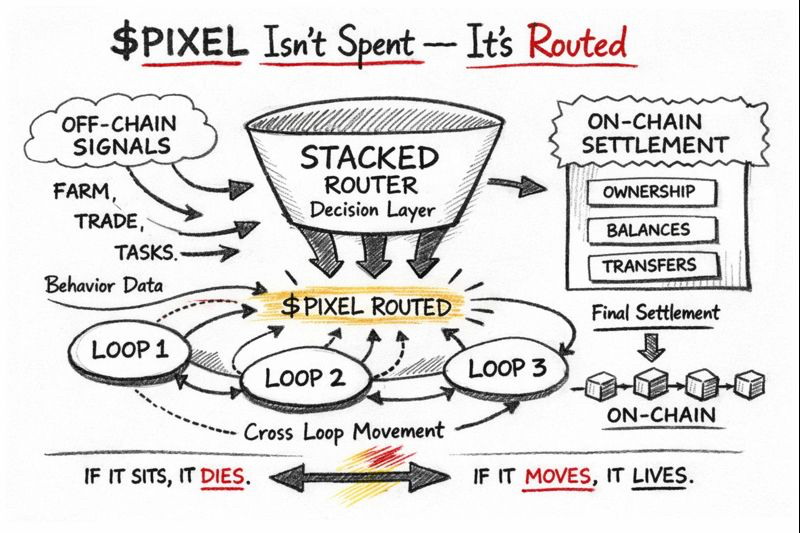
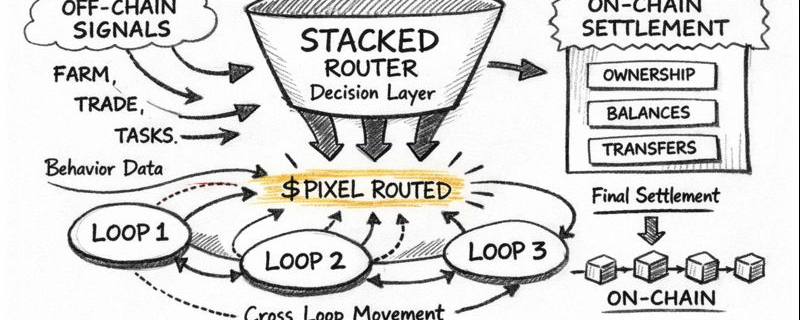
Everything I was doing — farming, trading, completing tasks — wasn’t just giving me rewards. It was feeding signals into the system. Not just how much I played, but where I was spending and what I kept returning to.
That data doesn’t sit still.
It gets routed.
Stacked sitting above Pixels doesn’t just distribute rewards.
It decides where activity should go next, and what should keep moving.
This is where $PIXEL starts changing role.
Instead of being tied to a single action loop, it becomes the unit that moves across loops.
Not because it’s forced to, but because the system keeps creating reasons for it to move.
You feel this when you’re playing.
You don’t just earn $PIXEL and spend it on the same thing repeatedly.
You get pulled into different sinks.
A task leads into a purchase.
That purchase opens another loop.
That loop feeds back into earning again.
The token doesn’t sit still.
It keeps transitioning.
$PIXEL isn’t spent. It’s routed.
And that only works because of how on-chain settlement is handled.
Everything final still settles on-chain ownership, balances, transfers. But by the time $PIXEL moves there, its path has already been shaped.
Off-chain tracks behavior → routing directs activity → on-chain settles movement.
The token is just the visible layer of that process.
But the real mechanism is underneath.
The system is constantly deciding where $PIXEL should matter next.
That’s what turns it into something closer to a currency.
Not because it’s used everywhere, but because it’s required across transitions.
You can’t stay in one loop and accumulate indefinitely.
At some point, to keep progressing, you have to move.
And moving requires $PIXEL.
This is where Stacked extends it $PIXEL isn’t just moving inside Pixels, it’s being routed across connected reward surfaces, not just one loop.
I noticed this in a small way.
There were moments where I had enough $PIXEL, but I couldn’t just stay where I was.
Progress required me to move into a different loop.
Not because the game told me to.
Because staying didn’t lead anywhere.
That’s where the token becomes necessary.
Not optional.
And that necessity is what defines a currency.
Not speculation.
Not supply.
Movement.
If a token doesn’t move, it dies.
If it moves too freely without structure, it inflates.
Pixels does something different.
It structures how it moves.
And that structure comes from the same system driving everything else.
Off-chain behavior → routing decisions → on-chain settlement.
The token follows that path.
Which means its role evolves with the system.
At the start, it looks like a game reward.
Then it becomes a progression tool.
Then something else happens.
It becomes the unit that connects different parts of the system — even parts you weren’t thinking about when you first earned it.
That’s the shift from token to currency.
And it doesn’t happen because of a single feature.
It happens because the system forces movement.
That resolves the tension.
At first, $PIXEL feels limited.
Like it’s stuck inside a game loop that won’t last.
But once you see how it’s routed, you realize it’s not stuck.
It’s being directed.
And as long as the system keeps creating new paths for it to move through,
it doesn’t behave like a game token anymore.
It behaves like something the system depends on to keep itself alive.