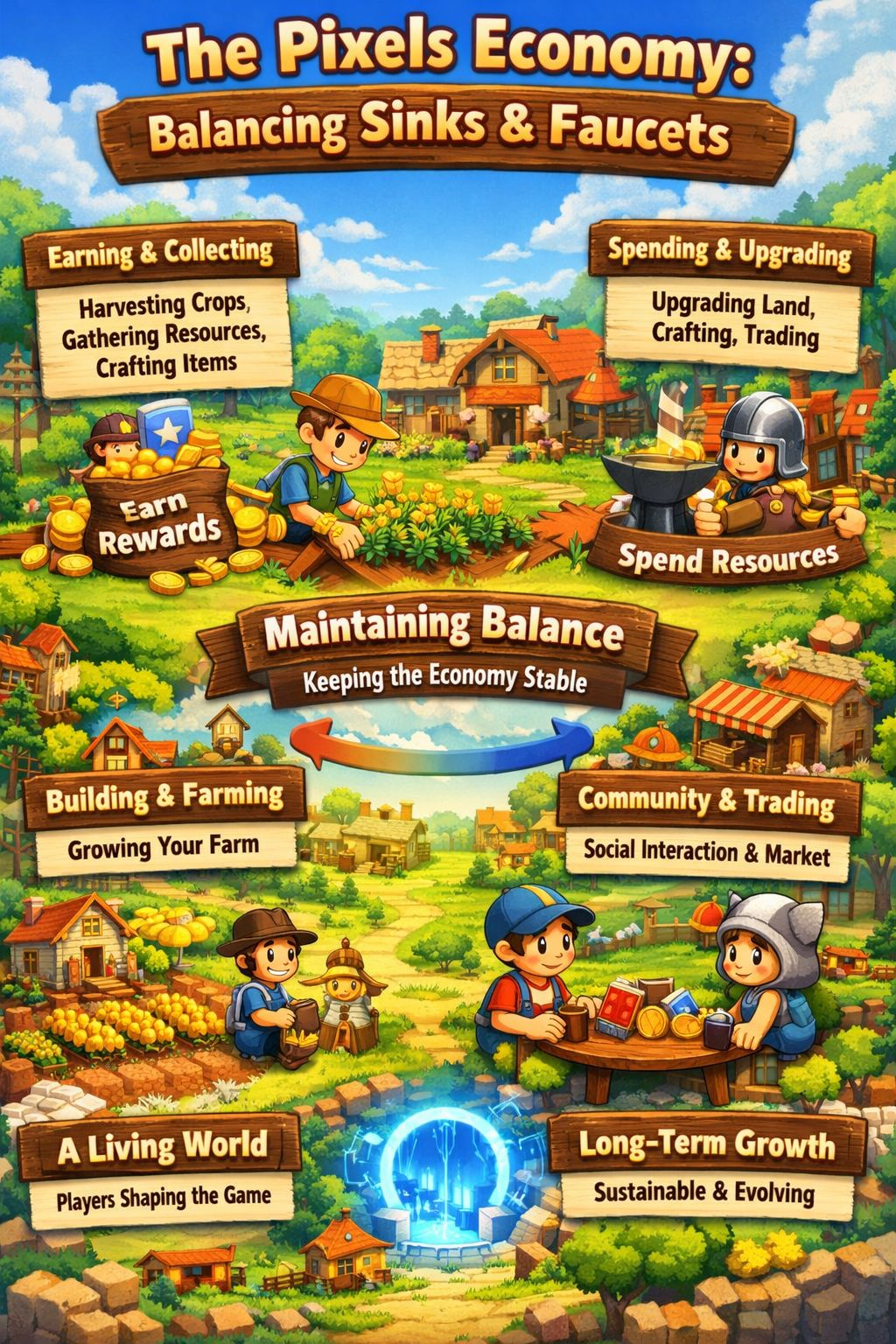
At first, Pixels felt like one of those quiet farming games you open just to relax for a few minutes. You plant crops, explore a colorful world, gather resources, and slowly build your own space. It didn’t feel complicated or overwhelming. In fact, that simplicity is what made it enjoyable. But after spending more time in the world of Pixels, something interesting started to stand out. This wasn’t just a farming game — it felt like stepping into a small, living digital economy that quietly grows with every player.
Pixels, powered by the Ronin Network, revolves around farming, exploration, and creation, but what makes it special is how everything connects. When you plant crops, craft items, or collect resources, you're not just progressing individually — you're contributing to a shared ecosystem. Over time, you begin to notice that every action has value, and every player plays a small role in shaping the game’s economy.
That’s where the idea of balance becomes important. In Pixels, resources and rewards flow into the game as players farm, complete activities, and interact with the world. At the same time, there are natural ways those resources are used, whether it's upgrading land, crafting items, or participating in community-driven features. This balance between earning and spending keeps the ecosystem healthy and prevents it from becoming unstable.
What makes Pixels interesting is that this balance doesn’t feel forced. It happens naturally through gameplay. Players want to upgrade their farms, improve efficiency, and experiment with different strategies. Some players focus on farming, others on crafting, and some enjoy trading and exploring. Every player contributes differently, and that diversity keeps the economy moving in a steady and organic way.
The longer you stay in Pixels, the more you start noticing the social side of the experience. You see familiar players, watch others develop their farms, and sometimes even trade or share tips. It slowly transforms from a solo farming experience into a shared world where everyone influences each other. This kind of community-driven activity strengthens the economy because it creates real demand and meaningful interaction.
Pixels also stands out because it doesn’t rush players. There’s no pressure to understand everything immediately. Instead, the game slowly reveals its depth. One day you're planting crops casually, and the next you're thinking about how to optimize your farm, manage resources, or plan long-term growth. This gradual discovery makes the experience feel natural and rewarding rather than complicated.
Looking at the bigger picture, Pixels has strong potential in Web3 gaming because it focuses on sustainability and player participation. Many games focus heavily on rewards, but Pixels seems to prioritize balance and long-term growth. That approach helps build a more stable ecosystem where players stay engaged not just for rewards, but for the experience itself.
What started as a simple farming game slowly turned into something more thoughtful and engaging. Pixels feels like a living world where players quietly shape an evolving economy without even realizing it. And maybe that’s what makes it so interesting. The more time you spend in Pixels, the more curious you become about where this world is heading and how big it could grow as more players discover it.
@Pixels #pixel $PIXEL