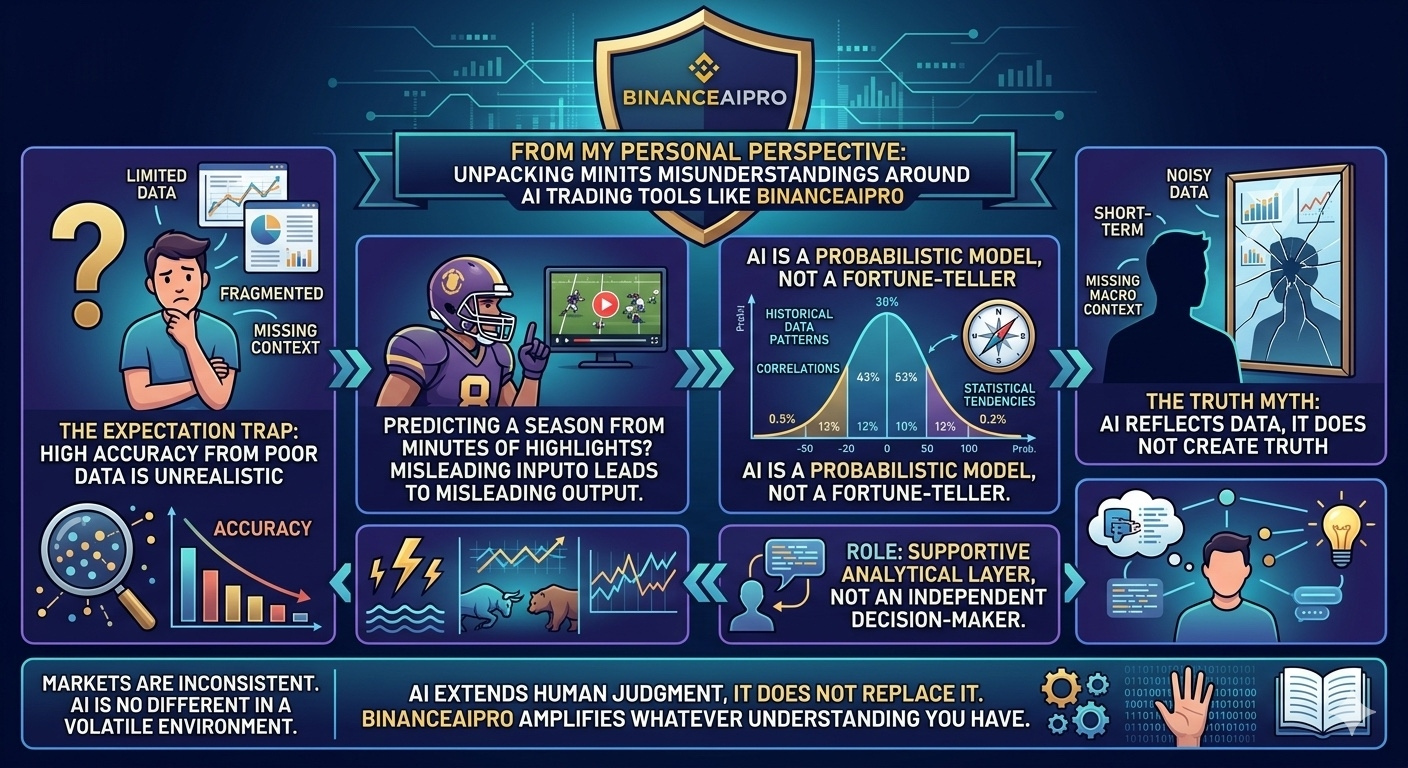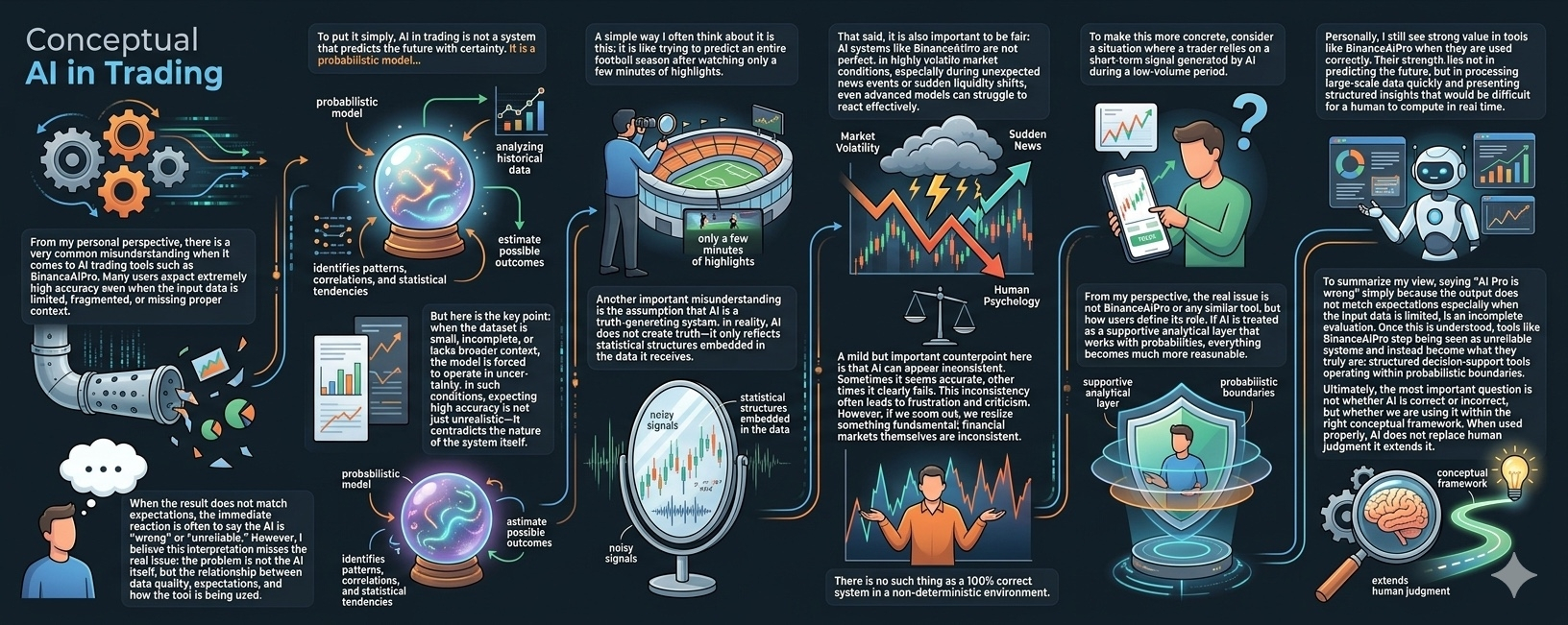
From my personal perspective, there is a very common misunderstanding when it comes to AI trading tools such as BinanceAIPro. Many users expect extremely high accuracy even when the input data is limited, fragmented, or missing proper context. When the result does not match expectations, the immediate reaction is often to say the AI is “wrong” or “unreliable.” However, I believe this interpretation misses the real issue: the problem is not the AI itself, but the relationship between data quality, expectations, and how the tool is being used.
To put it simply, AI in trading is not a system that predicts the future with certainty. It is a probabilistic model that works by analyzing historical data to estimate possible outcomes. It identifies patterns, correlations, and statistical tendencies based on past market behavior. But here is the key point: when the dataset is small, incomplete, or lacks broader context, the model is forced to operate in uncertainty. In such conditions, expecting high accuracy is not just unrealistic—it contradicts the nature of the system itself.
A simple way I often think about it is this: it is like trying to predict an entire football season after watching only a few minutes of highlights. You might catch some patterns, but you are clearly missing the bigger structure of the game. Yet many users still expect AI tools to produce “correct answers” even when the informational foundation is weak.
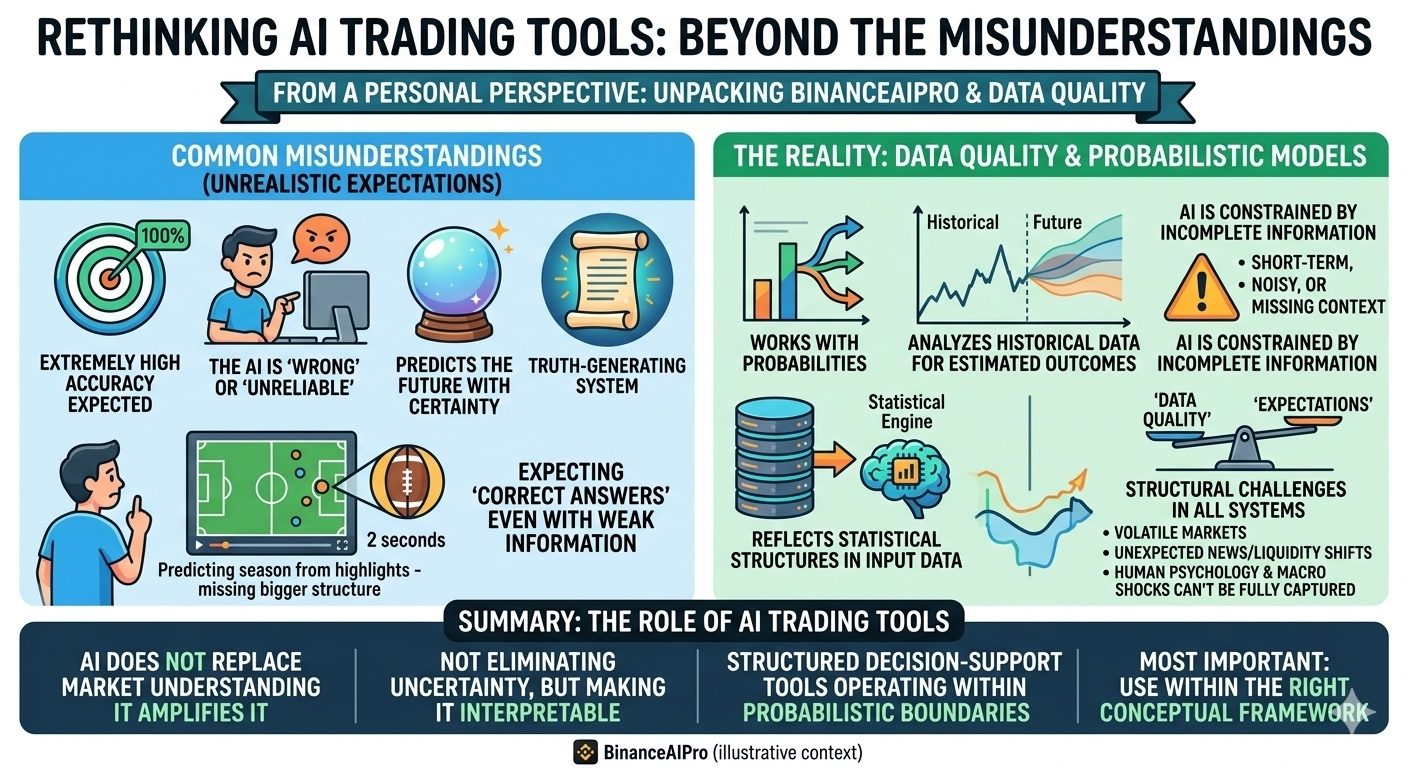
Another important misunderstanding is the assumption that AI is a truth-generating system. In reality, AI does not create truth—it only reflects statistical structures embedded in the data it receives. If the input data is short-term, noisy, or missing macro-level context, then the output will naturally reflect those limitations. In other words, AI is not failing in those cases—it is simply being constrained by incomplete information.
That said, it is also important to be fair: AI systems like BinanceAIPro are not perfect. In highly volatile market conditions, especially during unexpected news events or sudden liquidity shifts, even advanced models can struggle to react effectively. Markets are influenced by human psychology, institutional movements, macroeconomic shocks, and emotional reactions—factors that cannot always be fully captured by historical datasets. This limitation is not specific to BinanceAIPro; it is a structural challenge across all data-driven systems.
A mild but important counterpoint here is that AI can appear inconsistent. Sometimes it seems accurate, other times it clearly fails. This inconsistency often leads to frustration and criticism. However, if we zoom out, we realize something fundamental: financial markets themselves are inconsistent. Even professional traders, hedge funds, and algorithmic systems operate under probability distributions, not certainty. There is no such thing as a 100% correct system in a non-deterministic environment.
To make this more concrete, consider a situation where a trader relies on a short-term signal generated by AI during a low-volume period. The signal might suggest an upward move based on limited recent patterns. However, a sudden macroeconomic announcement causes the market to reverse sharply. In this case, blaming the AI alone ignores the fact that the input conditions were incomplete and that external shocks were not fully represented in the dataset. This is not a failure of intelligence it is a limitation of scope.
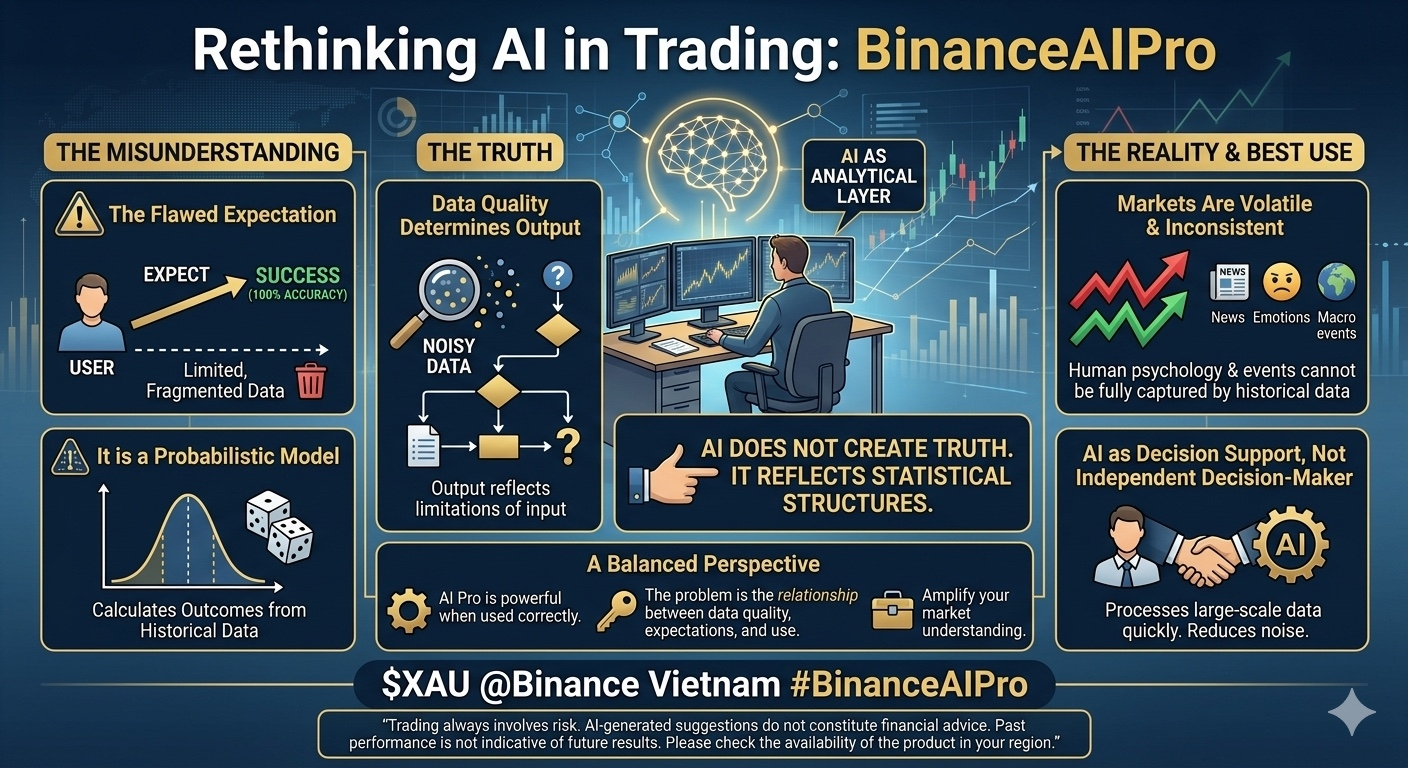
From my perspective, the real issue is not BinanceAIPro or any similar tool, but how users define its role. If AI is treated as a supportive analytical layer that works with probabilities, everything becomes much more reasonable. It helps reduce noise, highlight potential trends, and structure decision-making. But if it is treated as an independent decision-maker that should always be correct, then even small deviations will feel like failures, even when the system is functioning exactly as designed.
Personally, I still see strong value in tools like BinanceAIPro when they are used correctly. Their strength lies not in predicting the future, but in processing large-scale data quickly and presenting structured insights that would be difficult for a human to compute in real time. In fast-moving crypto markets, where information overload is a real challenge, this ability alone provides meaningful advantage.
At the same time, I have also observed a pattern among users: many rely heavily on short-term signals without considering broader market structure. When results fail, the AI is often blamed. But in many of these cases, the real issue is not the model itself, but the narrowness of the data window or the absence of contextual interpretation. AI does not replace market understanding it amplifies whatever understanding you already have.
To summarize my view, saying “AI Pro is wrong” simply because the output does not match expectations especially when the input data is limited, is an incomplete evaluation. AI is not designed to eliminate uncertainty or guarantee success. It is designed to operate within uncertainty and help make it more interpretable. Once this is understood, tools like BinanceAIPro stop being seen as unreliable systems and instead become what they truly are: structured decision-support tools operating within probabilistic boundaries.
Ultimately, the most important question is not whether AI is correct or incorrect, but whether we are using it within the right conceptual framework. When used properly, AI does not replace human judgment it extends it. And in a market defined by uncertainty, that distinction is far more important than chasing the illusion of perfect accuracy.
$XAU @Binance Vietnam #BinanceAIPro
"Trading always involves risk. AI-generated suggestions do not constitute financial advice. Past performance is not indicative of future results. Please check the availability of the product in your region."