
I keep coming back to this one small detail about Pixels, and it’s been bothering me in a good way. Not because it’s complicated, but because it’s almost too simple and somehow most of the space avoids it.
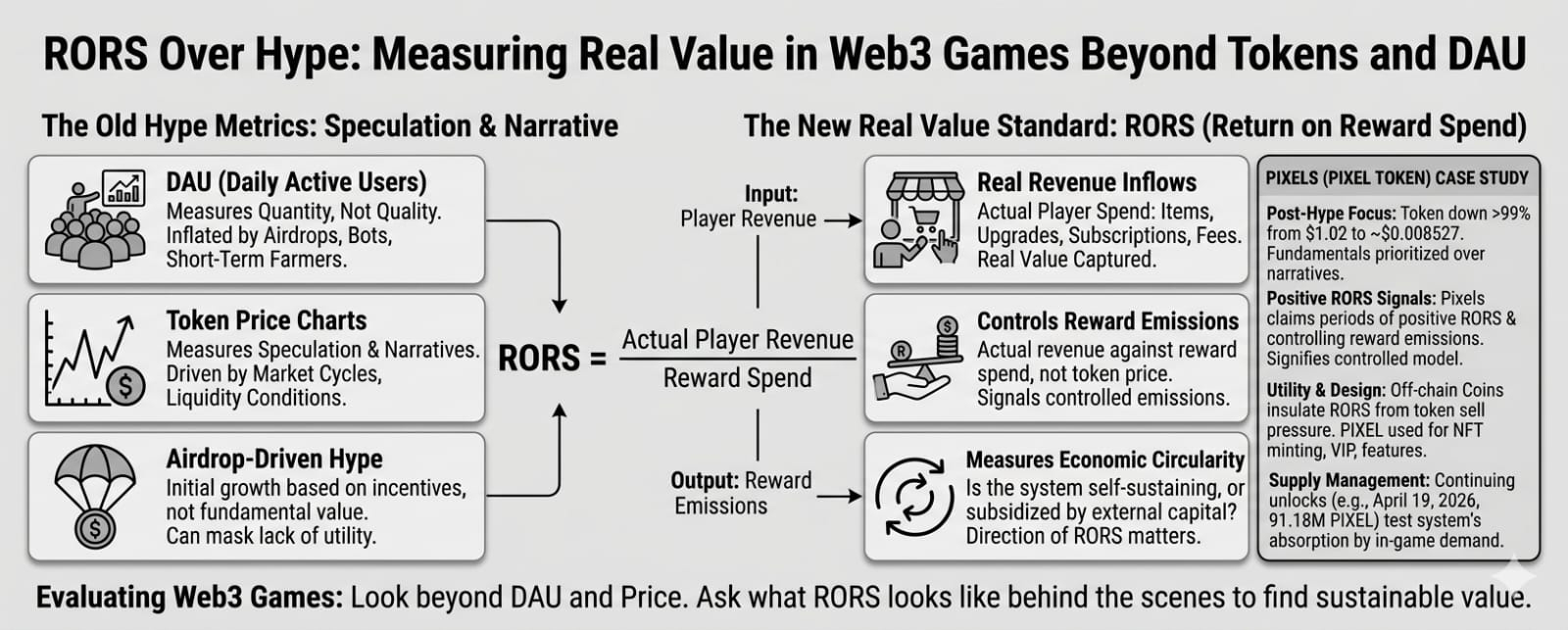
They don’t lead with DAU. They don’t flex token price charts. Instead, they quietly point to something they call RORS Return on Reward Spend.
At first, I brushed it off. I’ve seen enough “new metrics” in crypto to know the pattern: either it’s genuinely insightful, or it’s a distraction from weaker fundamentals. But the more I sat with it, the more it started to feel like one of those rare cases where the metric actually cuts through the noise.
RORS is brutally straightforward: for every $1 spent on rewards, how much real revenue comes back into the game?
Not token appreciation. Not trading volume. Actual player spend items, upgrades, subscriptions, fees.
I once tried to model a small play-to-earn loop myself nothing serious, just a simulation with a few friends. We created a simple farming loop, added token rewards, and watched behavior. At first, everything looked great. DAU climbed fast. Wallet activity exploded. Even the token price ticked up because of early speculation.
But then I noticed something strange. When we tracked actual inflows money coming from players buying things it didn’t match the outflows. We were distributing more value than the system was capturing. If I had to label it back then, our RORS would’ve been something like 0.6 or 0.7.
On paper, it looked like growth. In reality, it was leakage.
That’s the uncomfortable truth RORS forces you to face. It doesn’t care how busy your ecosystem looks. It asks a much simpler question: is the system economically circular, or is it subsidized by external capital?
This is where most Web3 games get exposed. DAU can be inflated airdrops, incentives, bots, short-term farmers. Token price can be driven by narratives, liquidity conditions, or even unrelated market cycles. Neither tells you if players actually value the game enough to spend inside it.
RORS does.
And I don’t think RORS needs to be above 1 all the time. Early-stage systems naturally burn capital. You experiment, you attract users, you iterate. That’s normal. But what matters is direction. If after multiple cycles you’re still below 1 with no improvement, then the issue isn’t timing, it’s design.
Now, looking at Pixels specifically, the numbers make this more interesting.
As of April 18, 2026, PIXEL is trading around $0.008527, with a market cap of about $28.84M and a 24-hour trading volume of $32.41M. Fully diluted valuation sits near $42.63M, with 5B total supply and roughly 3.38B in circulation.
The chart tells its own story. From an all-time high of $1.02 in March 2024, the token is down over 99%. Most of the speculative premium is gone. The airdrop-driven hype cycle is gone. What’s left is closer to a “post-reality” phase where fundamentals matter more than narratives.
And that’s where RORS becomes relevant.
Pixels claims around $25M in revenue, and more importantly, periods of positive RORS. If that holds true, it changes how you read the project. It’s no longer just “they made money,” but “they made money while controlling reward emissions.”
That’s a very different signal.
The tokenomics side adds another layer. Supply trackers don’t fully align, but estimates suggest around 52% of supply is already unlocked, with the rest vesting gradually through 2029. The next unlock April 19, 2026 will release about 91.18M PIXEL (around 1.8% of total supply, roughly $778K at current prices).
This matters because even if your RORS is healthy, continuous emissions can dilute that progress if not matched by growing demand.
Allocation-wise, the biggest bucket is Ecosystem Rewards at 34%, followed by Treasury (17%), Private Investors (14%), Team (12.5%), and Advisors (9.5%). Most of these follow cliff vesting schedules, which means supply shocks can still happen.
So the real question becomes: can the in-game economy absorb this over time?
There are some promising signs. PIXEL isn’t just a passive token, it’s tied to actual utility: NFT minting, VIP passes, guild access, and gameplay features. The game also separates off-chain Coins from the on-chain token, which helps isolate speculation from core gameplay loops.
I noticed something subtle here. By separating currencies, they’re indirectly protecting RORS. Rewards don’t immediately translate into sell pressure on the main token, and player spending can be measured more cleanly.
That’s a design choice, not just a tokenomics one.
Still, I wouldn’t take the “sustainability” claim at face value. The CEO mentioned that play-to-earn only became sustainable recently, after removing BERRY and letting the system stabilize. That honesty is actually a positive signal but it also means the current model hasn’t been battle-tested across full market cycles yet.
So skepticism is still warranted.
If you’re evaluating projects in this space, I’d suggest a simple framework: Look at DAU, but question its quality. Look at token price, but question its drivers. And then ask quietly what the RORS might look like behind the scenes.
Because if a project can’t answer that, or worse, doesn’t even try to measure it, then “sustainability” is probably just a narrative placeholder.
Pixels took nearly four years to get here. That doesn’t sound like inefficiency anymore it sounds like iteration toward the right question.
So now I’m curious how others see this.
If RORS became a standard metric, how many current Web3 games would actually pass the test?
And more importantly would teams be willing to show that number if it didn’t look good yet?

#ranRejectsSecondRoundTalks #AltcoinRecoverySignals? #ARKInvestReducedPositionsinCircleandBullish #RheaFinanceReleasesAttackInvestigation