while scanning the chain last night
While I was scanning the explorer at some ungodly hour, one pattern refused to let go. The token wasn’t flying out in speculative bursts the way most P2E projects do after a hype cycle. Instead, I saw quiet, repeated outflows — players spending $PIXEL on guild memberships, VIP access, and staking entries — all tied directly to gameplay loops that actually mattered to them.
Pixels has always positioned itself as the sustainable P2E play, and the team keeps the messaging clean. But last night the on-chain token flows told a quieter story than any announcement.
The first actionable insight hit me early: utility isn’t marketing copy when players have to pay $PIXEL to unlock it. The second was simpler — the team’s hard-won lesson from the earlier era is now visible in every small transaction that actually sticks.
I caught myself smiling at a personal memory from two years back. I’d stayed up tracking an earlier farming game that promised endless rewards, only to watch the soft currency inflate itself into oblivion while early players cashed out and left. Sitting there with Pixels open, it felt like watching the same script rewritten with better editing.
the contrast that stuck with me
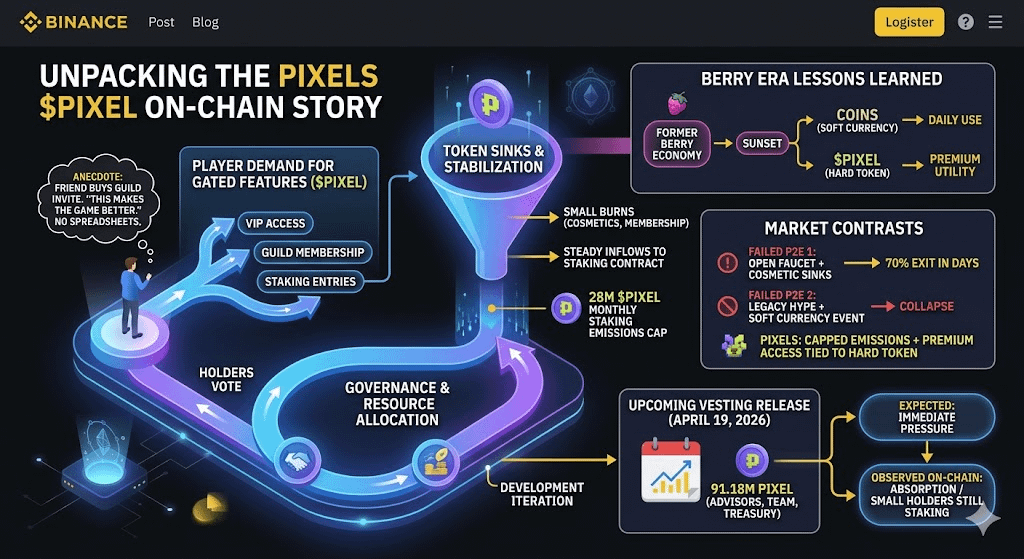
The contrast that stuck with me was how neatly the three interconnected layers actually worked in practice. Layer one: player demand created by gated features that require Pixel. Layer two: token sinks that pull supply out of circulation through guild fees and staking caps. Layer three: the slow governance feedback that lets holders vote on where ecosystem resources go next.
On-chain, it showed up as steady inflows to the staking contract and small burns on cosmetic or membership spends. Nothing flashy, just consistent. I cross-checked a handful of recent wallet interactions and the pattern held — real users, not bots, moving tokens because the game mechanics made it worth it.
Compare that to two timely market examples I’ve watched unfold. One mid-tier P2E title tried to fix inflation by adding cosmetic sinks but kept the reward faucet wide open; on-chain data showed 70% of new tokens exiting within days. Another, still riding legacy hype, saw its soft currency collapse after a single big event. Pixels, by contrast, capped monthly staking emissions and tied premium access to the hard token. The difference is measurable.
hmm... this mechanic in practice
Hmm… this mechanic in practice is where the skepticism crept in. I kept expecting the usual post-hype leakage — big wallets dumping after the Chapter 2 glow faded. Instead, the flows suggested something more stubborn. Players who stuck around were the ones who had already bought into the VIP tier or guild system; they weren’t treating Pixel as a quick flip.
Actually — I had to pause and reevaluate my own bias here. I’d assumed the upcoming April 19, 2026 vesting release of roughly 91.18 million PIXEL across advisors, team, and treasury would create immediate pressure. Yet the on-chain behavior ahead of it showed absorption rather than panic. Small holders were still entering staking pools. That quiet resilience forced a gentle self-adjustment in how I was reading the data.
The personal story that lingered was simpler than it sounds. A few weeks ago I helped a friend set up his first farmland plot. He spent Pixel on a guild invite without hesitation because the shared resource boosts actually paid him back in playtime value. No spreadsheets, no yield calculations — just “this makes the game better.” That single transaction told me more than any whitepaper ever could.
still pondering the ripple
Still pondering the ripple, I keep coming back to how the team’s hard lessons translated into something that feels almost ordinary now. The earlier sunset wasn’t glamorous; it was painful and necessary. By replacing an inflationary soft currency with Coins for everyday use and reserving Pixel for premium, gated interactions, they created a natural brake on supply pressure. On-chain, that brake is visible in the way token velocity has settled — not dead, just purposeful.
There’s honest skepticism worth holding onto. I still wonder whether the multi-game staking system will scale once more titles join the ecosystem rewards feed. Will the same demand layers hold when the player base grows beyond the current core? The data so far is encouraging, but ecosystems have a habit of surprising you once the novelty wears off.
Yet the forward-looking part feels measured. The way governance is structured around Pixel holders voting on resource allocation suggests a longer horizon than most P2E projects allow themselves. It invites the kind of patient iteration that actually builds staying power.
I keep thinking about the small anecdotes — the late-night guild chats, the quiet satisfaction of a well-timed stake — and how they compound into something larger than any single unlock event.
The whole setup leaves me with one lingering thought. What happens to player behavior when the next round of utility upgrades lands and the on-chain flows have to absorb not just the April unlock but the next wave of genuine demand?