
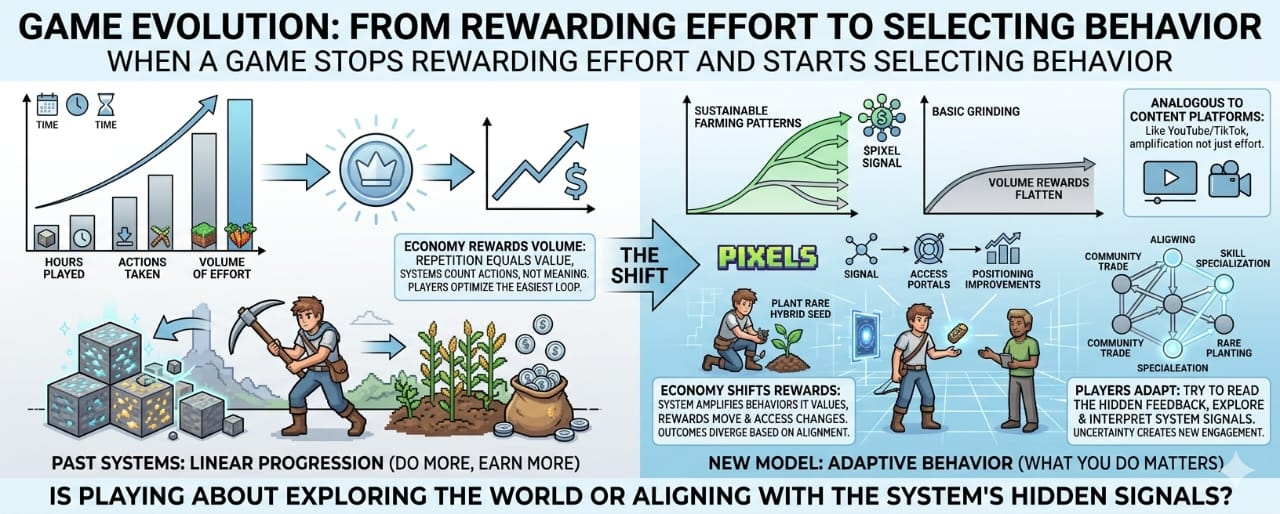
Most projects in this space start to blur together after a while. The language changes, the features sound new, but underneath it’s usually the same structure, do more, earn more, move faster, repeat. It feels fair at first, almost logical. But over time, it becomes clear that these systems don’t really understand what players are doing. They just count it.
What’s been happening inside Pixels doesn’t quite follow that pattern. It doesn’t announce itself as something different, and that’s probably why it’s easy to miss. The shift isn’t visible in a single update or feature. It’s something you start to feel only after spending time in the system, watching how outcomes slowly diverge between players who, on the surface, seem to be doing similar things.
At first, the game feels unusually calm. There’s no pressure pushing you to spend, no urgency forcing you down a specific path. You can move at your own pace, try different loops, and nothing seems to punish you for choosing wrong. But that calmness hides something more selective underneath. Not everything you do seems to carry the same weight over time.
Some actions begin to open doors. They connect to other parts of the system, create better positioning, or quietly improve what becomes available to you later. Other actions keep working, but they don’t really go anywhere. You can repeat them endlessly and still feel like you’re standing in the same place.
That difference is subtle, but it changes how you think about the game. It stops being about how much you can do and starts becoming about whether what you’re doing actually matters inside the system.
Most game economies never make that distinction. They reward volume because it’s easy to measure. If you farm more, you get more. If you grind longer, you earn more. The system doesn’t question whether that activity contributes anything meaningful. It assumes that repetition equals value, and that assumption is where things usually begin to break.
Because once players realize that everything is rewarded equally, they stop caring about what’s meaningful. They just find the easiest loop and optimize it until it collapses.
Pixels feels like it’s moving away from that. Not by removing rewards, but by quietly shifting how they behave. Some loops seem to gain momentum the longer you stay in them, while others flatten out no matter how much effort you put in. It’s not explained, and it’s not always obvious, but it’s there.
That’s where $PIXEL starts to feel different too. It doesn’t behave like a simple reward or spending token anymore. It feels closer to a signal. Something that reflects which patterns the system is reinforcing and which ones it’s letting fade into the background.
The closest comparison isn’t another game, but something like a content platform. On YouTube or TikTok, effort alone doesn’t decide what grows. The system amplifies what it can distribute, and creators slowly adapt without ever fully understanding why something works. Over time, behavior shifts to match whatever the system seems to favor.
Pixels is starting to create a similar dynamic, just in a slower and less visible way. Instead of an algorithm deciding everything, the game leans on economic signals. Rewards move, access changes, and certain actions begin to compound into better outcomes while others stay isolated.
That creates an uneven landscape. Two players can spend the same amount of time playing but end up in completely different positions. Not because one worked harder, but because one aligned with something the system recognizes.
And that’s where things get interesting, but also a bit uncomfortable.
Because once a system starts selecting behavior instead of just rewarding activity, players begin to adapt in a different way. They stop asking how to do more and start trying to figure out what the system actually values. But unlike a clear set of rules, this isn’t fully visible. You can sense it, but you can’t always define it.
That uncertainty changes how the game feels. Playing becomes a mix of exploration and interpretation. You’re not just progressing, you’re trying to read something that isn’t directly shown to you.
There’s also a risk in that. If players ever fully decode what works, they’ll compress everything into a single dominant loop, and the system will break the same way others did. But if they can’t understand it at all, frustration builds, and people lose interest.
So Pixels sits in this strange middle space. It’s trying, intentionally or not, to avoid being too predictable while still giving enough feedback for players to adapt. And that balance is hard to maintain.
What’s forming here doesn’t really look like a traditional game economy anymore. It looks more like a system where behaviors compete with each other. Some scale, some stall, and over time, that difference shapes the entire experience.
Which leads to a question that’s hard to ignore once you notice it.
If the game is constantly filtering which behaviors deserve to grow, then at what point does playing stop being about exploring the world, and start becoming about staying aligned with something you can’t fully see?
