
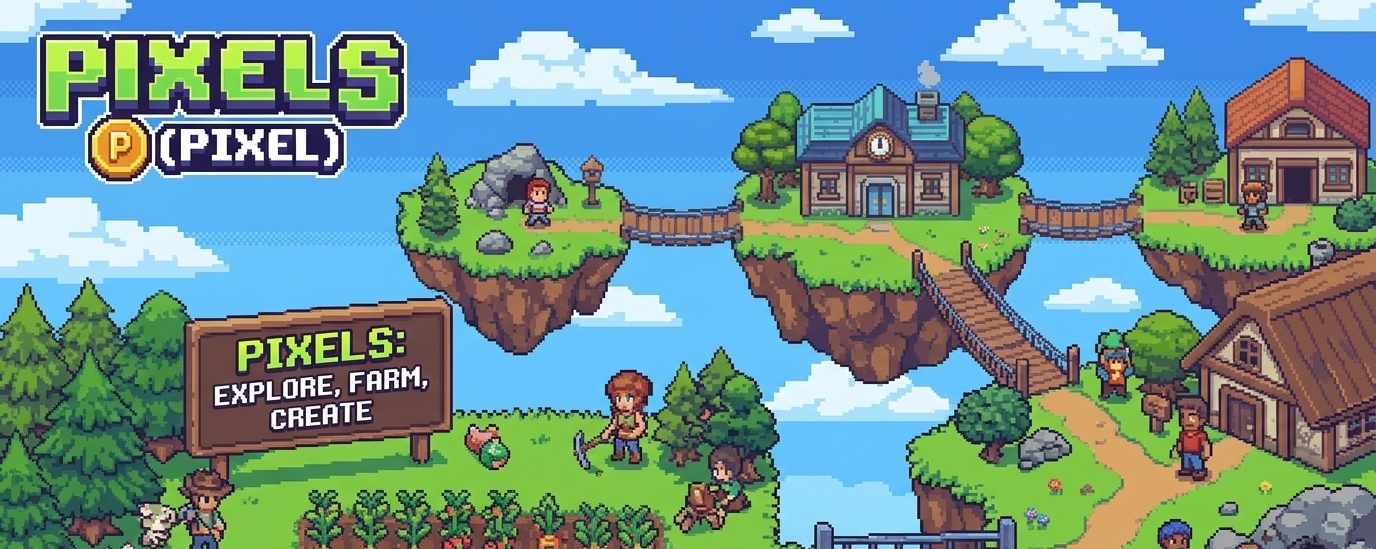
@Pixels Most people look at Pixels and see a simple loop — plant crops, spend energy, earn tokens, repeat. I did the same at first. It felt straightforward, almost intentionally casual.
But the longer I’ve spent time around it, the more I’ve realized that the farming isn’t really the point.
What caught my attention is something people don’t usually talk about: the way the game quietly shapes how we behave.
When I step back, I don’t see isolated features anymore. I see a system where everything leans on something else.
Energy controls how active I can be. Resources determine what I’m capable of producing. Land changes my access and influence. And tokens sit at the end, almost like a summary of how well I’ve navigated everything before them.
None of these pieces feel powerful on their own. But together, they create a kind of pressure — pushing me to make decisions about time, efficiency, and positioning.
That’s when it started to feel less like a farming game and more like a living system.
Over time, I began noticing patterns in how people play.
Some players don’t really care about the farming itself — they care about where they sit in the system. They gravitate toward land ownership, or they specialize in specific resources, or they figure out how to use their energy more efficiently than everyone else.
At first glance, it just looks like different playstyles.
But I don’t think that’s all it is.
What I’m actually seeing is people slowly finding roles — almost like an economy forming beneath the surface. Not officially, not explicitly… but naturally.
And then there’s the social layer, which I think is more powerful than most people realize.
When players are alone, they experiment. They play casually. They make random choices.
But once they’re in groups — guilds, communities, even just active chats — something shifts. Efficiency spreads. Certain strategies start to dominate. People copy what seems to work, even if they don’t fully understand it.
I’ve watched this happen again and again: One person finds a better way to do something…
A few others adopt it…
Then suddenly, it becomes the “right” way to play.
At that point, the game isn’t just guiding behavior anymore — the community is amplifying it.
What really changed my perspective was how I started thinking about progress.
I used to think progress meant leveling up, unlocking new items, or earning more tokens.
Now, I see it differently.
Progress is really about reducing friction — getting more value out of the same effort. And the players who understand that early don’t just move faster… they move smarter.
They choose better positions. They pay attention to timing. They understand how other players affect the system.
Meanwhile, others keep grinding, not realizing the system rewards awareness just as much as effort.
That’s the part I think most people overlook.
Pixels isn’t just a game with farming and tokens. It’s a system where gameplay, economy, and social behavior are constantly shaping each other.
And once I started seeing it that way, I stopped asking, “What should I do next?”
Instead, I started asking, “Where do I fit in all of this — and how do I move from here?”
That shift alone gave me a different kind of advantage.
Not because I’m playing more…
But because I’m finally paying attention to what’s actually happening underneath.
