
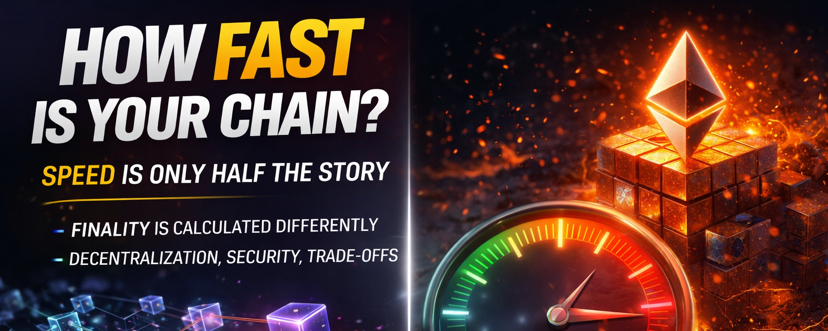

At first glance, this ranking makes one thing clear: crypto is getting fast. Sub-second finality used to be impossible, now multiple chains are already there. But before calling one chain “better” than another, there are a few important nuances most people miss.
The biggest thing to understand is that not all “finality” is measured the same way. Some chains report soft finality which feels instant but can still be reversed in edge cases. Others, like Ethereum, measure economic finality, which is much slower but extremely secure. That’s why comparing milliseconds to minutes can be misleading without context.
Looking at your list, you covered most of the big players, but a few notable ones are missing.
Chains like Avalanche typically finalize in around 1–2 seconds, which puts them in a very competitive middle ground between speed and security. Cosmos-based chains also tend to have fast finality, often around 6–7 seconds depending on the network.
Then there are Layer 2 solutions like Arbitrum and Optimism. They feel instant to users, but their finality ultimately depends on Ethereum, meaning true settlement can take longer behind the scenes.
Another interesting category is newer modular and parallelized systems. Some of these aim for near-instant execution but rely on different assumptions around consensus and validator trust. That’s where trade-offs start to matter more than raw speed.
Because speed alone doesn’t define a blockchain.
Faster chains often sacrifice something else, whether it’s decentralization, validator requirements, or long-term security guarantees. Slower systems, like Ethereum, intentionally prioritize robustness over speed.
So the better question isn’t just “how fast is your chain?”
It’s “how fast, under what conditions, and at what cost?”
That’s where the real comparison begins.
This article is for informational purposes only. The information provided is not investment advice.
