

When I first started analyzing Pixels, it looked like one of the rare Web3 games that actually worked. A simple farming loop, a friendly aesthetic, and most importantly real user activity. Not inflated numbers, not empty wallets, but actual engagement at scale. At different points, Pixels has pushed into hundreds of thousands of daily active wallets, even flirting with the million-player mark across its ecosystem.
On the surface, everything checks out.
But the more time I spent studying how people actually play the game not just the numbers they generate the more I noticed something that doesn’t get talked about enough.
Pixels isn’t just growing. It’s diverging.
At first, everyone starts in the same place. You plant crops, manage energy, complete small tasks, and slowly build your progression. It feels balanced. It feels fair. And that’s exactly why the early experience works so well—it’s accessible, predictable, and rewarding enough to keep you going.
But that shared experience doesn’t last.
As players spend more time in the system, a gap begins to form. Not an obvious one, not something the UI will show you but a structural divide between those who understand the system deeply and those who are still interacting with it at face value.
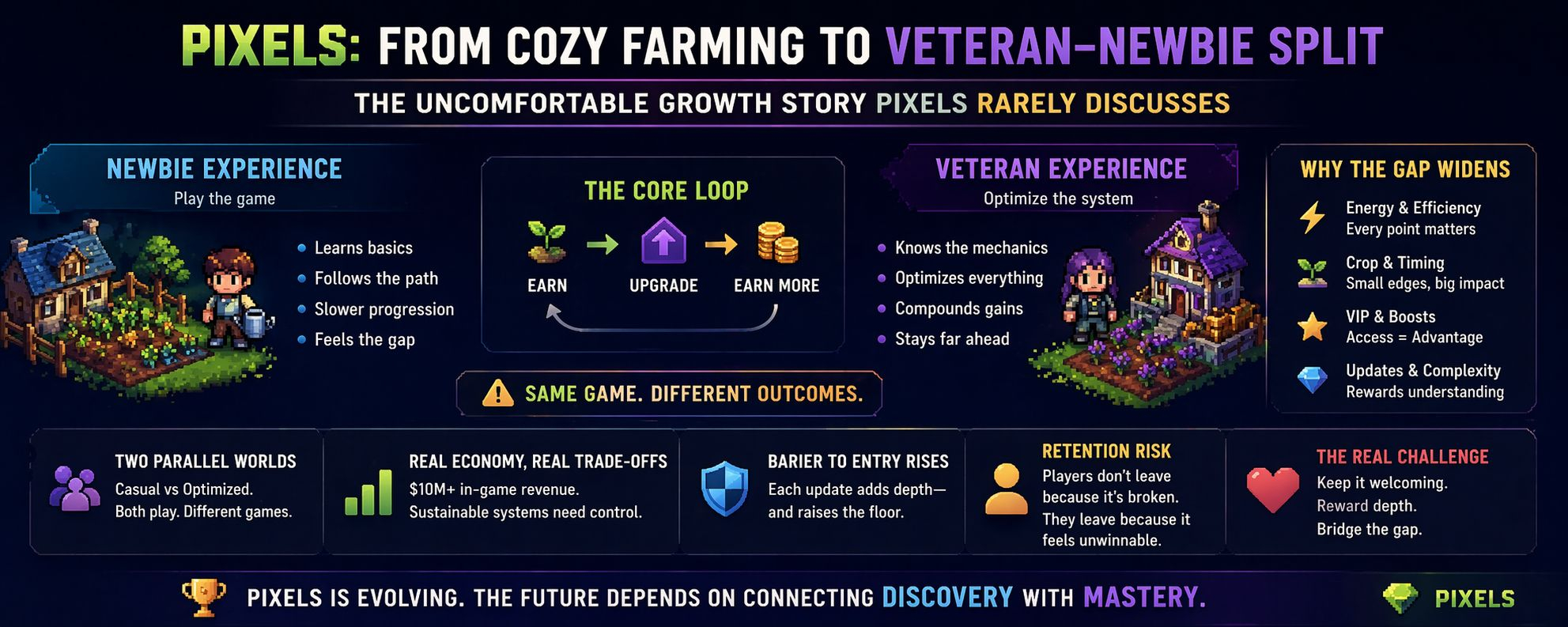
I started noticing that two players with similar playtime could have completely different outcomes. One would barely progress, while the other would compound gains in ways that felt disproportionate. That’s when it becomes clear: Pixels isn’t just about playing—it’s about optimizing.
The core loop—earn, upgrade, earn more—looks simple. But underneath, it’s layered with efficiency mechanics. Energy usage, crop selection, land optimization, timing strategies, boosts, VIP systems—each one adds a small edge. Individually, they don’t seem game-changing. Together, they create exponential differences.
Veteran players understand this. They don’t just farm—they engineer their sessions. They know when to act, where to allocate resources, and how to extract maximum value from each cycle. Over time, that knowledge compounds.
New players don’t see this layer immediately. They follow the intended gameplay path, but miss the hidden efficiencies. And in a system driven by rewards, missing efficiency isn’t just a small mistake—it’s the difference between growth and stagnation.
This is where the real shift happens.
The game stops being a shared experience and becomes two parallel ones.
On one side, you have optimized players who treat Pixels like a system to be solved. On the other, you have casual participants engaging with it like a traditional game. Both are playing correctly—but they’re not playing the same game anymore.
What makes this more complex is that Pixels itself is evolving. It’s not static. The team constantly introduces updates—VIP tiers, new zones, balancing changes, reward adjustments, and staking layers tied to the PIXEL token. Each update adds depth, but also complexity.
And complexity has a bias.
It favors those who are already ahead.
Every new system is an opportunity for veterans to optimize further, while new players have to first understand the baseline before even thinking about efficiency. That creates a widening gap—not because the system is unfair, but because it rewards understanding.
From a design perspective, this makes sense. Pixels has generated significant in-game revenue—reportedly in the tens of millions—and has become one of the few Web3 games where economic activity is actually meaningful. But that economic depth comes with trade-offs.
To sustain a token economy, you can’t just hand out rewards endlessly. Emissions have to be controlled. Systems have to discourage bots and low-effort farming. Efficiency has to be rewarded. Otherwise, the entire model collapses.
Pixels is clearly aware of this. You can see it in how often they tweak reward structures, adjust outputs, and experiment with new mechanics. They’re not chasing short-term hype—they’re trying to build something that doesn’t break under its own incentives.
But every time they tighten the system, something subtle happens.
The barrier to entry increases.
What used to feel like a smooth progression curve starts to feel steeper for new players. Not impossible—but noticeably harder. And when progression slows, perception changes. It starts to feel like you’re behind, even if you’re playing correctly.
That’s where retention risk quietly enters.
Most Web3 games fail because they can’t get users. Pixels doesn’t have that problem. It gets users. It keeps them active. But the real question is: who is it retaining long-term?
From what I’ve observed, veteran players are deeply locked in. They’ve invested time, learned the system, and positioned themselves to benefit from it. Their engagement is rational—it makes sense for them to stay.
New players are different. Their experience depends heavily on how quickly they “figure it out.” If they don’t cross that invisible threshold—from casual play to optimized play—the game can start to feel slow, even unrewarding.
And in any reward-driven system, that feeling matters more than the actual numbers.
Players don’t leave because the system is broken. They leave because it feels unwinnable.
That’s the uncomfortable part of Pixels’ growth story.
It’s not about declining activity or failing mechanics. It’s about a system that works—but works differently depending on where you stand within it.
I don’t think this is a failure. In fact, it’s what happens when a simple game evolves into a real economy. Early participants gain advantages. Knowledge compounds. Efficiency becomes the main differentiator. These are natural outcomes, not design mistakes.
But they do create a challenge.
Pixels started as a cozy farming game—accessible, relaxed, and broadly appealing. Now it’s becoming something else: a layered economic system where understanding the mechanics matters as much as playing them.
The question is whether it can hold both identities at the same time.
Can it stay welcoming to new players while continuing to reward depth? Can it keep progression feeling fair, even if it’s not equal? Can it maintain that initial simplicity while supporting an increasingly complex economy?
Those are not easy problems to solve.
What keeps me interested is that Pixels isn’t ignoring them. It’s actively experimenting, adjusting, and iterating in public. You can see the trial-and-error in real time. And that alone sets it apart from most projects that either overpromise or quietly stagnate.
But beneath all the updates, all the growth, and all the impressive metrics, one reality stands out to me.
Pixels is no longer a single experience.
It’s two overlapping systems one driven by discovery, and one driven by mastery.
And the future of Pixels won’t just depend on how well it grows.
It will depend on how well it connects those two worlds before the gap between them becomes too wide to cross.