
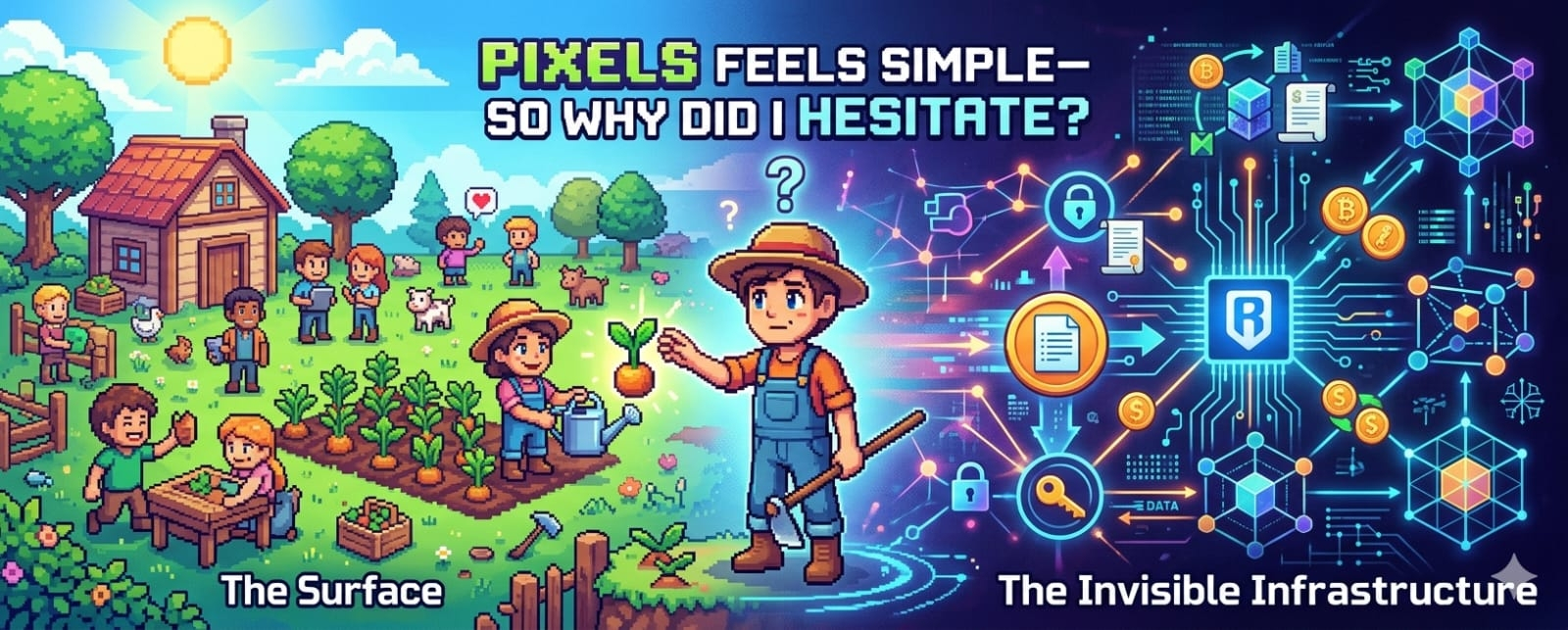
There was a moment small, almost unnoticeable where I hesitated before doing something in Pixels. Not because it was difficult, but because I wasn’t entirely sure how the system would interpret my action.
That hesitation felt out of place.
On the surface, Pixels presents itself as intuitive, almost effortless. It borrows the language of familiar farming and social simulation games—plant, build, interact, repeat. But beneath that simplicity, there’s a second layer quietly influencing everything: ownership, transactions, and state changes, likely anchored on Ronin.
What’s interesting is how well that layer hides itself. I’m not constantly thinking about wallets or blockchain mechanics. There’s no friction demanding attention. And yet, the awareness never fully disappears. It lingers—subtle, but enough to shape how I approach even simple decisions.
That’s where the hesitation comes from.
Progression or Presence?
In most games, progression is clear: you improve, unlock, advance. In Pixels, it feels different. Progress doesn’t just move forward—it accumulates around you.
The longer you stay, the more the system begins to reflect your activity back at you. Your land, your resources, your interactions—they become signals of participation. But that raises a question:
Is progression here about becoming better at the game, or simply becoming more embedded within its system?
Those aren’t the same thing.
One is skill-based. The other is structural.
Pixels seems to blur that line.
The Invisible Infrastructure
A large part of this experience depends on something you rarely see.
Transactions happen. Ownership updates. State changes are recorded. But all of it sits beneath the surface, intentionally out of view. That invisibility is part of the design—it keeps the experience smooth, approachable.
But it also introduces a quiet dependency.
If that underlying layer—technical, economic, or infrastructural—were to falter, how much of the experience would change? Even if the gameplay remained identical, would it feel the same once that invisible certainty is disrupted?
The system works because you don’t have to think about it.
But that also means you’re trusting something you rarely see.
Simplicity vs. Depth
Pixels doesn’t try to overwhelm. It doesn’t compete on intensity or complexity. Instead, it leans into accessibility—lowering the barrier to entry for players who might otherwise avoid Web3 environments.
That strategy works.
But it raises a longer-term concern:
Does simplicity evolve into depth over time, or does it settle into repetition?
Early on, the loop feels engaging because it’s new. But as familiarity grows, the question becomes whether the system can expand meaningfully—or whether it simply reinforces the same patterns at a larger scale.
Expression or Optimization?
Customization exists, but within boundaries.
You can shape your space, make choices, express preferences. But over time, those choices begin to converge. Players optimize. Patterns emerge. Efficiency starts to override individuality.
This isn’t unique to Pixels—it happens in many systems. But here, it feels more noticeable because expression is part of the appeal.
So the tension becomes:
Are you designing something personal, or something optimal?
And how long before those two paths become the same?
The Weight of Community
In Pixels, other players aren’t just background—they’re structural.
Their presence influences value, meaning, and momentum. Progress feels different when it’s shared, observed, or mirrored by others. The world feels alive not because of mechanics alone, but because of participation.
That also makes the system fragile in a different way.
If participation drops, the experience doesn’t just become quieter—it changes fundamentally. The same mechanics, in a less active environment, can feel entirely different.
The system depends on people continuing to show up.
A Moving Target
The roadmap promises evolution, but not certainty.
Future updates could deepen the experience—or complicate it. They could reinforce what works or disrupt it entirely. That unpredictability isn’t necessarily a flaw, but it does make it difficult to anchor expectations.
You’re not just playing the game as it is—you’re playing it as it might become
The Unresolved Question
I keep coming back to the same thought:
Pixels feels natural, continuous, and stable—but is that stability coming from strong underlying design, or from the fact that, right now, enough people are sustaining it?
In other words:
Is the system inherently resilient, or is it currently balanced on participation?
That hesitation I felt at the beginning might not have been about confusion.
It might have been awareness.
A recognition that even in something designed to feel simple, there are layers shaping every action—whether you notice them or not.
And once you sense those layers, even briefly, the experience doesn’t feel quite as effortless anymore.
