
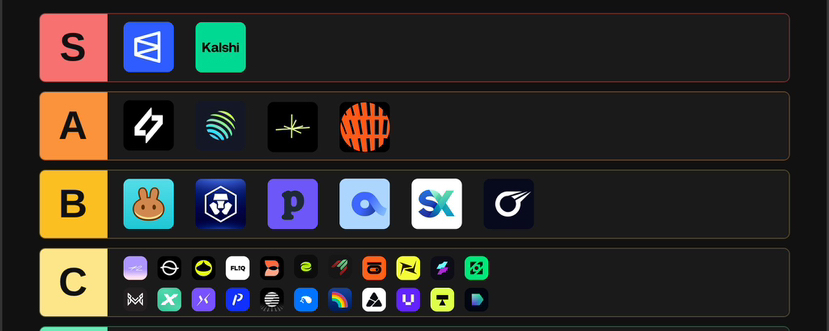

The prediction market sector is rapidly consolidating, with a clear duopoly emerging as Polymarket and Kalshi capture the overwhelming majority of trading volume, leaving dozens of smaller platforms fighting for visibility and liquidity.
Recent market observations indicate that Polymarket continues to lead the space, benefiting from strong user traction and brand recognition, while Kalshi has carved out a unique position by aligning closely with regulatory frameworks. Together, the two platforms are estimated to control roughly 95% of total market activity, underscoring a widening gap between leaders and the rest of the field.
Beyond the top tier, a second group of platforms is attempting to gain traction by leveraging existing ecosystems. Projects tied to major crypto networks or exchanges are showing moderate adoption, often relying on built-in user bases rather than organic growth. However, even these players remain far behind in terms of liquidity and consistent trading volume.
Further down the spectrum, many platforms appear to be struggling with fundamental challenges, including lack of differentiation, weak branding, and limited user engagement. While several projects have successfully launched products, their market presence remains minimal, suggesting that deployment alone is not enough to secure adoption in an increasingly competitive environment.
At the bottom end, a number of platforms show little to no measurable traction, raising questions about long-term viability. The sector is already seeing early signs of attrition, with some projects shutting down or fading into inactivity as capital and attention concentrate around dominant players.
The current landscape highlights a classic network effect dynamic: liquidity attracts users, and users reinforce liquidity. In prediction markets, this feedback loop appears to be accelerating consolidation, leaving little room for fragmented competition.
If current trends persist, the prediction market industry may soon resemble a winner-takes-most structure, where only a handful of platforms define the future of the sector.
This article is for informational purposes only. The information provided is not investment advice.