
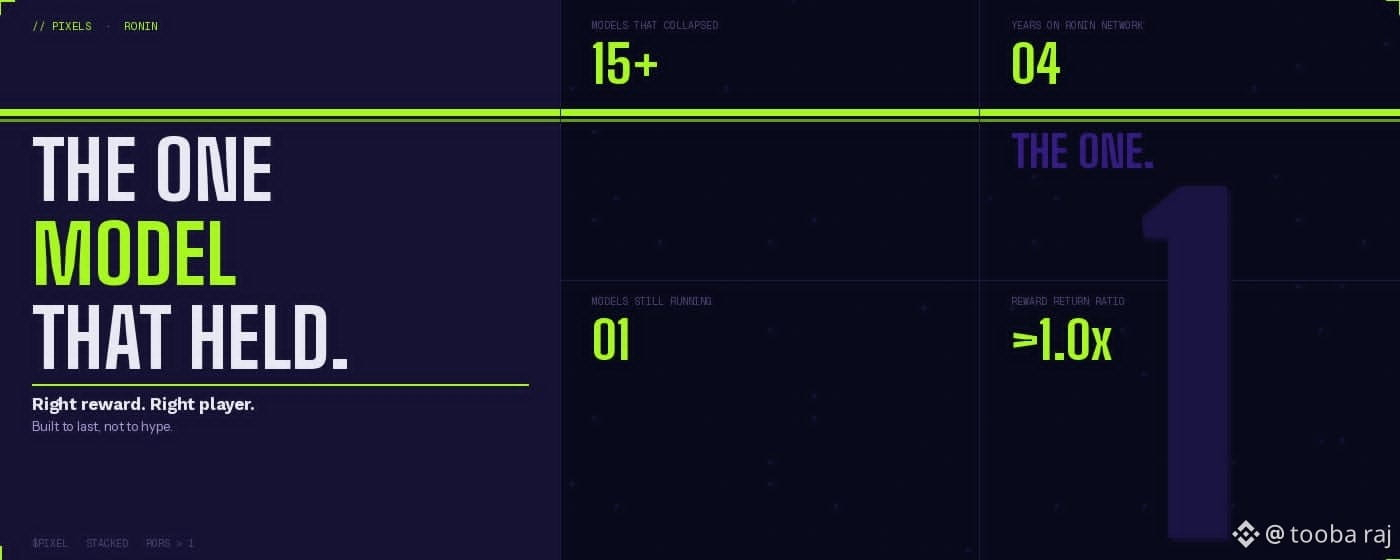
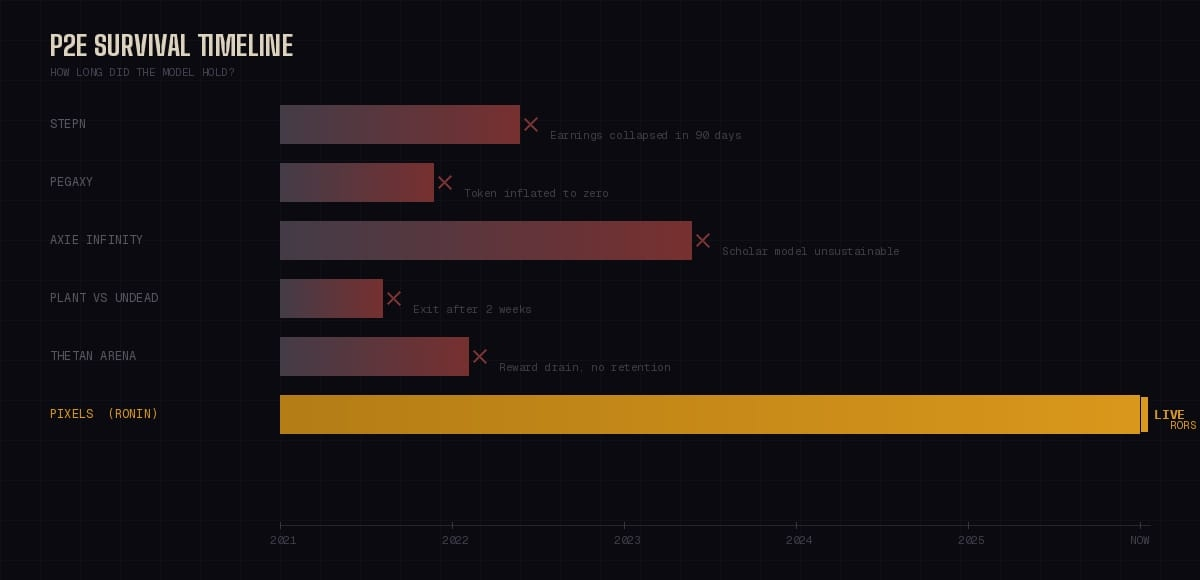
Axie Infinity peaked in 2021 with a token price that made headlines and a player base that, for a brief window, felt like proof that gaming could replace income. Then the token started falling and never really stopped. The scholars who had been earning real money playing a game about cartoon creatures watched the value of that money evaporate faster than they could withdraw it. The model was not dishonest exactly. It just could not hold its own weight. When enough players decided to sell what they earned, the price fell, which made earning less valuable, which pushed more players to sell, until the spiral became the story.
That collapse did not happen to Pixels, and understanding why is more interesting than the success story itself.
Pixels lives on the Ronin Network, the blockchain Sky Mavis built specifically for gaming after Axie Infinity demonstrated both what was possible and what could go catastrophically wrong with on-chain game economies. Ronin handles transactions fast and cheaply, which matters practically because a game economy where every small action costs a fee becomes unplayable. But the technical foundation is only part of what changed. The more important shift was in how the Pixels team thought about what a reward is actually for.
Most play-to-earn games were built around a simple idea: give players a token for playing, let them sell that token, call it earned income. The problem with that model is that it treats the reward as the product. Every player becomes an extraction machine, optimizing for how to earn the most tokens in the least time, then selling them as fast as possible. The game becomes secondary. The economy becomes a one-way pipe moving value outward, and the moment new players stop arriving to buy the tokens the existing players are selling, the whole thing falls over.
The Pixels team had a different starting question. Instead of asking how to give rewards, they asked which player deserves a reward right now and what kind of reward would make them more engaged rather than less. Those are much harder questions and they take much longer to answer correctly, which is probably why nobody was asking them in 2021 when everyone was rushing to launch tokens and capture the moment.
The metric they built around is called Return on Reward Spend. The idea is that every token or dollar distributed as a reward should generate more value back into the ecosystem than it cost to give out. A game with a Return on Reward Spend below one is quietly paying players to leave. It is subsidizing extraction rather than engagement. The number sounds technical but the concept is simple: your reward budget has to be an investment in keeping people playing, not a salary for showing up.
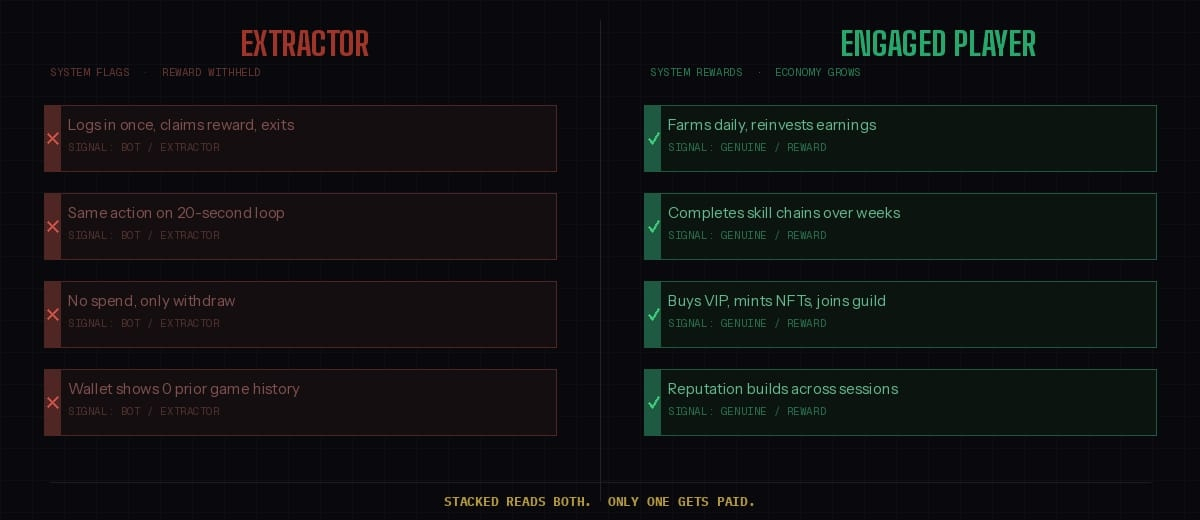
Getting that ratio above one required the Pixels team to build something that most game studios do not have: a system that knows the difference between a player who crafted a complex item chain, reached a skill milestone, and logged in consistently for three weeks, versus a player who opened the app once to claim a daily bonus. Both players exist inside the same game. Both technically qualify for rewards under a naive distribution model. But only one of them is the kind of player the economy needs more of, and only one of them benefits from the kind of reward that compounds their engagement.
Stacked, the rewards infrastructure the Pixels team built and tested inside their own games before releasing it externally, is what closes that gap. It reads behavioral signals continuously: what players do, how long they stay, whether they reinvest what they earn or pull it out immediately, whether their activity looks like genuine decision-making or like a script running on a schedule. A veteran player who has been farming seriously for six months receives a different offer than someone in their first week. Someone who cleared a high-stakes dungeon in Pixel Dungeons gets a different signal than someone who logged in to tap through a notification. The system is not more generous to one and stingy to the other. It is trying to give each player the thing that keeps them meaningfully inside the game economy rather than simply extracting from it.
This is why the Pixels ecosystem on Ronin has survived long enough to grow when most of its contemporaries are either dead or on life support from treasury funds. The PIXEL token has real things it needs to do inside the economy: minting NFTs, joining guilds, accessing VIP tiers, staking into game pools. It is not purely an earn-and-sell instrument. Players who want to go deeper into what the game offers need the token to do it, which creates demand from people who want to participate rather than just people who want to leave.
The VIP system is worth noting on its own. Players pay in PIXEL for access to higher earning potential inside the game. That is a clean loop: earning more requires investing more, which means the players gaining the most from the ecosystem are also the ones putting value back into it. A player who bought a VIP tier is not the same player who will drain the economy dry the moment the price moves. They already committed something.
What Pixels built is not a charity program for gamers. It is a game economy that treats the reward as a tool for keeping the right players playing rather than as an incentive to show up once and leave. The games that collapsed treated those two things as the same. Pixels figured out early that they are not, and built accordingly.
Most of the industry is still learning that lesson. Pixels learned it by staying in the problem long enough that there was no other option.
