
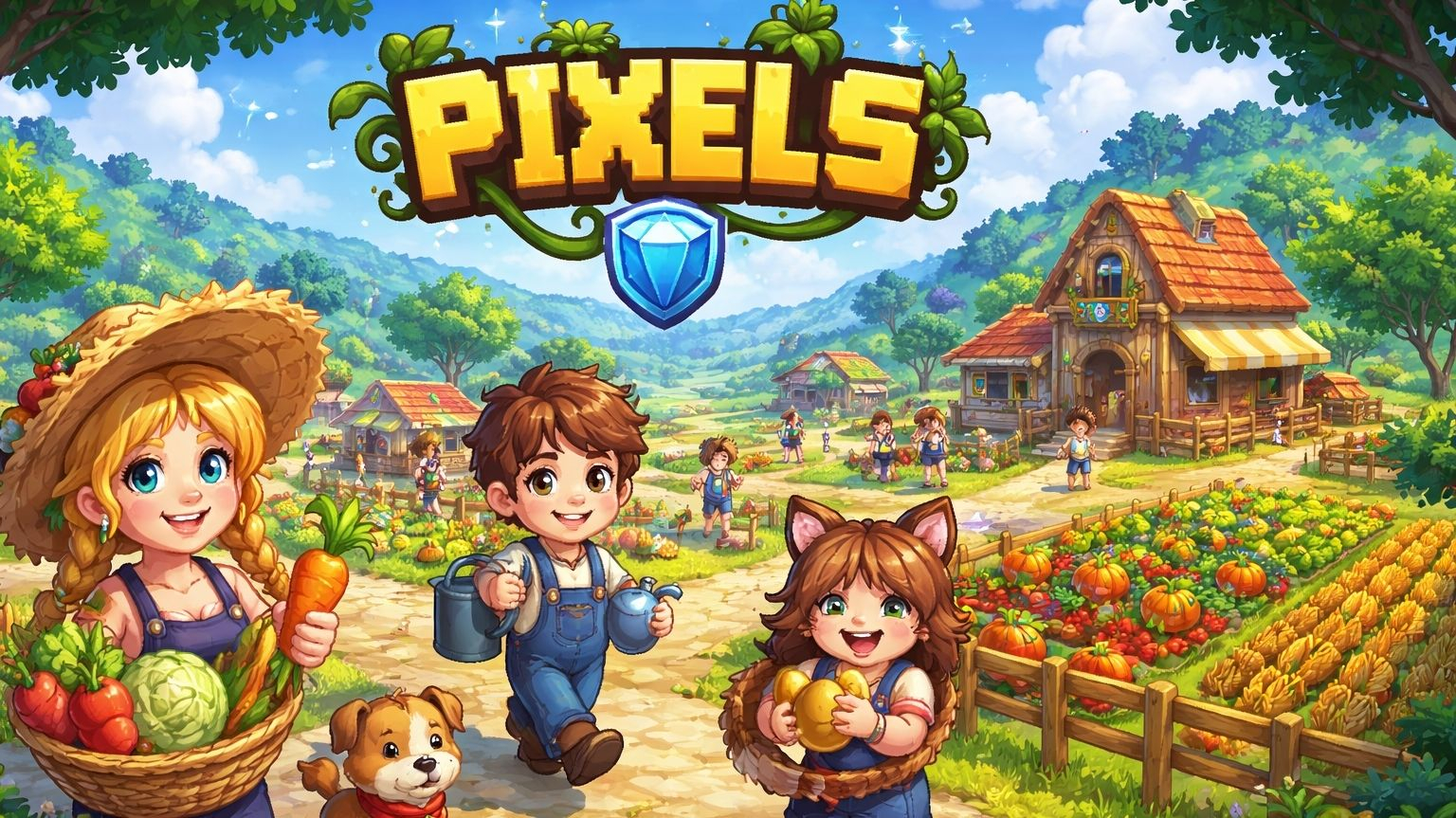
Most Web3 games follow a familiar pattern—you log in, click through a few tasks, maybe earn a token, and log out. It works, but it rarely feels like playing. That’s exactly where Pixels (PIXEL) takes a different path.
Instead of pushing earnings first, Pixels builds a world you actually want to spend time in. It’s calm, social, and surprisingly immersive. You plant crops, explore new areas, chat with other players, and gradually build something that feels personal. The blockchain layer exists—but it doesn’t dominate the experience.
That subtle shift—from “earn first” to “play first”—is what makes Pixels one of the most interesting projects in the Web3 gaming space today.
What Is Pixels?
Pixels is a social, casual Web3 game built on the Ronin Network. It combines elements of farming simulators, open-world exploration, and multiplayer interaction into a persistent digital world.
At its core, the game revolves around:
Farming and resource management
Exploration and discovery
Crafting and upgrading
Social interaction and community building
But unlike traditional farming games, everything you earn or create can be tied to blockchain ownership—giving players actual control over their in-game assets.
Gameplay: Simple on the Surface, Deep Over Time
Pixels doesn’t overwhelm you. You start small—maybe with a patch of land and a few basic tools. But over time, the game opens up into a layered system of progression and creativity.
🌱 Farming and Resource Gathering
Players grow crops, harvest materials, and manage energy. It’s a slow, satisfying loop that rewards consistency rather than constant grinding.
🧭 Exploration
The world isn’t static. As you explore, you unlock new areas, discover resources, and interact with NPCs or other players.
🔨 Crafting and Building
Resources aren’t just for selling—they’re used to craft tools, cook food, and upgrade your land. This adds a strategic layer to how you spend your time.
💬 Social Gameplay
Pixels shines as a social experience. You’ll see other players farming nearby, trading, chatting, or just hanging out. It feels more like a community than a solo grind.
Why the Ronin Network Matters
The decision to build on the Ronin Network wasn’t random—it’s a major reason Pixels works as smoothly as it does.
Ronin is designed specifically for games, which means:
Faster transactions
Lower fees
Better scalability for large player bases
This allows Pixels to integrate blockchain features without slowing down gameplay—a common problem in many Web3 titles.
The PIXEL Token: Utility Without Pressure
The PIXEL token acts as the premium currency within the ecosystem. But here’s the key difference—it’s not required to enjoy the game.
What PIXEL is used for:
Speeding up progress (time boosts, energy)
Unlocking cosmetics and customization
Accessing special features or recipes
Enhancing gameplay efficiency
This design keeps the experience balanced. Players who spend can enhance their journey, but free players are never locked out of core gameplay.
A Smarter Game Economy
Pixels originally experimented with a dual-token system, combining a soft currency for daily gameplay with a premium token for advanced features. Over time, the ecosystem evolved toward a more streamlined structure centered around PIXEL.
Why does this matter?
Because many Web3 games fail due to overly complex or unsustainable economies. Pixels, on the other hand, focuses on:
Controlled token supply
Meaningful in-game utility
Balanced reward systems
It’s less about quick profits—and more about long-term sustainability.
What Makes Pixels Stand Out
1. It Feels Like a Game First
This might sound obvious, but in Web3, it’s rare. Pixels is designed to be enjoyable even if you ignore the blockchain entirely.
2. Low Pressure, High Retention
There’s no constant urgency to optimize or maximize. You can play at your own pace—and that’s exactly why players keep coming back.
3. Real Social Layer
Unlike many “multiplayer” blockchain games, Pixels actually feels alive. Player interaction is natural, not forced.
4. Expanding Ecosystem
Pixels is starting to connect with other experiences in the Ronin ecosystem, hinting at a future where assets and identities move across games.
Real-World Momentum and Growth
After migrating to the Ronin Network, Pixels saw a major surge in player activity. Daily users climbed rapidly, and the game quickly became one of the most active titles in the ecosystem.
This growth wasn’t just hype—it reflected genuine engagement. Players weren’t just logging in to earn; they were staying to play.
That distinction is critical in evaluating the long-term potential of any Web3 project.
The Bigger Vision: Beyond a Single Game
Pixels isn’t just building a farming simulator—it’s building a foundation.
The long-term vision includes:
Interoperable game assets
Cross-game economies
Shared player identities across worlds
Expansion into new gameplay systems (pets, skills, mini-games)
If executed well, Pixels could evolve into a hub within a broader Web3 gaming ecosystem rather than remaining a standalone title.
Challenges and Risks
No project is without challenges, and Pixels is no exception.
⚠️ Economic Balance
Maintaining a healthy token economy without turning the game into a grind-for-profit system is a delicate task.
⚠️ Player Retention
Casual gameplay is appealing—but long-term retention requires continuous updates and new content.
⚠️ Web3 Perception
Despite improvements, many gamers still associate blockchain with speculation. Pixels must continue proving it offers more than that.
Future Outlook: What Comes Next?
Looking ahead, Pixels is positioned for steady evolution rather than explosive, unsustainable growth.
Key trends to watch:
Deeper social systems and player-driven economies
More cross-game integrations within Ronin
Enhanced customization and land development
Expansion into new gameplay loops (like pets and skills)
If the team maintains its “fun-first” philosophy, Pixels could become a benchmark for how Web3 games should be built.
Conclusion: A Quiet Shift in Web3 Gaming
Pixels doesn’t try to overwhelm you with promises of massive earnings or revolutionary mechanics. Instead, it does something much simpler—and more powerful.
It makes you want to stay.
By focusing on gameplay, community, and gradual progression, Pixels shows that Web3 gaming doesn’t need to feel like a financial tool. It can feel like a world.
And in a space still searching for its identity, that might be exactly what matters most.
FAQs
What makes Pixels different from other Web3 games?
Pixels prioritizes gameplay and social interaction over earning mechanics, making it more engaging and sustainable.
Do I need to invest money to play Pixels?
No. The game is playable without spending. The PIXEL token enhances the experience but isn’t required.
Is Pixels beginner-friendly?
Yes. Its simple mechanics and relaxed pace make it accessible even for players new to blockchain gaming.
Can I earn from playing Pixels?
There are earning opportunities, but they are not the primary focus. The game emphasizes enjoyment first.
What is the future of Pixels?
Pixels is evolving toward a broader ecosystem with cross-game integrations, expanded features, and deeper social gameplay.