
I was standing in the kitchen this morning, watching my coffee cool while the newspaper lay unread on the table. The headlines were the usual mix of economic anxiety and fleeting distractions—people chasing stability in systems that seem rigged to favor the loudest or the luckiest. It reminded me how much of daily life feels like waiting for some invisible hand to hand out scraps fairly.
That feeling carried over when I opened the Binance Square CreatorPad campaign and started the task for “Balancing Reward Distribution in a Dynamic Game Economy.” I clicked through to the project dashboard, scrolled past the leaderboards and point-allocation sliders, and landed on the reward simulation screen where you adjust parameters for player activity tiers and contribution multipliers. While tweaking the distribution curve to favor sustained engagement over burst farming, something uncomfortable clicked into place.
The real issue isn't that games fail to reward players—it's that most crypto projects still pretend equal or random distribution creates healthy economies, when it actually punishes the very behavior that keeps things alive.
We’ve been sold this notion that fairness in Web3 means giving everyone a shot at the same pie slice, as if tokens or points are neutral gifts from the protocol gods. But watching the simulation update in real time, with rewards tapering for low-contribution accounts while scaling for consistent builders, it became clear: true balance demands deliberate inequality. Not the toxic kind driven by whales or insiders, but the kind that quietly acknowledges some players add frictionless value through retention, creation, or ecosystem defense, while others extract and exit. Treating them the same drains the pool faster than any exploit.
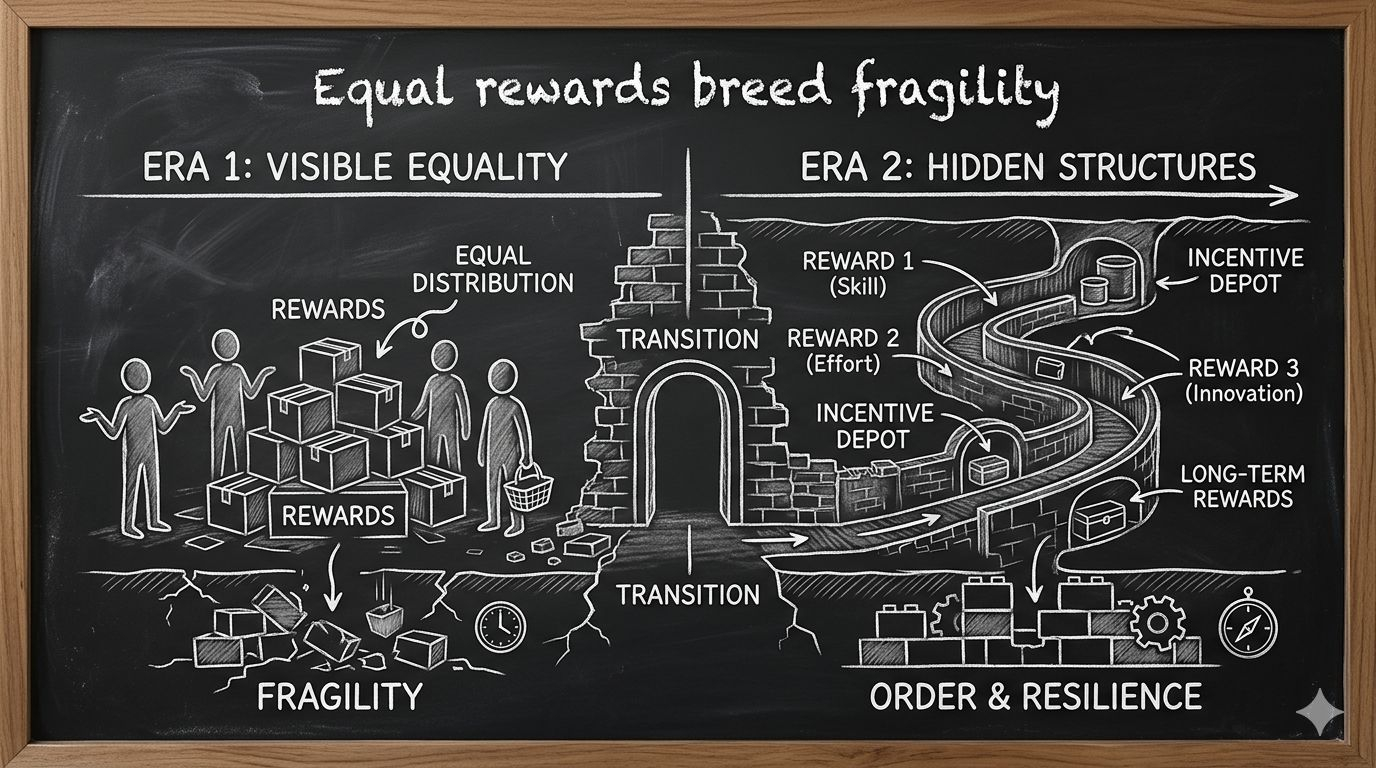
't limited to one game. Look at how many play-to-earn experiments collapsed under the weight of mercenary farmers who optimized for quick flips rather than long-term play. The economy inflates, engagement drops, and suddenly the “community” evaporates because the incentives never distinguished between tourists and residents. The task’s moment of dragging the activity threshold higher made that visible in numbers—retention curves steepened, sell pressure projections flattened, and the projected lifetime value of engaged users rose without needing bigger reward pools.
Pixels serves as a quiet example here. Its approach leans into data that highlights meaningful actions—farming that builds rather than depletes, exploration that encourages social layers—over blanket airdrops. When I adjusted the in-task sliders for contribution weighting, the model showed how small shifts away from uniform distribution preserved token velocity without killing fun. It challenged the knee-jerk crypto faith that “more accessible rewards = more adoption.” Accessibility without discernment often breeds fragility.
The deeper discomfort is admitting that decentralized systems still require centralized judgment calls on value. Algorithms can simulate fairness, but someone or something has to define what “contribution” even means in a dynamic setting. Ignore that, and you end up with ghost towns dressed up as vibrant metaverses. Reward everyone equally and you reward no one meaningfully; the system learns to game itself until collapse feels inevitable.
Yet here we are, still repeating the cycle with new launches promising utopian tokenomics. The simulation screen didn't lie: balanced distribution isn't about equality of outcome but alignment of effort with longevity. It forces a harder question about human nature in incentive design—do we trust players to self-regulate, or do we build guardrails that feel almost paternalistic?
What lingers is whether we’re ready to accept that in crypto game economies, a little honest asymmetry might be the only path to genuine sustainability. @Pixels #pixel $PIXEL