
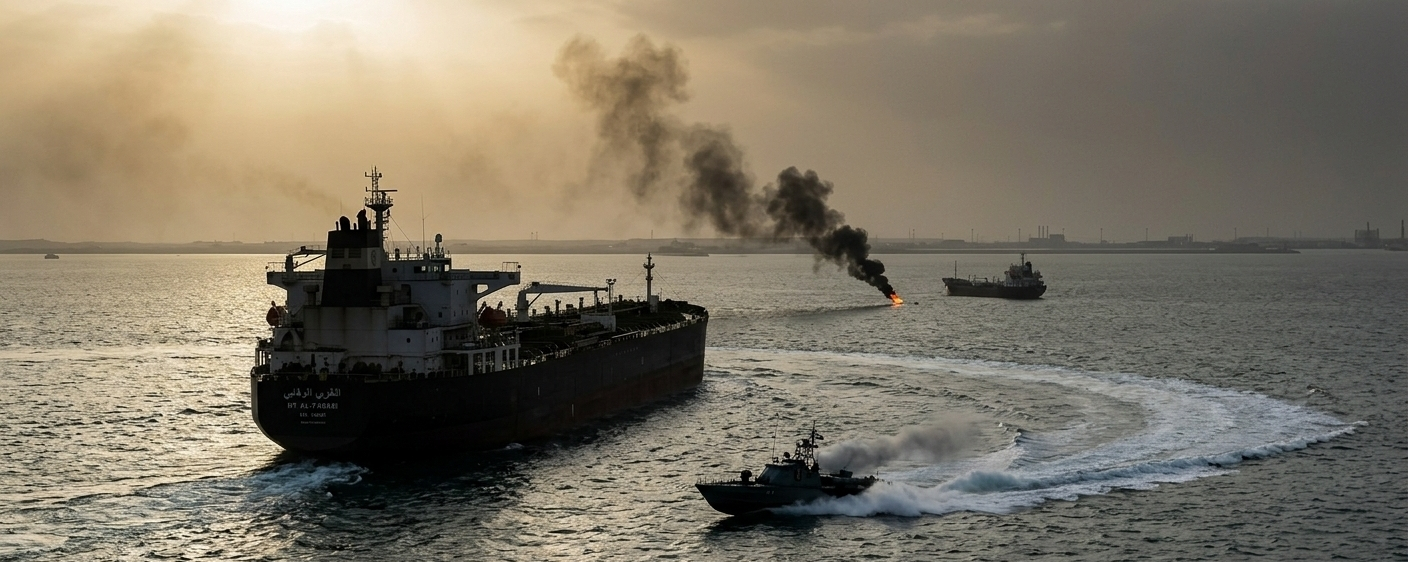
Just as the world economy was beginning to digest the era of higher interest rates, a new and volatile variable has been injected into the equation: the closure—and partial reopening—of the world’s most critical oil chokepoint.
The crisis unfolding in the Strait of Hormuz has moved beyond diplomatic posturing into live maritime warfare. With Iran re-imposing shipping restrictions and engaging tankers despite recent promises of de-escalation, the global energy market is facing its most severe supply threat since the 1970s.
A Shot Across the Bow’
The past 72 hours have seen a dramatic reversal. Early in the week, Iranian officials signaled a willingness to ease restrictions, briefly calming futures markets. That promise evaporated when Iranian naval forces reportedly fired upon commercial tankers in the strait, forcing vessels to perform a "hard reverse"—turning around in the narrow waterway against standard safety protocols.
"This isn't just about a few ships being delayed," said Maria Tadeos, a senior energy analyst at the Atlantic Council. "When the Islamic Revolutionary Guard Corps fires on a tanker in the Strait of Hormuz, they aren't just targeting that ship. They are firing a shot across the bow of the entire globalized economy."
The immediate result was chaos: shipping insurance rates for Gulf routes skyrocketed by 400% overnight, and at least four tankers have reversed course, holding their crude cargo for safety rather than delivery.
The Economic Domino Effect
The disruption is feeding directly into the 2026 "fragile" global outlook recently published by the International Monetary Fund (IMF).
Oil Prices Surge:
Brent crude briefly touched $120 a barrel in early trading Friday before settling at $114. The spike, if sustained, threatens to undo the progress central banks have made against inflation.
The Aluminum Anomaly:
Perhaps the strangest symptom of the crisis is the record high in aluminum prices. While oil grabs headlines, the Strait of Hormuz is also the transit point for raw materials from Gulf producers. Europe, which has already been struggling with energy costs, is seeing a secondary spike in industrial metals as smelters brace for input shortages.
Aviation Fuel Crunch:
Europe is the most exposed. With reserves of jet fuel estimated to cover only six weeks of demand at current consumption rates, airlines are beginning to hedge aggressively. Industry sources warn that if the strait remains choked for another 30 days, transatlantic flight prices could rise by as much as 25%.
The Political Paradox: Negotiations vs. Aggression
In a scene that defines the contradictory nature of modern diplomacy, the United States is simultaneously preparing for conflict and announcing a deal.
President Donald Trump stated from the White House on Thursday that a nuclear agreement with Iran was "imminent," claiming that Tehran had agreed to hand over fissile material for inspection.
Yet, on the water, no such detente exists.
Critics argue that the Iranian leadership is using the nuclear talks as cover to extract economic concessions while maintaining military pressure on the strait. "They are playing a double game," said a European diplomat speaking on condition of anonymity. "They want the sanctions relief from the nuclear deal while keeping the weapon of the strait cocked and loaded."
G7 Intervention and the Road Ahead
The G7 has pledged to intervene to cap the economic damage, though specific mechanisms remain unclear. Options on the table include releasing more strategic petroleum reserves (SPRs) and offering a price cap guarantee for European buyers willing to take Iranian oil should the deal close.
However, the International Energy Agency (IEA) has warned that SPRs are at their lowest levels in decades. There is no longer a deep cushion to fall back on.
For now, the world watches the GPS signals of tankers in the Persian Gulf. As long as the vessels keep turning back, the risk of a global recession—driven not by bad debt, but by a lack of fuel—remains dangerously high.