
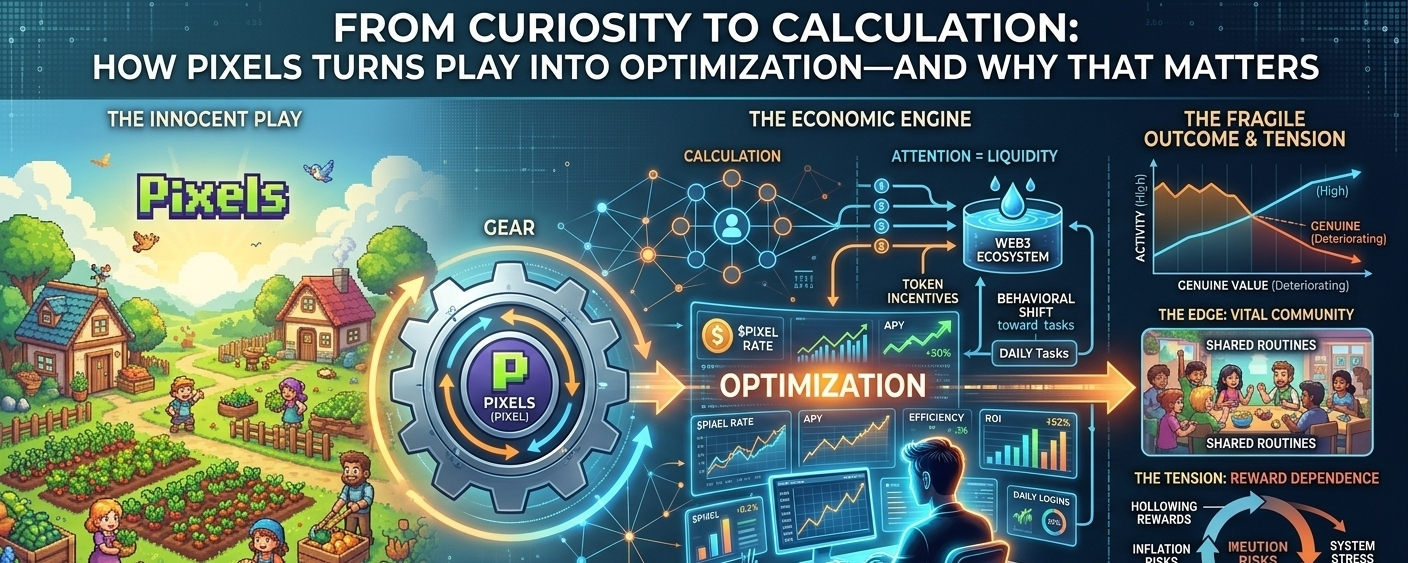
At first, I didn’t think much of Pixels. It looked like a soft, familiar loop—plant crops, gather resources, explore a colorful world, repeat. The kind of experience that feels more like routine than ambition. I logged in casually, almost absentmindedly, expecting nothing more than a gentle distraction.
But after a while, something underneath started to reveal itself.
What seems like a simple farming game is actually a carefully constructed system of incentives. Every action—planting, harvesting, crafting—is tied to a broader economy powered by tokens. And that’s where the tone shifts. Pixels isn’t just about what I do inside the game, it’s about why I keep doing it. The design quietly pushes me toward consistency, toward daily engagement, toward becoming part of a loop that extends beyond entertainment into value extraction.
It made me realize that Pixels isn’t solving for fun alone. It’s trying to solve for attention.
In Web3, attention is liquidity. If people show up, stay active, and keep interacting, the system breathes. Pixels understands this deeply. It doesn’t demand intensity—it encourages routine. Log in, complete tasks, optimize output, repeat tomorrow. Over time, I stopped playing freely and started playing efficiently. My curiosity turned into calculation.
And that’s where things get complicated.
Because activity doesn’t always equal value.
At some point, I noticed that I wasn’t exploring anymore—I was optimizing. I wasn’t asking “what can I do?” but “what gives the best return?” The game loop didn’t change, but my behavior did. And when enough players shift like that, the system itself begins to lean in a different direction. It becomes less about creation and more about extraction.
That shift introduces fragility.
If the primary motivation becomes earning rather than experiencing, then the system depends heavily on new attention flowing in. New players, new capital, new demand. Without that, the loops can start to feel hollow. Rewards lose meaning, inflation creeps in quietly, and what once felt engaging begins to feel mechanical.
Pixels sits right on that edge.
On one hand, it has something rare—a living, social environment where users genuinely interact and build routines together. On the other, it carries the familiar tension of tokenized systems: balancing growth with sustainability. Governance exists, but like many projects, the real influence often concentrates among those most invested. And growth metrics can look strong even when retention quietly weakens beneath the surface.
I don’t see Pixels as a failure or a success yet. It feels more like an experiment still unfolding.
What interests me most is what it reveals about us.
We come into these systems curious, open, willing to explore. But over time, we adapt. We optimize. We turn play into strategy, and strategy into expectation. And in doing so, we sometimes drain the very thing that made the experience meaningful in the first place.
Pixels reflects that behavior back at us.
The real test won’t be during growth, when everything feels alive and expanding. It will come later—when attention slows, when easy rewards fade, and when the system has to rely on its core design rather than momentum.
That’s when we’ll find out what Pixels really is.
And maybe, in the process, we’ll learn something uncomfortable about how we behave in every crypto system we touch.
