
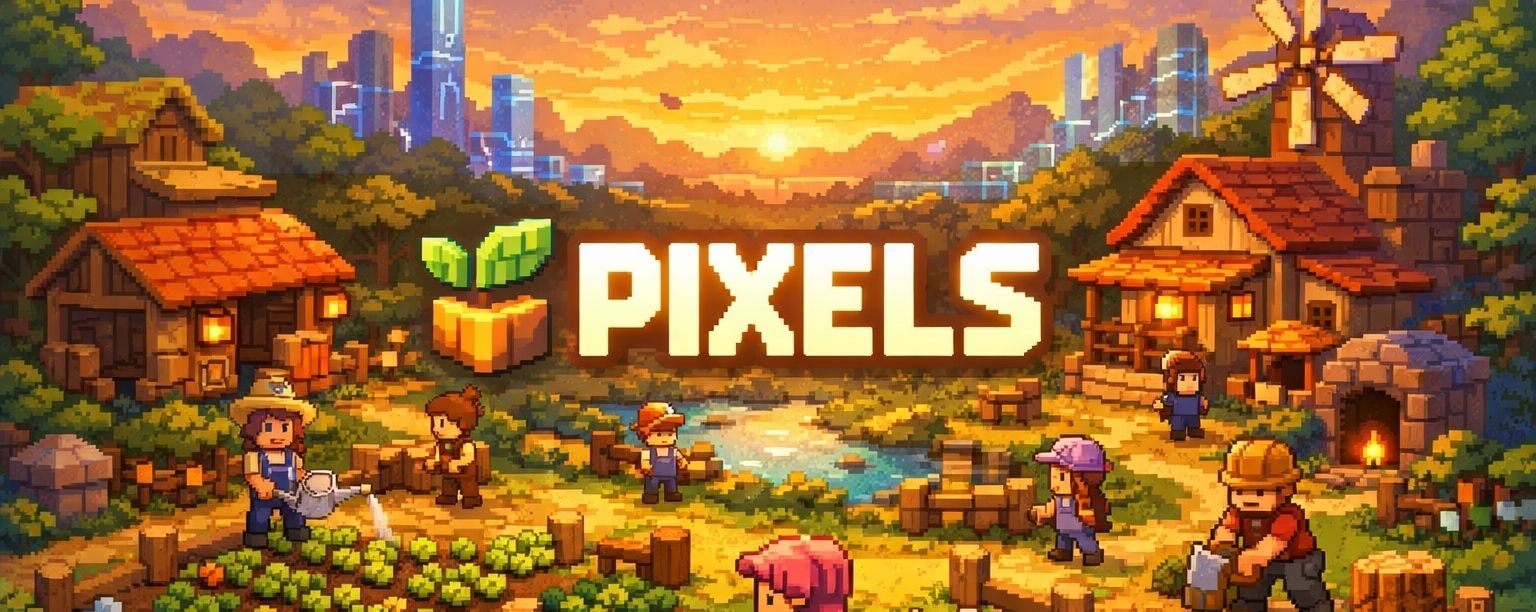
Spending time inside @Pixels, there’s a noticeable gap between what the game promises and how it actually feels moment to moment. On the surface, the world appears calm and inviting—simple farming loops, light exploration, and a social layer that hints at something deeper. But after a while, the experience starts to feel more procedural than alive. Actions repeat in predictable rhythms, and progression leans heavily on time investment rather than meaningful decision-making.
The $PIXEL economy is present everywhere, yet it doesn’t always feel naturally embedded into gameplay. Instead of enhancing immersion, it sometimes feels like an external layer guiding behavior. You’re not always asking “what do I want to do next?” but rather “what is most efficient to do next?”—and that shift changes the emotional tone of the game.
The Stacked ecosystem adds an interesting dimension, especially with the idea of interconnected systems and assets, but it raises a quiet question: is this depth, or just complexity? There are moments where systems overlap in a way that suggests long-term potential, but also moments where it feels like those layers exist mainly to extend engagement rather than enrich it.
Social interaction is another area that feels unfinished. Players coexist, but the world doesn’t always encourage meaningful collaboration or emergent behavior. It’s functional, but not yet organic. The game doesn’t quite feel “alive”—more like a well-assembled structure waiting for something unpredictable to happen inside it.
What’s unclear is how this experience holds up over time. Once the novelty fades and optimization paths become obvious, the question becomes whether players stay because they want to—or because the system nudges them to. Right now, it feels like something still in motion, not fully settled into its identity.
There’s potential here, but also uncertainty. It’s not obvious yet whether @pixel is building a lasting world, or just a loop that feels engaging until it doesn’t. #pixel $PIXEL
