I’ll be honest, most dual token systems in Web3 gaming never impressed me.
In fact, I used to see them as a warning sign. Too often, projects introduce two tokens not because the economy is well designed, but because they want more room to inflate, more room to confuse players, and more room to delay the same collapse everyone already sees coming. One token starts losing value, so they bring in another and act like the structure is suddenly smarter. Most of the time it is not.
That is why @Pixels caught my attention.
The more I looked at the relationship between $BERRY and $PIXEL , the more I felt this was one of the rare cases where a dual token system actually has a real purpose. I am not saying it is flawless, and I am not saying it cannot come under pressure, but I do think it makes more sense than most of what Web3 gaming has produced so far.
What makes it interesting to me is that it seems built around a problem that has already destroyed a lot of play-to-earn systems.
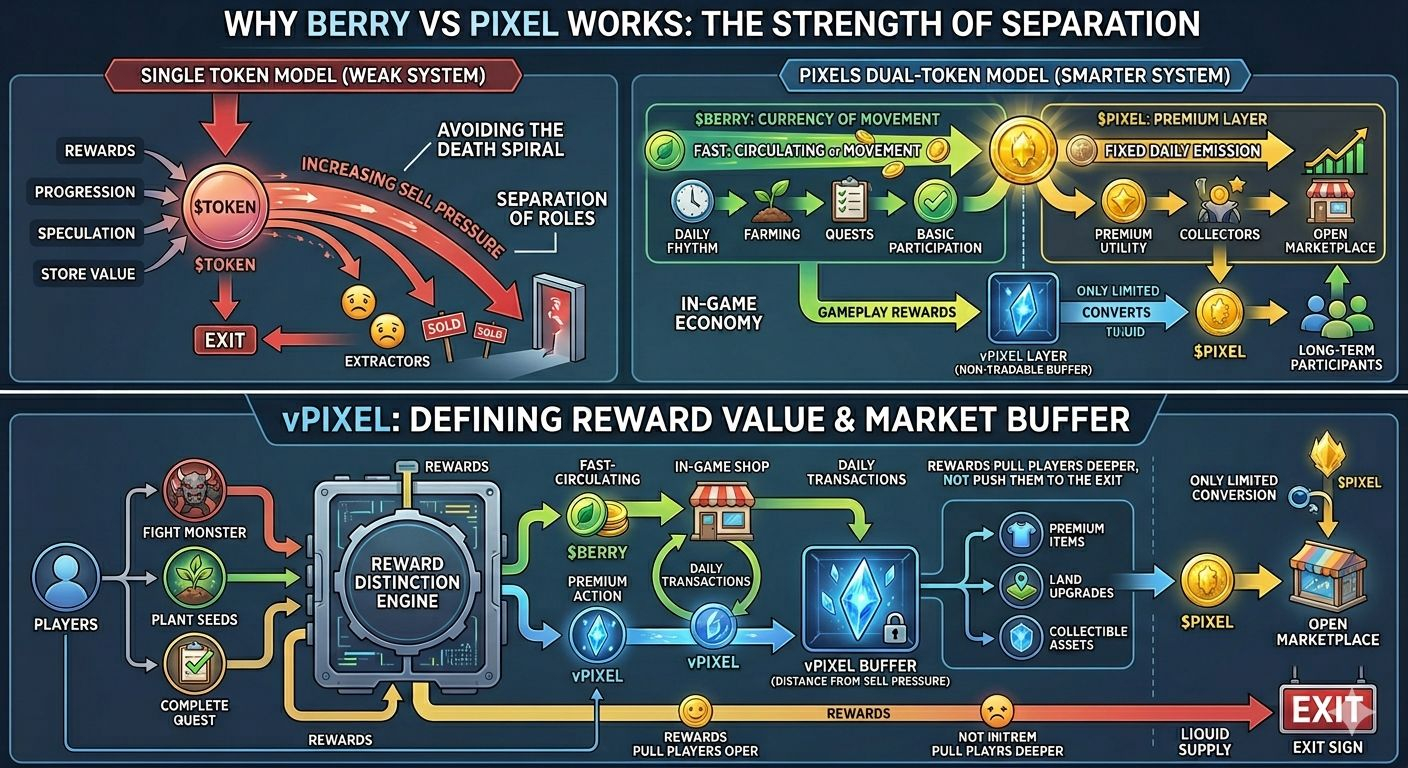
The problem with a single-token game economy is simple. When one token is expected to do everything, reward players, support progression, carry speculation, store value, and absorb constant selling, the whole system becomes fragile very quickly. The moment activity rises, emissions rise too. More users may look bullish at first, but if those users are mostly farming and selling, growth starts creating its own weakness.
I have seen this happen too many times. At first, everyone feels excited because rewards look attractive. Then supply starts building faster than real demand. Price begins to slide. Once that happens, player behavior changes. People stop thinking like participants and start acting like extractors. When earnings become less attractive, they leave. Then demand weakens again and the token ends up draging the rest of the ecosystem down with it.
That is the death spiral I think Pixels is trying to avoid.
The way I see it, the real strength of this model is the separation of roles.
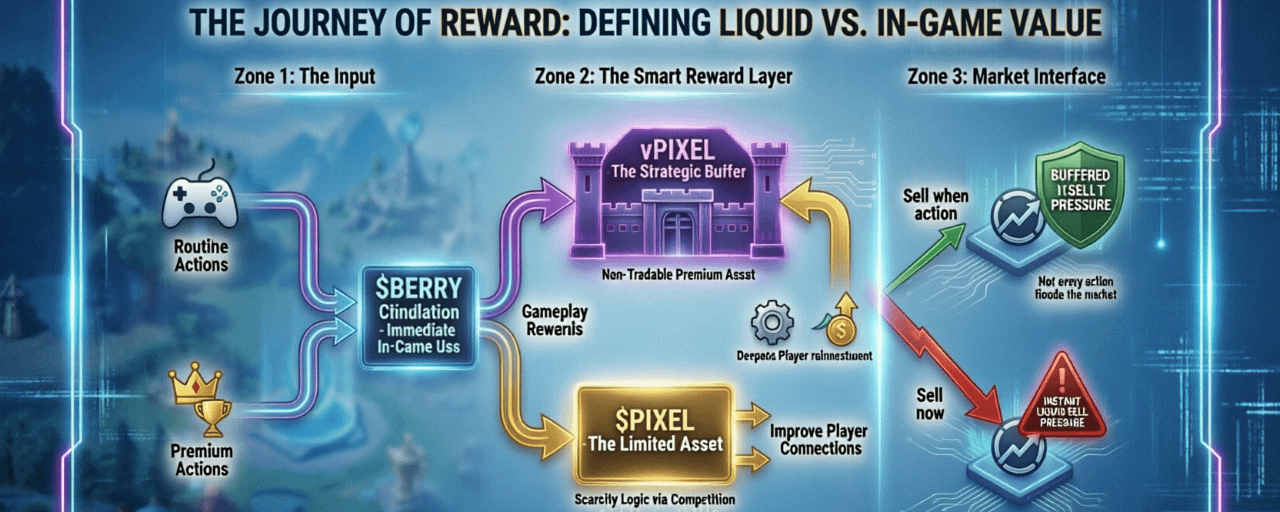
$PIXEL feels like the premium layer, the asset that is meant to stay more limited and more meaningful. It is tied to the part of the ecosystem that serious players, collectors, and long-term participants care more deeply about. That already makes it different from the usual reward token model, because not every routine action is designed to flood the same premium asset into circulation.
BERRY, on the other hand, feels more like the currency of movement. It supports the daily rhythm of the game. It is there for farming, quests, and basic participation. I do not look at it as something that needs to carry long-term prestige. To me, it works more like functional in-game money, something designed to circulate rather than something designed to be treated like a scarce store of value.
That split is what makes the structure feel more intelligent to me.
What really made it click for me was the scarcity logic. If the premium asset has a fixed daily emission, then growth changes access, not just visibility. That is very different from the standard Web3 gaming model. In a lot of broken economies, more players often means more supply and more sell pressure. Here, more players can mean more competition over the same limited premium asset.
And I find that genuinely interesting.
Because once you start thinking that way the whole system looks different. If player demand grows while premium supply stays constrained, then earning that premium asset becomes harder relative to the size of the network. That creates a form of scarcity that feels structural, not artificial. It does not rely only on aggressive burns or temporary token sinks that look impressive in announcements but fail in practice. It comes from simple competition.
To me, that is one of the smartest parts of the design.
I also think the comparison to premium currencies in traditional games is more useful than many people realize. When Pixels compares its premium asset to Gems in games like Clash of Clans, I actually think that framing helps. In traditional gaming, premium currencies are intentionally harder to obtain, and that scarcity is what gives them weight. Players either grind for them slowly or acquire them by spending money. The system works because that premium layer is not treated like disposable reward dust.
What makes the blockchain version more compelling, at least in theory, is ownership.
That is where I think the idea becomes bigger than just game design. If the premium asset is scarce, useful, and transferable, then players are not just consuming a closed currency controlled by a company. They are participating in an economy where the premium unit can move beyond the game itself. That does not automatically guarantee lasting value, but it does create a different relationship between effort, scarcity, and economic freedom.
Then there is the vPixel layer, which to me feels like a very thoughtful next step rather than a small adjustment.
I actually think this may be one of the strongest ideas in the whole system. A non-tradeable version of the premium asset creates distance between gameplay rewards and direct market sell pressure. That matters because one of the hardest problems in Web3 games is figuring out how to reward participation without turning every reward into instant liquid supply. If players are rewarded in a version that can still be used inside the ecosystem but cannot be dumped immediately, then the project has more room to protect the premium asset’s role.
From my point of view, this solves something deeper than inflation.
It helps define what kind of reward gameplay should actually produce. Not every reward needs to become instantly tradable to feel valuable. Sometimes a healthier system is the one where rewards pull players deeper into the economy instead of pushing them straight toward the exit. That is why I think the vPixel layer could matter more than people expect. It suggests Pixels understands that scarcity alone is not enough. You also need a system that decides which actions should create liquid value and which should create in-game value first.
That distinction is exactly where many weaker projects fail.
Overall, my view is simple. I do not think Pixels deserves credit just because it uses two tokens. Web3 gaming has already shown that two-token systems alone solve nothing. What makes this one worth paying attention to is that each part seems to have a clear role. One supports daily activity. One protects premium scarcity. And the new reward layer looks like an attempt to defend that scarcity without breaking the player experience.
For once, the pieces do not feel randomly assembled.
They feel like they were given different jobs for a reason.
And in this space, that already makes #Pixels more interesting to me than most.