
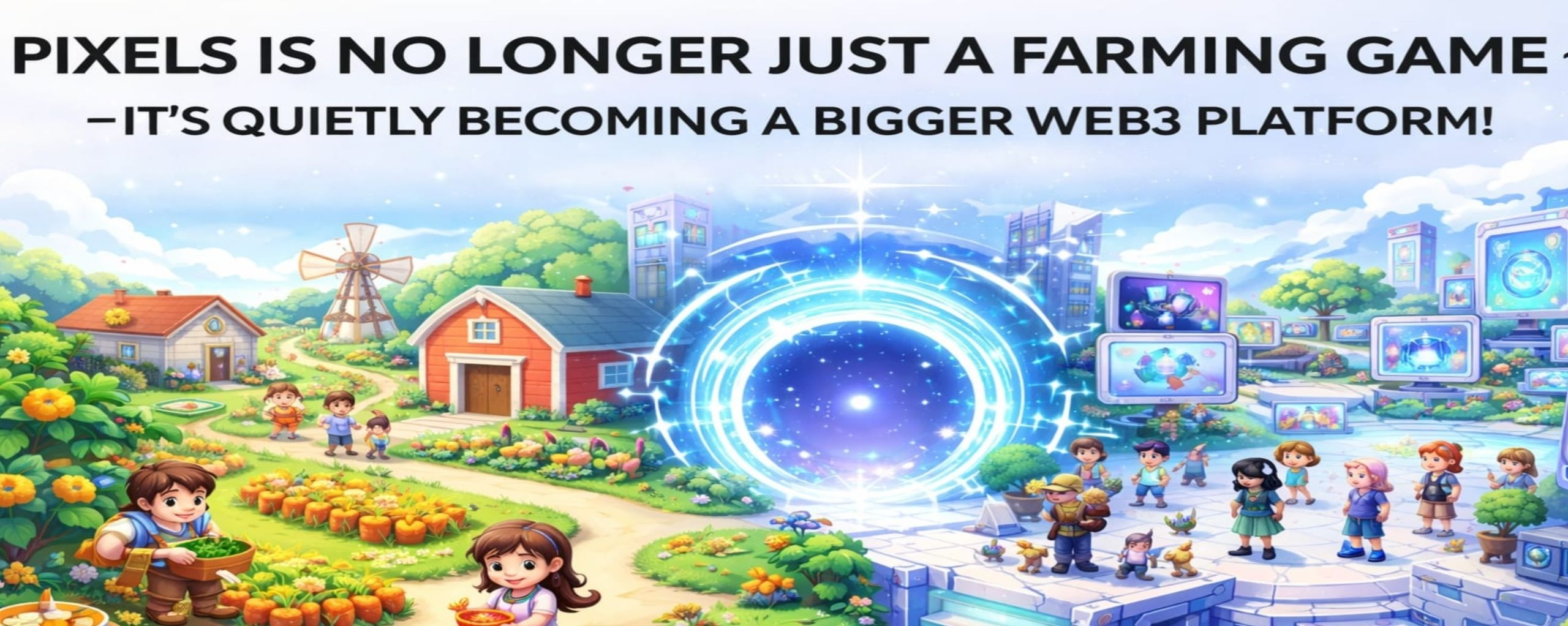
At first, Pixels looks easy to explain.
You open it, and what you see feels familiar: crops, land, pets, crafting, exploration, and that calm, repetitive rhythm that farming games are known for. It is colorful, accessible, and simple enough that almost anyone can understand the loop within minutes. That first impression is part of why the project spread so quickly. But the more I look at it, the more I think that first impression is also where many people stop too early.
Because Pixels is not just trying to be a good farming game.
What stands out to me is that the farming layer feels more like the front door than the full house. It is the easiest way to bring people in, especially in Web3 where many projects still struggle to feel approachable. But underneath that easy entry point, Pixels is slowly building something that looks much broader: a social ecosystem, a digital economy, and potentially a platform that can support more than one gameplay experience over time. That is where the story becomes much more interesting.
I see this as one of the main reasons Pixels matters more than people assume.
A lot of Web3 projects make the mistake of showing people the infrastructure before giving them a reason to care. They talk about tokenomics, ownership, wallets, interoperability, and onchain mechanics before the player has built any emotional connection to the world. Pixels took the opposite path. It gave people something soft, readable, and habit-forming first. A world where you could log in, plant something, gather resources, see other players moving around, and feel part of a living environment without having to overthink the blockchain side of it. That was a smart decision, and I think it is a big part of why the project managed to stand out.
But the important thing is this: once a player enters through that farming loop, Pixels starts becoming something else.
It starts introducing identity, community, digital ownership, social coordination, and economic participation in a way that feels less forced than what we saw in earlier Web3 games. That shift matters. A normal game can survive for a while on content and updates. A platform, though, works differently. A platform grows by making users, communities, creators, assets, and experiences more connected over time. When I look at Pixels now, I do not just see a game trying to keep people entertained. I see a project trying to build an environment that can keep expanding without always depending on a single gameplay loop.
That is a very different ambition.
And to understand why that ambition has a real chance, you also have to look at Ronin. Pixels did not grow in a vacuum. It grew inside an ecosystem that already understands gaming behavior much better than most chains. That matters more than people think. Building a Web3 game is already difficult. Building one while also trying to educate users, normalize wallets, create liquidity, and maintain community energy from scratch is even harder. Ronin removes part of that burden. It gives Pixels a more natural home, a chain where gaming is not treated like a side experiment but like the center of the culture.
I think that changed the trajectory of the project.
Instead of spending all its energy convincing users that blockchain gaming can work, Pixels was able to focus more on experience, retention, and expansion. That does not make the challenge easy, but it does create a much stronger base. And once you have a strong base, the real question stops being whether the farming loop is fun enough on its own. The real question becomes whether that loop can serve as the beginning of something bigger.
To me, that is exactly what is happening.
The reason I do not see Pixels as just another farming title is because its systems are already pointing beyond that label. When a game starts building around land, collectible value, guild structures, progression tied to wallets, social identity, and community-led participation, it begins to act less like a closed product and more like an operating environment. That does not mean it has fully become a platform yet. But it does mean the direction is clear.
And direction matters.
There is a huge difference between a project that accidentally becomes bigger than its genre and a project that quietly designs for that outcome from the beginning. Pixels feels like the second type. The farming game works because it is familiar and sticky. It gives players routine. It gives them reason to return. It creates daily behavior. But routine alone is not what builds long-term significance in Web3. Long-term significance comes when routine connects to ownership, and ownership connects to status, and status connects to community, and community starts to create value that survives beyond one mechanic or one update cycle.
That is where things get powerful.
A lot of older Web3 games were built around extraction. They gave people a financial reason to show up, but not much emotional reason to stay. As long as rewards looked attractive, activity looked healthy. Once rewards weakened, the illusion broke. We have seen that pattern enough times now that it should no longer surprise anyone. The hard part is building a game where the economy supports the world instead of replacing it. I think Pixels understands that challenge better than many of its predecessors.
It is not perfect, of course, and it still carries the same risks every onchain game carries. But its structure suggests something more thoughtful. The game is not only asking, “How do we reward activity?” It is also asking, “How do we make activity feel meaningful before the reward even enters the picture?” That is a much harder question, and also a much better one.
What stands out to me is that Pixels seems to understand that fun, routine, and social attachment have to come first. If the economy becomes the only reason people care, the project becomes fragile. If the world matters first, then the economy can strengthen it instead of distorting it.
That difference may end up defining whether Pixels becomes a lasting platform or just a successful phase.
Another thing I keep noticing is how often people misread accessibility as weakness. Because Pixels looks casual, some assume it must also be shallow. I think that is one of the biggest misconceptions around the project. In reality, accessibility is often the smarter strategic choice. If you want to build something broad, you do not start by making the front door difficult. You start with something people can understand immediately. Farming, collecting, crafting, and social exploration are powerful because they are easy to enter and easy to repeat. They do not scare away new users. They do not require a technical mindset. They create comfort first.
And comfort is underrated.
Especially in Web3, where so many products still feel like they were designed for insiders talking to other insiders, comfort can be a competitive advantage. Pixels makes blockchain participation feel less intimidating. That alone is valuable. But beyond that, it opens the door for bigger things. Once players are inside the ecosystem and attached to their progress, their land, their social connections, and their digital identity, the project no longer has to rely only on simple farming mechanics. It can layer in more complexity naturally.
That is why I think the farming label is no longer enough.
What we may actually be watching is the early shape of a broader consumer platform disguised as a game.
And that matters for Web3 gaming as a whole, because this sector has spent years trapped in the wrong conversation. Too much energy went into asking whether games should be more financial or more traditional, as if those were the only two paths. Pixels suggests a third path. It suggests that the strongest Web3 products might not win by being the most financialized, and they also might not win by pretending the blockchain barely matters. They may win by making digital ownership, community coordination, and economic participation feel native inside a world people already enjoy spending time in.
That is a much more mature model.
I am paying close attention to this because the strongest crypto products increasingly look less like isolated applications and more like ecosystems. They build identity. They build habit. They build social behavior. They make users feel like participants, not just consumers. Pixels fits that pattern more than many people realize. The game itself may be the obvious layer, but the deeper layer is network formation. Once you have communities, guilds, shared assets, and social status building inside a world, the value of that world starts to exceed the original gameplay loop.
That is when a game begins turning into infrastructure.
Of course, none of this means the outcome is guaranteed. The risks are still real, and they should not be ignored just because the narrative sounds strong. Every Web3 game that touches tokenized incentives faces the same uncomfortable balancing act. If rewards are too strong, the player base becomes mercenary. If rewards are too weak, users lose motivation. If expansion moves too fast, the core identity gets diluted. If expansion moves too slowly, momentum fades. There is no easy formula for solving that.
Pixels still has to prove that it can manage those tensions over time.
And time is the real test. Not a good quarter. Not a strong narrative cycle. Not one burst of attention. Time. That is where serious projects separate themselves from temporary ones. It is easy to say you are building sustainably. It is much harder to keep users engaged, economies balanced, and communities growing after the initial excitement wears off. That is why I think the next stage for Pixels is so important. The ambition is becoming clearer now. But once you present yourself as something broader than a game, expectations change too. Users start expecting not just fun, but consistency, fairness, expansion, and vision.
That is a higher standard.
Still, even with those risks, I think the upside here is larger than many people see. If Pixels keeps strengthening its social systems, keeps making ownership feel meaningful, and keeps expanding without losing the softness that made people care in the first place, it could become one of the more important consumer layers in Web3 gaming. Not because it shouted the loudest, but because it built the right habits first. That is usually how durable products grow. Quietly. Through repeated use. Through familiarity. Through emotional attachment that deepens before people even realize how invested they have become.
That is exactly why I keep coming back to the same conclusion.
Pixels matters because it may be solving a bigger problem than “how to make a farming game work onchain.” It may be answering a harder question: how do you turn a simple, playable world into a place where identity, community, ownership, and new experiences can keep compounding over time?
That is a platform question, not just a game question.
And if Pixels succeeds, I do not think people will remember it only for crops, pets, or land. They will remember it as one of the projects that understood something early: in Web3 gaming, the biggest opportunity is not just building one popular game. It is building a world that can become bigger than the game people first came for.
That, to me, is the real reason Pixels is more than a farming game.
The farm is only the beginning. The deeper story is that Pixels is trying to become a place where gameplay, community, ownership, and digital culture start reinforcing each other in a much bigger way. And if that transition continues to work, then what looks simple today may end up being remembered as one of the smarter long-term plays in the space.
