
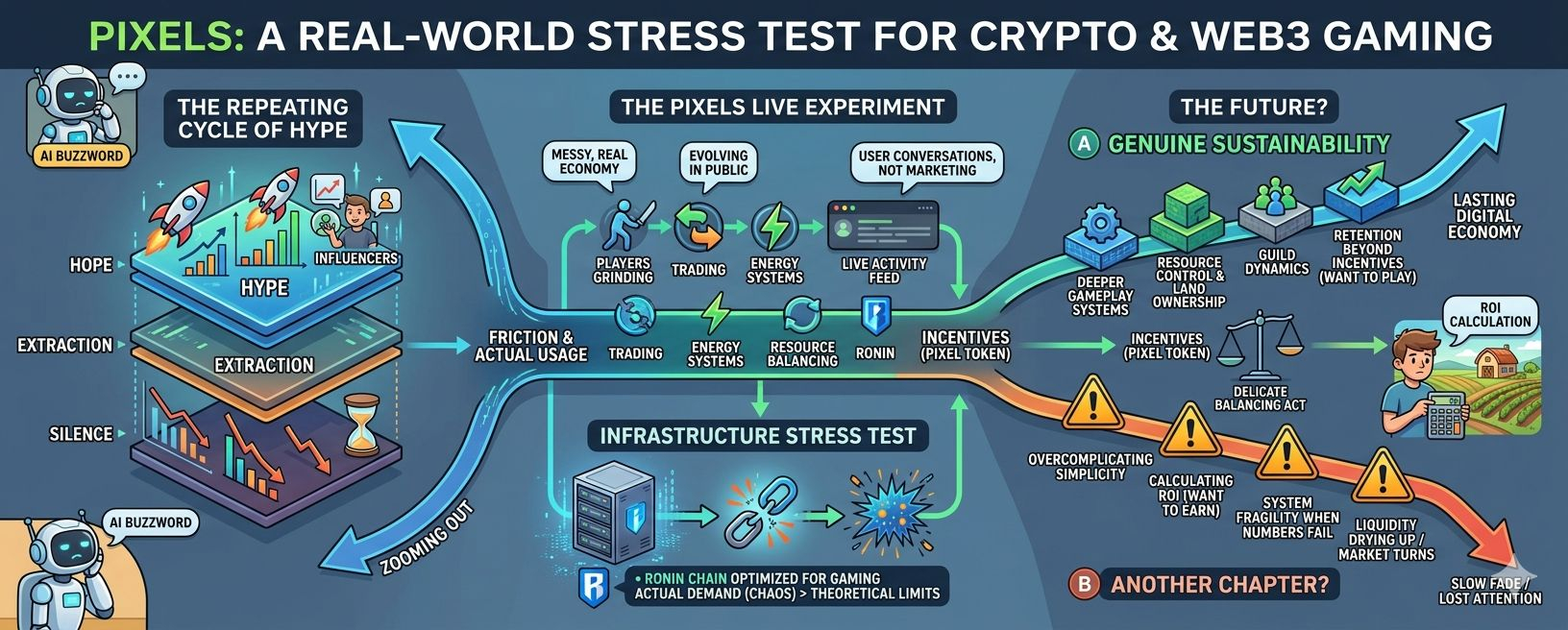

I’ve been staring at my screen for too long again, scrolling through the same recycled threads, the same “next big thing” takes, the same charts dressed up as destiny. It’s weird how crypto can feel both hyperactive and completely stuck at the same time. Every cycle pretends it’s different, but if you zoom out even a little, it’s the same emotional loop—hope, hype, extraction, silence. And somewhere in the middle of all that noise, I keep noticing these quieter projects that don’t scream for attention but just… keep building.
Pixels is one of those things I didn’t take seriously at first. I’ll be honest. When I first saw it, it felt like another “cute Web3 game” trying to wrap farming mechanics around tokenomics and call it innovation. I’ve seen that movie too many times. Slap NFTs on a simple gameplay loop, promise digital ownership, sprinkle in “community-driven economy,” and suddenly it’s supposed to be the future of gaming. Most of the time, it’s just spreadsheets pretending to be fun.
But I kept seeing it pop up. Not in the loud influencer circles, but in actual user conversations. People grinding. People trading. People complaining about energy systems and resource balancing like it actually mattered. That’s usually the first signal I pay attention to—not marketing, but friction. Real users create friction.
So I started watching it more closely.
Pixels runs on Ronin, which already tells you something about the direction here. Ronin isn’t trying to be everything to everyone. It’s very clearly optimized for gaming, and that focus matters more than people admit. Everyone loves to talk about “infrastructure breakthroughs,” but most chains don’t break because of bad tech—they break because real users show up all at once and stress everything in ways whitepapers never predicted. We’ve seen it over and over again. It’s never the theoretical limits that kill you. It’s actual demand.
And Pixels actually had that moment. When activity surged, when people piled in, when suddenly this “simple farming game” wasn’t so simple anymore because thousands of players were interacting with the same systems at the same time. That’s where things get interesting. Not in testnets. Not in curated demos. In chaos.
The game itself isn’t revolutionary if you describe it mechanically. You farm, you gather, you craft, you explore. It’s almost deliberately familiar. But that’s the point, I think. Instead of forcing players to learn some entirely new interaction model just to justify blockchain integration, it leans into what already works. The Web3 layer isn’t the front-facing gimmick—it’s underneath, quietly handling ownership, assets, and economy.
And yeah, that sounds like marketing language, but in practice it feels different. Mostly because players don’t talk about “blockchain features” when they’re playing. They talk about time, effort, and value. That shift matters.
Still, I can’t ignore the bigger pattern here. We’ve been stuck in this weird loop where AI is the new buzzword glued onto everything, even when it makes zero sense. AI-powered trading, AI-generated NFTs, AI companions in games that nobody actually interacts with long enough to care. It’s like the industry got bored of “metaverse” and needed a new costume.
Pixels doesn’t really lean into that, at least not in a loud way. And that alone makes it feel slightly more grounded. It’s not pretending to be some AI-driven revolution. It’s just trying to be a game that people don’t immediately abandon after the token incentives drop.
But let’s not pretend incentives aren’t still a huge part of it. They are. They always are.
The PIXEL token itself plays into the same delicate balancing act every GameFi project struggles with. Reward players enough to keep them engaged, but not so much that you destroy the economy. Create sinks, create demand, create reasons to stay beyond just farming tokens. It’s a fragile system, and most projects fail because they lean too heavily in one direction.
From what I’ve seen, Pixels is still figuring that out in real time. There have been adjustments, tweaks, rebalancing efforts. Some players love it, some get frustrated, some leave. That’s normal. Honestly, if everyone was happy all the time, I’d be more suspicious.
The more interesting part is how the ecosystem around it is evolving. Land ownership, guild dynamics, resource control—it’s starting to resemble a small, messy economy rather than a polished product. And messy economies are usually more real than perfectly designed ones.
But here’s the uncomfortable truth nobody likes to admit: most people in crypto still don’t want to play games. They want to earn from them. There’s a difference.
You can build the most engaging gameplay loop in the world, but if the majority of your user base is calculating ROI instead of enjoying the experience, you’re not building a game—you’re running a system. And systems are fragile when the numbers stop working.
That’s the part I keep going back to with Pixels. Are people actually here for the game, or are they here because it currently makes sense financially?
Because those are two very different kinds of retention.
The Ronin ecosystem helps, though. There’s already a precedent with games like Axie Infinity, for better or worse. People understand the environment. They know how to onboard, how to interact, how to extract value if that’s their goal. That familiarity reduces friction, but it also brings baggage. Everyone remembers how quickly things can spiral when the economy tilts the wrong way.
And then there’s liquidity. Always liquidity.
No matter how fun a game is, if players can’t easily move value in and out, things get weird fast. Prices distort, incentives break, and suddenly the whole experience feels off. Pixels has done a decent job so far keeping activity flowing, but that’s not something you solve once. It’s a constant pressure point.
Same with infrastructure. Even on a chain optimized for gaming, scaling isn’t just about transactions per second. It’s about user experience under load. Lag, delays, failed actions—those things kill engagement faster than any token crash. People don’t stick around to debug your system.
What I find myself respecting, though, is that Pixels doesn’t pretend to have everything figured out. It’s evolving in public. Updates roll out, systems change, sometimes things break a little. It feels more like a live experiment than a finished product. And in this space, that might actually be the more honest approach.
There are competitors, obviously. Other Web3 games, other ecosystems trying to capture the same attention. Some look more polished, some have bigger funding, some lean harder into narrative or graphics. But most of them still struggle with the same core issue: getting people to stay when the initial excitement fades.
Pixels, for now, seems to be holding attention longer than expected. That’s not nothing.
But I’m still cautious.
Because I’ve seen this phase before. The phase where a project finds product-market fit just enough to create momentum. Where engagement metrics look good, where community feels active, where updates are frequent. It feels like the turning point.
Sometimes it is.
Sometimes it’s just the peak before reality sets in.
The future updates they’re hinting at—expanding gameplay systems, deeper economy layers, more social features—those could push it into something genuinely sustainable. Or they could overcomplicate a system that currently works because it’s simple enough for people to understand.
That’s another trap. Adding complexity in the name of growth.
And then there’s the broader market. Because no project exists in isolation, no matter how much it tries to. If the market turns, if liquidity dries up, if attention shifts to the next shiny thing, even the most well-designed system feels the impact.
That’s the part people underestimate. It’s not always about building better tech. Sometimes it’s just about surviving long enough.
So yeah, I keep watching Pixels. Not because I’m convinced it’s the future of gaming, but because it’s one of the few projects that actually feels like it’s being used instead of just talked about. There’s a difference between activity and narrative, and right now, it leans more toward activity.
Still, I don’t trust anything in this space blindly anymore. Not the hype, not the metrics, not even the “organic growth” stories.
I trust patterns. And I trust friction.
Pixels has both.
Whether that turns into something lasting or just another chapter in the same repeating cycle… I don’t know.
It might actually evolve into a real digital economy where people stay because they want to, not because they’re calculating exits.
Or it slowly fades the moment the numbers stop making sense.
Right now, it’s somewhere in between.
And in crypto, that’s usually where the real story is.