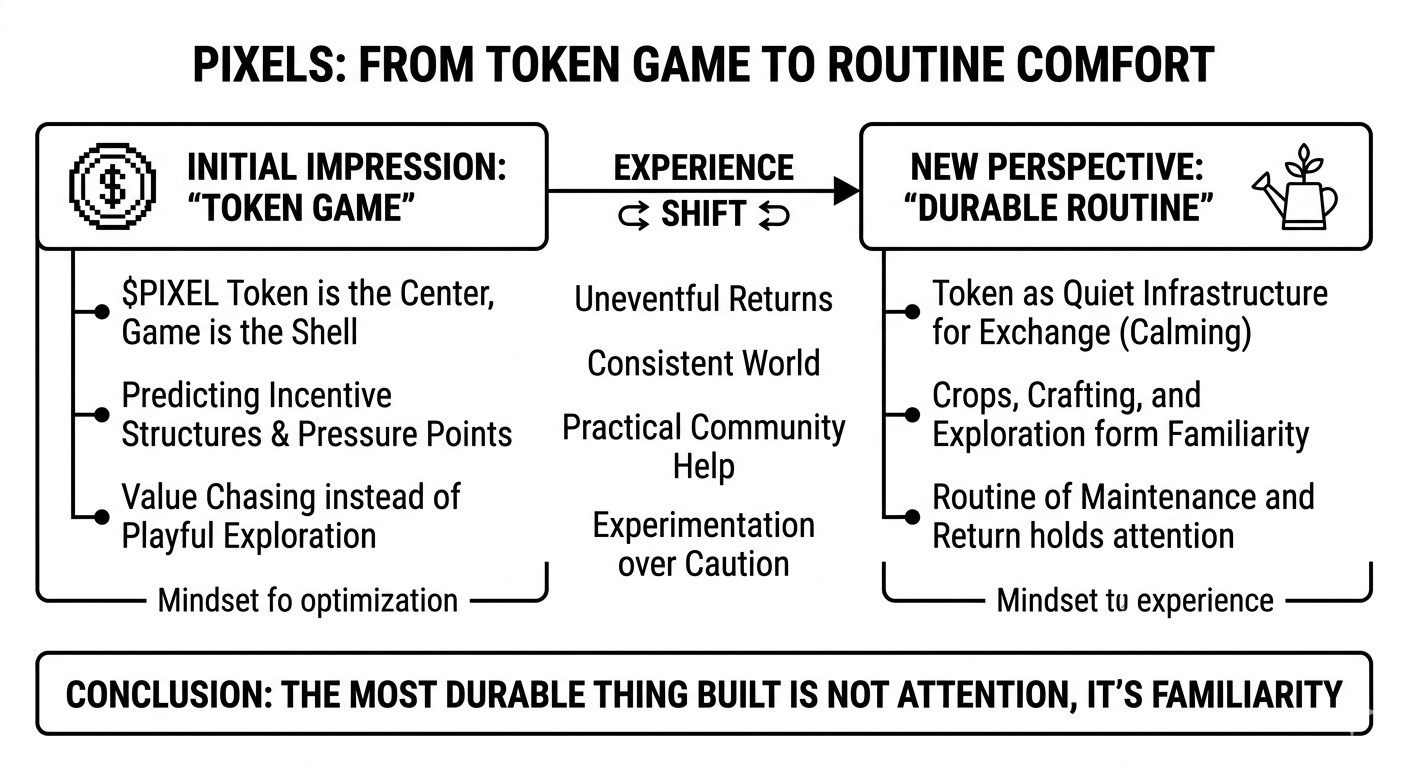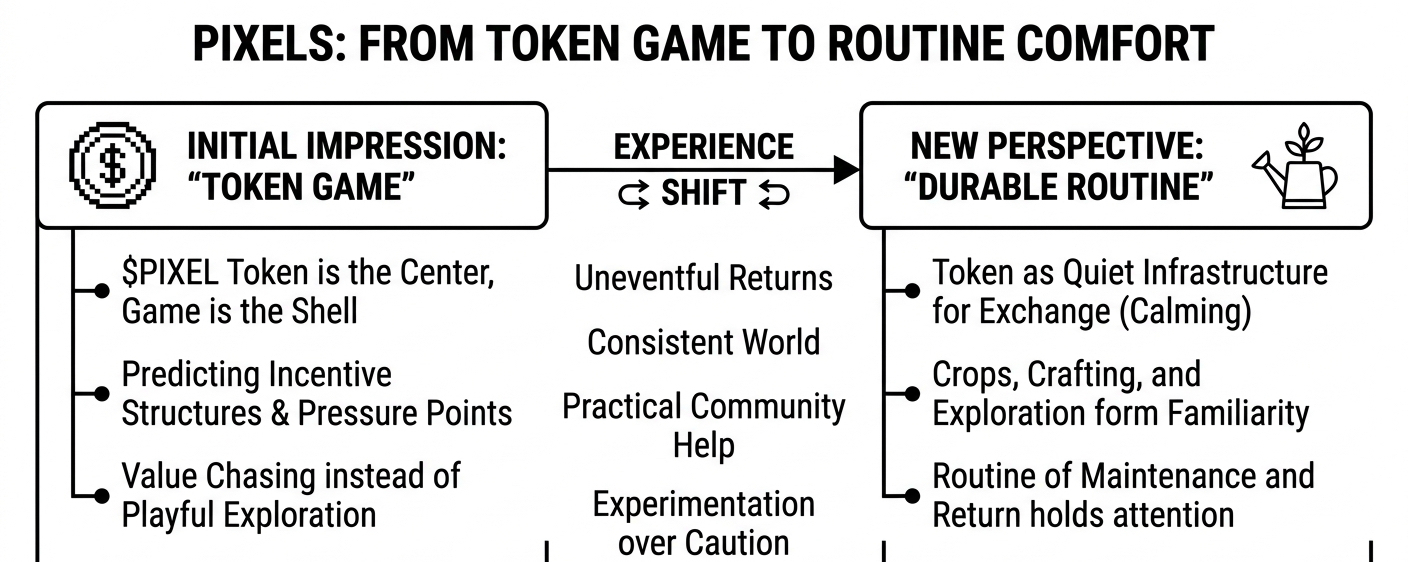
The first time I tried Pixels, I kept my expectations low in a familiar way. A social casual Web3 game on Ronin, open-world farming and crafting, with $PIXEL sitting there like the explanation you’re meant to remember later. The visuals were pleasant, the menu flow looked clean, and I understood what I was “supposed” to do. Plant, harvest, craft, wander. If I’m honest, I treated it like a quick item to classify. I assumed the token was the center and the game was the friendly shell.
That impression didn’t come from deep research. It came from my own habits. When I see a token connected to gameplay, my mind automatically looks for the incentive shape first. I try to predict where the pressure points would be: where people would chase value instead of play, where social would turn into a marketplace of attention. I thought I’d spend a short time in the world, confirm the loop, and then move on.
I didn’t move on right away. Not because I suddenly discovered some hidden mechanic, but because I kept returning in ways that felt… uneventful. I’d stop by for a small task and then stay a little longer, not because something urgent unlocked, but because the world felt consistent. Crops were ready when they should be. Crafting didn’t turn into a long interruption. Walking around didn’t feel like I was killing time waiting for the “real” part to start. Over a few sessions, I stopped measuring my visits in excitement and started measuring them in comfort.
That’s when my perspective shifted. I began watching what people did when they weren’t trying to impress anyone. In chat, the questions were usually practical and modest: where something could be found, how long a certain task tends to take, whether a location is worth the detour. When others answered, it wasn’t theatrical. It was the kind of help you give because you’ve done it before and you want someone else to get through it smoothly. Sometimes people shared their farms or their layouts, and it didn’t always sound like bragging. It sounded more like “this is what I liked,” even when there was no obvious reason to care.
In that context, $PIXEL started to look different to me. I expected it to be a constant emotional driver, the thing that people orbit and interpret everything around. Instead, it felt more like quiet infrastructure for exchange. When trading and crafting came up, the token was there to make those actions legible. But it didn’t invade the tone of play. It didn’t turn every click into a statement about value. It simply sat in the background, doing its job when needed and fading when not. I found that surprisingly calming.
Ronin, similarly, became something I noticed only by not noticing it. Because actions were quick and the friction stayed low, I stopped feeling like every choice was a decision with a heavy outside consequence. When the cost of small actions is small, you don’t feel pushed into carefulness from the start. You experiment. You try something “just to see.” You help someone with less hesitation, because the help doesn’t feel like a trade you must justify later.
Beneath the farming, exploration, and creation, Pixels seems to be about maintenance and return. The open world is not just a backdrop; it’s where routines overlap. Farming gives you a reason to return even when nothing dramatic is happening. Exploration gives you a way to move beyond your plot without turning it into a grind. Creation provides a personal footprint that accumulates over time, less like a trophy and more like evidence that you spent time here.
I think that difference matters because a lot of Web3 leans hard on narrative. It needs a story you can repeat quickly, a layer of excitement that explains why someone should care right now. Pixels, at least from what I’ve observed, feels more oriented toward usage than visibility. The infrastructure and the token mechanics recede enough that the real question becomes whether the place holds together across days, not whether it performs well under a spotlight.
I’m still not sure what the long-term balance will be. Communities change. Tokens pull attention in ways that aren’t always controllable. But I keep coming back to one quiet thought: if a game can make the token feel like background accounting and the world feel like a routine you genuinely want to resume, then maybe the most durable thing it builds isn’t attention—it’s familiarity. And I’m left wondering how many projects are actually designed for that, versus how many are just hoping it happens by accident.