
I remember a small moment that stuck with me more than any chart.
A friend of mine—he’s not even deep into crypto—started playing Pixels sometime last year. Nothing serious. Just farming, crafting, figuring things out slowly. A few weeks in, I asked him why he was still playing when the token hype had already cooled off.
He didn’t mention rewards. He didn’t mention profit.
He said, “It just feels like something is happening there even when I’m not online.”
That answer bothered me a bit, because it’s rare.
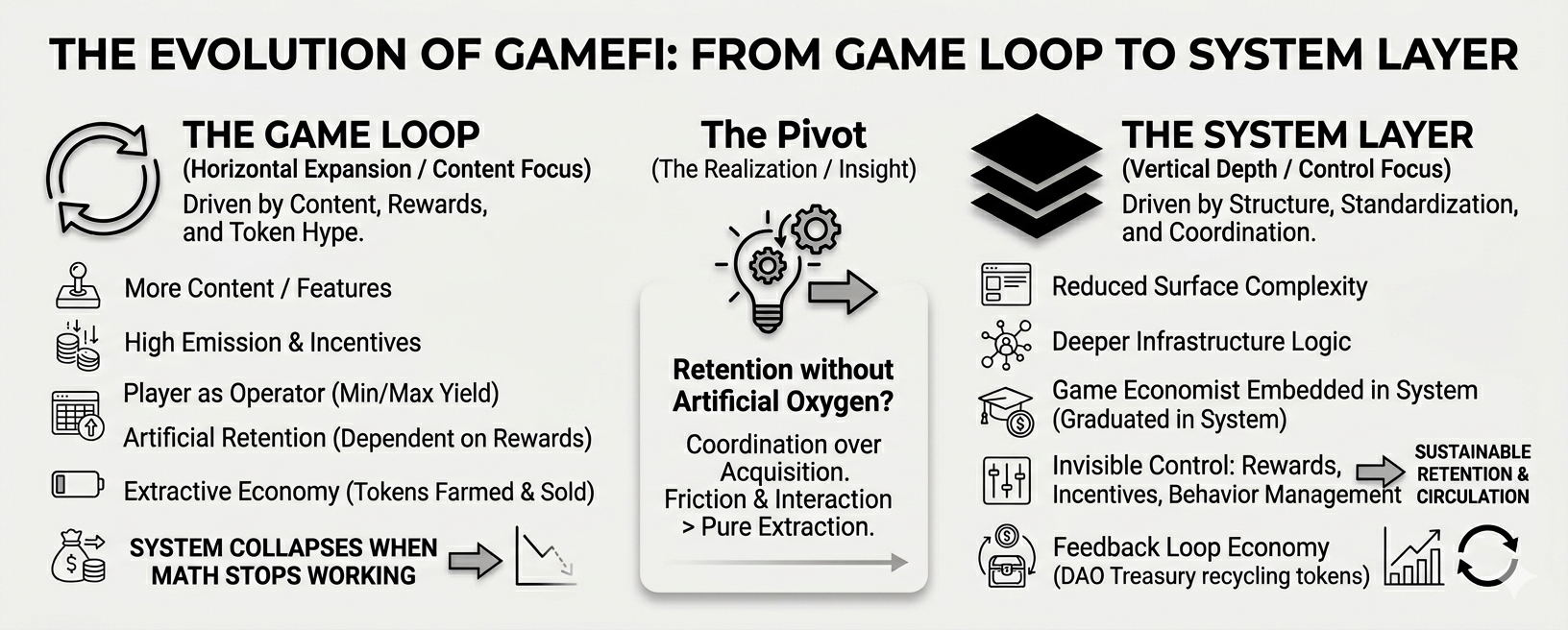
Most GameFi loops I’ve seen don’t survive that question. Players usually stay because something is being emitted to them. Remove that, and the system collapses into silence. I’ve seen this cycle repeat too many times—new game launches, incentives spike, dashboards look good, then slowly everything fades when the math stops working.
And that’s why this shift—from Pixels into something like Stacked—feels worth paying attention to, even if it’s not obvious at first glance.
Because the real problem was never TPS or which chain is faster. It’s retention without artificial oxygen.
I’ve personally tried “gaming the system” in multiple GameFi titles. At some point, I stopped thinking like a player and started acting like an operator—optimizing yield, calculating ROI, timing exits. That’s when the illusion breaks. You’re no longer playing a game. You’re managing a spreadsheet disguised as one.
Pixels, at least for a period, disrupted that pattern slightly. Not perfectly, but enough to notice. The economy wasn’t purely extractive. There was friction, but also interaction. Players weren’t just farming tokens—they were spending them, shaping the in-game economy in real ways.
And the data actually reflects that balance.
As of April 18, the PIXEL token is sitting at $0.00891, with a market cap of $6.87M and a 24-hour volume of $26.5M. FDV is around $44.5M, with 771M circulating out of a 5B total supply—about 15.42% unlocked so far. That’s important because it tells you something most people ignore: this system has already absorbed a large part of its dilution narrative.
Back in March 2024, PIXEL peaked around $1.02–$1.03 during the TGE phase. Now it’s down roughly 99%. On paper, that looks like failure. But in reality, it’s more like compression—two years of unlock pressure, GameFi fatigue, and liquidity shifts priced in early.
What’s left now is closer to the “real” state of demand.
And that demand isn’t purely speculative. In November 2024, for example, 22 million PIXEL tokens were distributed as rewards, and players spent about 50% of that—roughly $2M in value at the time. That’s not extraction. That’s circulation.
Even more interesting: the game reportedly reached around 1.2M daily active users with a 68% 30-day retention rate, compared to the GameFi average of ~35%. At one point, it peaked near 1.8M MAU.
That’s not normal for this category.
So when I look at Stacked, I don’t see it as “another feature.” I see it as a response to what happens when your system actually works—when thousands or millions of players behave unpredictably at the same time.
Because that’s the next problem.
It’s no longer about acquiring users. It’s about coordinating them.
Stacked seems to be designed not as a game layer, but as a control layer. Something that sits underneath and standardizes how rewards, incentives, and player behaviors are managed. Almost like a game economist embedded into the system itself.
And this is where things get subtle.
Most GameFi projects try to expand horizontally—more quests, more tokens, more mechanics. But this approach goes vertical. It reduces surface complexity and pushes logic deeper into infrastructure.
Not more features. More structure.
I noticed something similar in traditional systems too. A messy marketplace doesn’t scale by adding more sellers—it scales by improving the rules underneath. Payment systems, logistics layers, recommendation engines. Invisible things that make visible behavior more stable.
That’s what Stacked feels like.
But I’m still cautious.
Because I’ve seen beautifully designed systems fail the moment real users enter. Assumptions break. Incentives get exploited. Behavior doesn’t follow theory.
There’s also a token layer to consider.
With a circulating supply of 771M and a total cap of 5B, there’s still significant unlock pressure ahead. The next unlock on April 19, 2026, will release 91.18M tokens to advisors. Vesting schedules stretch out to around February 2029, with major allocations like Ecosystem Rewards (34%), Treasury (17%), and Private Investors (14%) still gradually entering circulation.
That means one thing: any sustainable growth must outpace dilution.
And that’s not easy.
Utility helps. PIXEL isn’t just a reward token—it’s used for VIP memberships, pet NFT minting, guild systems, cosmetics, and high-value crafting. Importantly, 80% of spent tokens go back to the DAO treasury, while 20% recycles into rewards. That creates a feedback loop rather than a leak.
But loops can still break.
So I keep coming back to that original question.
Is this balance something that can be engineered repeatedly? Or was Pixels just a rare alignment of timing, design, and user behavior?
And if Stacked is the attempt to “lock in” that balance as infrastructure… will it actually work when applied across different games with different player psychologies?
I don’t have a clean answer yet.
What I do see is a shift—from building games that distribute rewards to building systems that manage how those rewards behave over time.
That’s less exciting on the surface. But maybe more important underneath.
If you’re looking at this purely from a price perspective, it’s easy to dismiss. If you’re looking at it as an evolving system, it becomes harder to ignore.
So I’m curious how you see it.
Do you think GameFi needs more content… or better control layers?
And more importantly—can player behavior ever really be “standardized,” or is that the one variable that always breaks the model?
$PIXEL @Pixels #pixel $HIGH $REQ #ranRejectsSecondRoundTalks #AltcoinRecoverySignals? #ARKInvestReducedPositionsinCircleandBullish #RheaFinanceReleasesAttackInvestigation
