Nobody asked me to write about Pixels this week. I just kept thinking about something the team quietly dropped and felt like it needed to be said out loud.
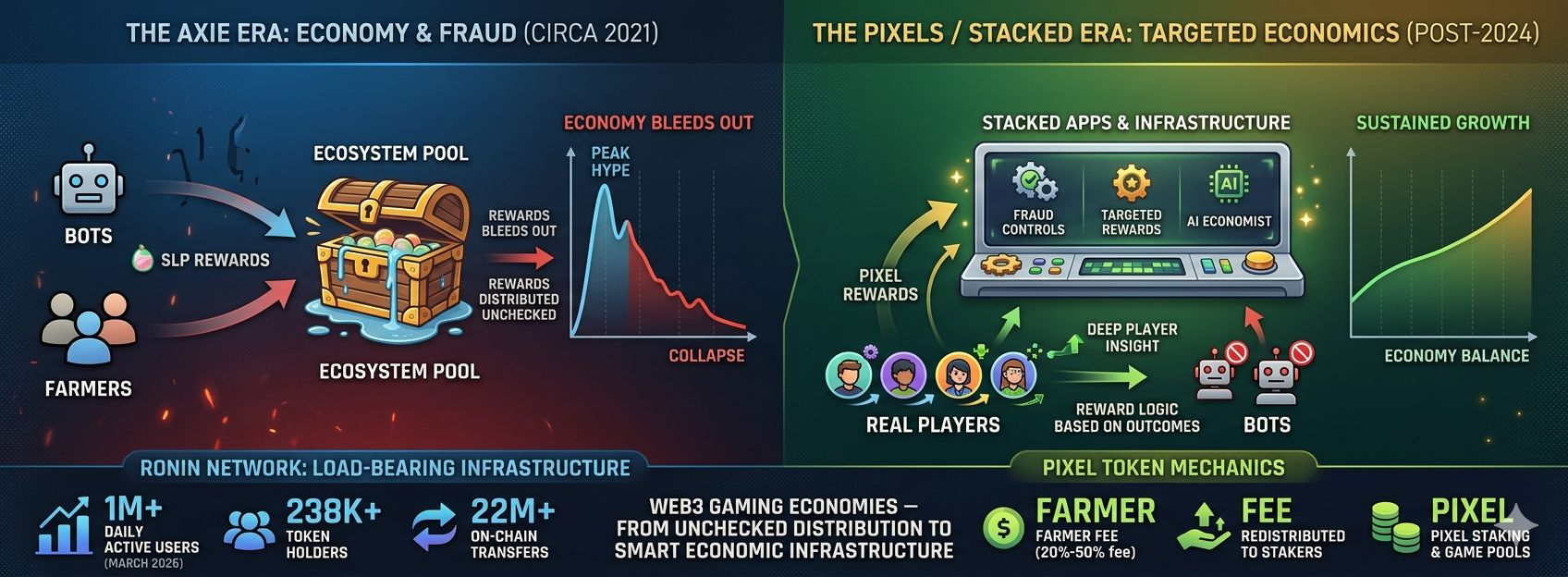
I've been watching Web3 gaming long enough to remember when Axie Infinity felt untouchable. Peak hype, millions of players, people in Southeast Asia quitting their jobs to farm SLP full time. Then the whole thing fell apart. Not overnight, but fast enough that most people never really understood why. In my view the core problem was simple. The team had no way to tell a real player from a bot. Rewards went to everyone. Bots cleaned up first. The economy bled out.
I keep coming back to that story every time I look at what Pixels just launched.
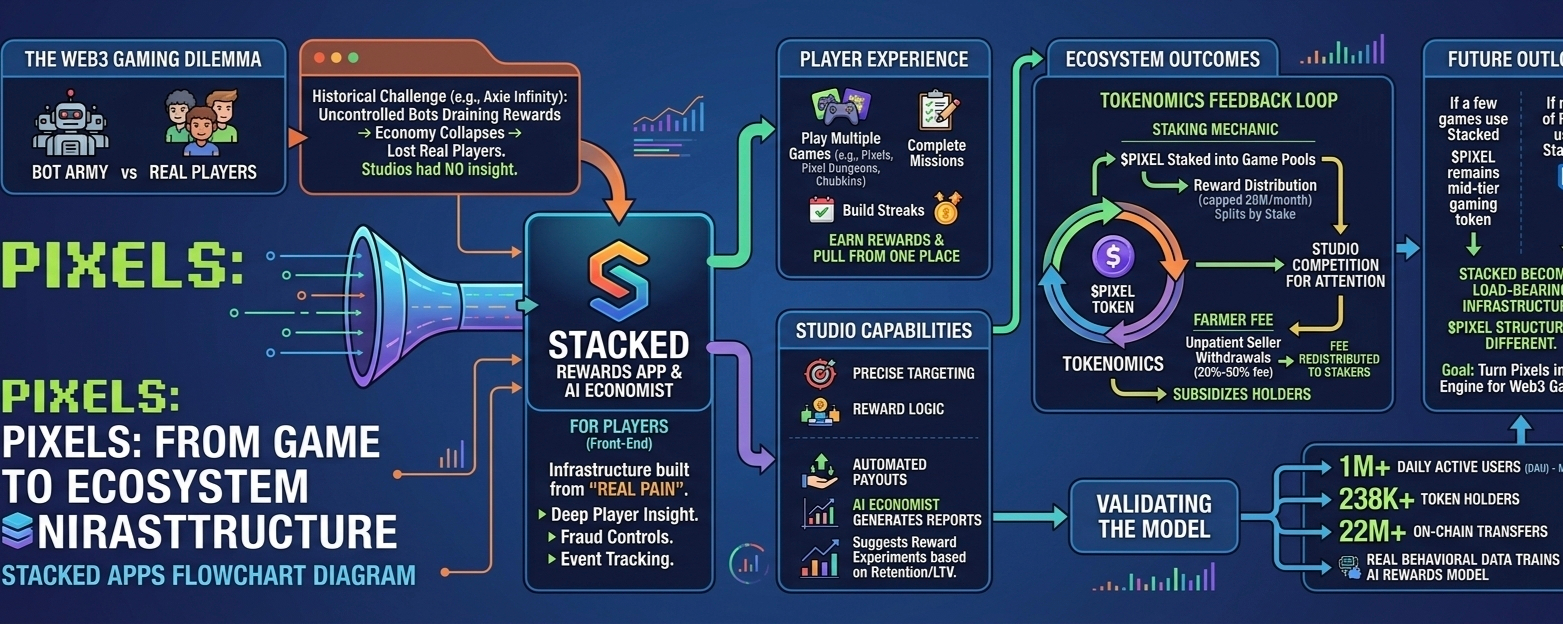
Stacked is a new rewards app built by the Pixels team. You play multiple games, complete missions, build streaks, earn rewards, and pull them all from one place. That description makes it sound basic. It is not. Under the hood, studios get deep player insight including event tracking, precise targeting, reward logic, fraud controls, and automated payouts. That is the part most people skimmed past.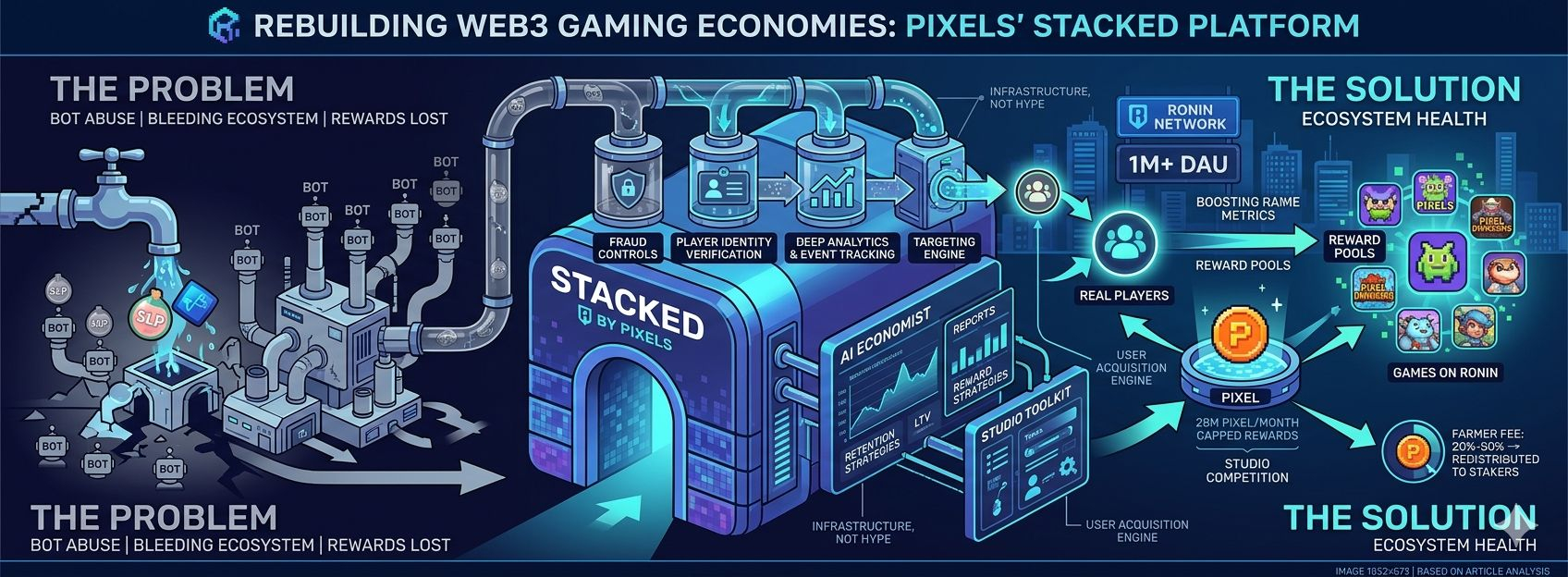
Think about what that actually solves. Every Web3 game team I have watched struggle with the same thing. They set up quests, load up reward pools, and then have no real way to measure whether any of it worked. Did that reward bring back a churned player or just feed a bot? Did it increase real spending or just inflate withdrawal numbers? For years nobody had the tooling to answer those questions honestly.
Pixels built Stacked because it is the infrastructure they wish they had from day one. That line hit me. Because it is a team admitting they built this out of real pain, not because some investor deck said it was a good idea. That kind of honesty is rare in this space and I think it matters more than people give it credit for.
Stacked also has an AI game economist built in. It generates reports, spots which player cohorts are worth targeting, suggests reward experiments, and helps studios build logic around outcomes they actually care about, like retention and lifetime value. For a small studio building on Ronin, that is a capability that would cost serious money to build independently. Pixels is handing it to them as part of the ecosystem.
This is where the pixel token story gets more interesting to me personally. Right now players stake $PIXEL into different game pools and earn from a monthly reward distribution capped at 28 million $PIXEL. The rewards split based on how much is staked per game, which means studios are actively competing for staker attention. That mechanic is quietly clever. Stakers end up directing capital toward the games they actually believe in, which creates a feedback loop between quality and reward flow.
Then there is the Farmer Fee that I think deserves more attention. If you want to withdraw $PIXEL directly, you pay a fee between 20% and 50%, and that fee gets redistributed to stakers. Every impatient seller is effectively subsidizing everyone willing to hold. I have not seen many GameFi projects think that carefully about sell pressure before token launch.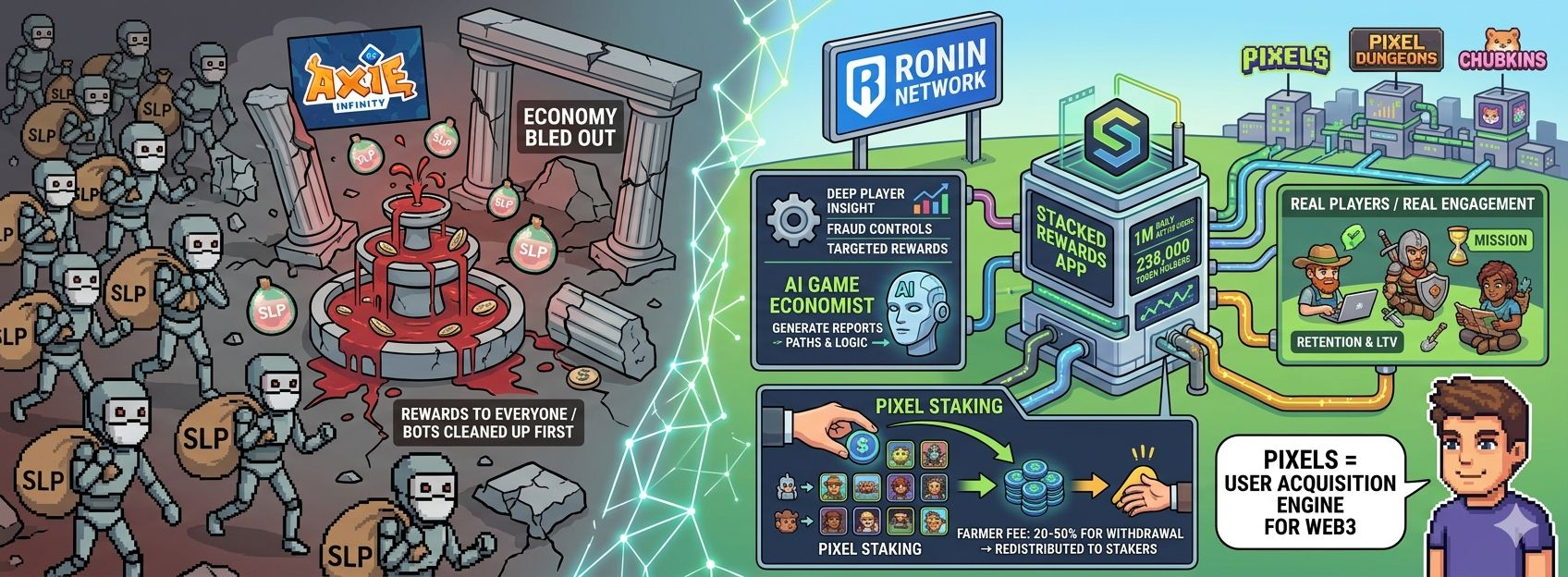
Pixels crossed 1 million daily active users in March 2026. And there are over 238,000 token holders and 22 million on-chain transfers recorded. Those numbers matter for Stacked specifically because the AI economist needs real behavioral data to be useful. You cannot train a rewards model on a ghost town. Pixels has the user base to make the tooling actually work.
From my experience the projects that survive long cycles in Web3 are rarely the ones with the flashiest gameplay. They are the ones that become load-bearing infrastructure for other builders. The Pixels team has already been running Stacked across Pixels, Pixel Dungeons, and Chubkins. Three games is a small start. But the plumbing is live and any studio on Ronin can now plug into it.
That shifts the question I think you should be asking about this project. It is not whether the farming loop is fun enough to hold attention. It is how many studios end up depending on Stacked to keep their own economies from falling apart the way Axie did.
If the answer is a handful of games, $PIXEL stays a mid-tier gaming token. If the answer is most of Ronin, it starts looking like something structurally different. And honestly, given that the founder has publicly framed the goal as turning Pixels into a user acquisition engine for Web3 gaming broadly I do not think that second outcome is as far fetched as the current price suggests.
What I keep sitting with is this. If Stacked becomes the default way studios run their economies on Ronin, does Pixels even need its own game to be the best product in the ecosystem anymore?