
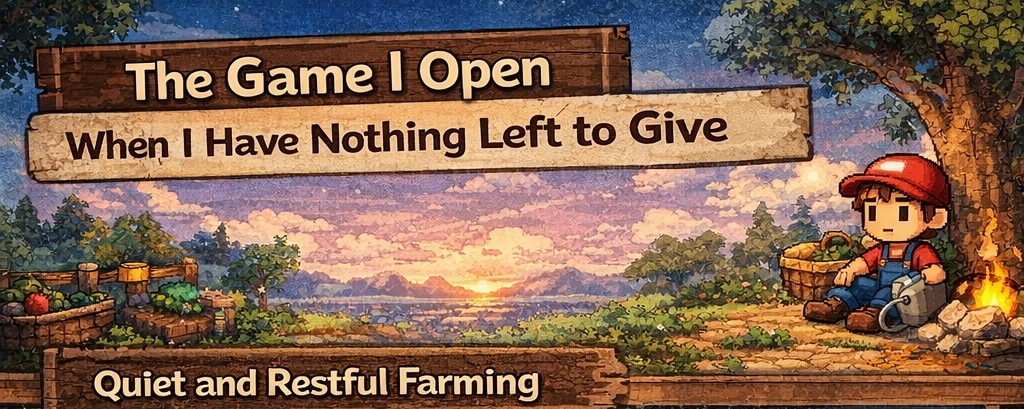
I remember the first time I genuinely looked forward to logging into Pixels. It wasn't because of the token price. It wasn't because someone told me to. It was a Wednesday evening. I had been staring at screens since morning and something in me just didn't want another thing that required real effort. I opened Pixels almost by accident. An hour later I realized I hadn't checked my phone once.
That said something to me.
There is a particular kind of exhaustion that has nothing to do with your body. Your legs are fine. You could technically go for a walk. But your mind has been running since morning. Emails, decisions, conversations that required more emotional energy than they should have. By the time evening arrives the last thing you want is another thing asking something of you.
That's the moment I started understanding why Pixels kept pulling me back.
It's a browser-based farming game built on the Ronin Network. Simple premise. You tend crops, gather resources, explore an open world, craft items and build something over time. On paper it doesn't sound like much. In practice it solves a problem that most games don't even try to address. What do you play when you're genuinely tired?
Most games are designed around urgency. Timers, enemies, objectives piling up faster than you can clear them. That design works when you have energy to spend. But after a long day urgency is the last thing you need more of. You've already been urgent. You've already been making fast decisions and managing other people's expectations and staying sharp when you didn't particularly feel like it. What you're looking for by evening isn't more of that. It's somewhere the pace belongs to you.
Pixels gives you that almost immediately. You log in and your crops are simply waiting. Not demanding, not about to expire in forty seconds. Just there, ready when you are. You harvest them. You plant the next row. Maybe you check on your animals, maybe you wander over to a crafting station, maybe you just walk around the map with no particular goal. The game doesn't punish you for moving slowly. It doesn't track whether you were efficient. It just holds space for whatever kind of session you showed up to have.
I've had sessions in Pixels where I was fully locked in, planning my resource strategy, thinking about land management and genuinely invested. And I've had sessions where I was basically just watching my character move around while my brain quietly switched off. Both felt worth it. That flexibility is more unusual than it sounds.
Game designers talk a lot about flow state, that zone where challenge matches skill and time disappears. But flow state assumes a consistent player. Pixels somehow accommodates an inconsistent one. You can be sharp and strategic one night and genuinely invested in your resource planning. The next night you can be barely present, just going through quiet motions, and the game remains just as welcoming. Both sessions leave you feeling like you did something. That's hard to engineer and easy to underestimate.
The visual language helps with this too. Pixel art when done with care doesn't demand full attention the way a photorealistic world does. There's no dense detail pulling at your focus and no cinematic lighting asking you to process and appreciate it. The world is clear and readable at a glance. Your eyes can rest even while your hands are moving. After hours of staring at screens filled with small text and complex information there's genuine relief in a game that doesn't visually overwhelm you. It sounds minor. It doesn't feel minor after a long difficult day.
Then there's the way Pixels handles its social features, which is with a kind of restraint you rarely find in this space. Guilds exist. Other players are around. Community is woven into the design in meaningful ways. But none of it is mandatory on any given evening. You can play quietly and privately without being penalized for it and without missing out on anything critical. Sometimes you want company. Sometimes you just want your farm and your thoughts. Pixels lets you choose without making either feel like the wrong answer.
What I noticed after a few weeks was that I never dreaded opening it. With a lot of games there's this invisible pressure. You feel behind, you feel like you should be performing better and you feel the weight of everything you haven't done yet. Pixels never gave me that feeling. Every session felt like I was picking up exactly where I left off, on my own terms and with no judgment waiting for me.
The blockchain elements add something that gets described wrong most of the time. Yes there are $PIXEL tokens. Yes your land is an NFT with real ownership attached. But what those mechanics create on a day-to-day level is a sense that your effort stays. You log off and the progress is still there. What you built over the past two weeks is still there waiting. In a digital world where so much disappears there's something quietly satisfying about a game that holds onto what you did.
That permanence is part of why returning feels easy. You're not restarting. You're continuing. And continuing something, even something unhurried and small, gives each session a meaning that pure entertainment doesn't always provide.
What Pixels really offers after a long day isn't escape. Escape implies running from something. This feels more like a change of register, moving from a world built around demands into one where your only obligation is to a few crops and a loose plan you made for yourself.
Some games you play when you're feeling alive and sharp. Pixels is the one you return to when you need somewhere quiet to put the day down. I found that out on a Wednesday evening without even looking for it. Ten million other people seem to have found it too, each in their own way and each for their own version of the same reason.