
I keep coming back to one simple thought after looking at Tier 5…
When does a game stop feeling like a place…
and start feeling like a mechanism?
Because honestly, the more layers Pixels adds, the harder that line becomes to see.
At first glance, Tier 5 looks familiar.
New tier. New materials. New recipes.
Nothing surprising.
But the more you sit with it, the more it feels like something deeper has shifted. Not just content… but behavior.
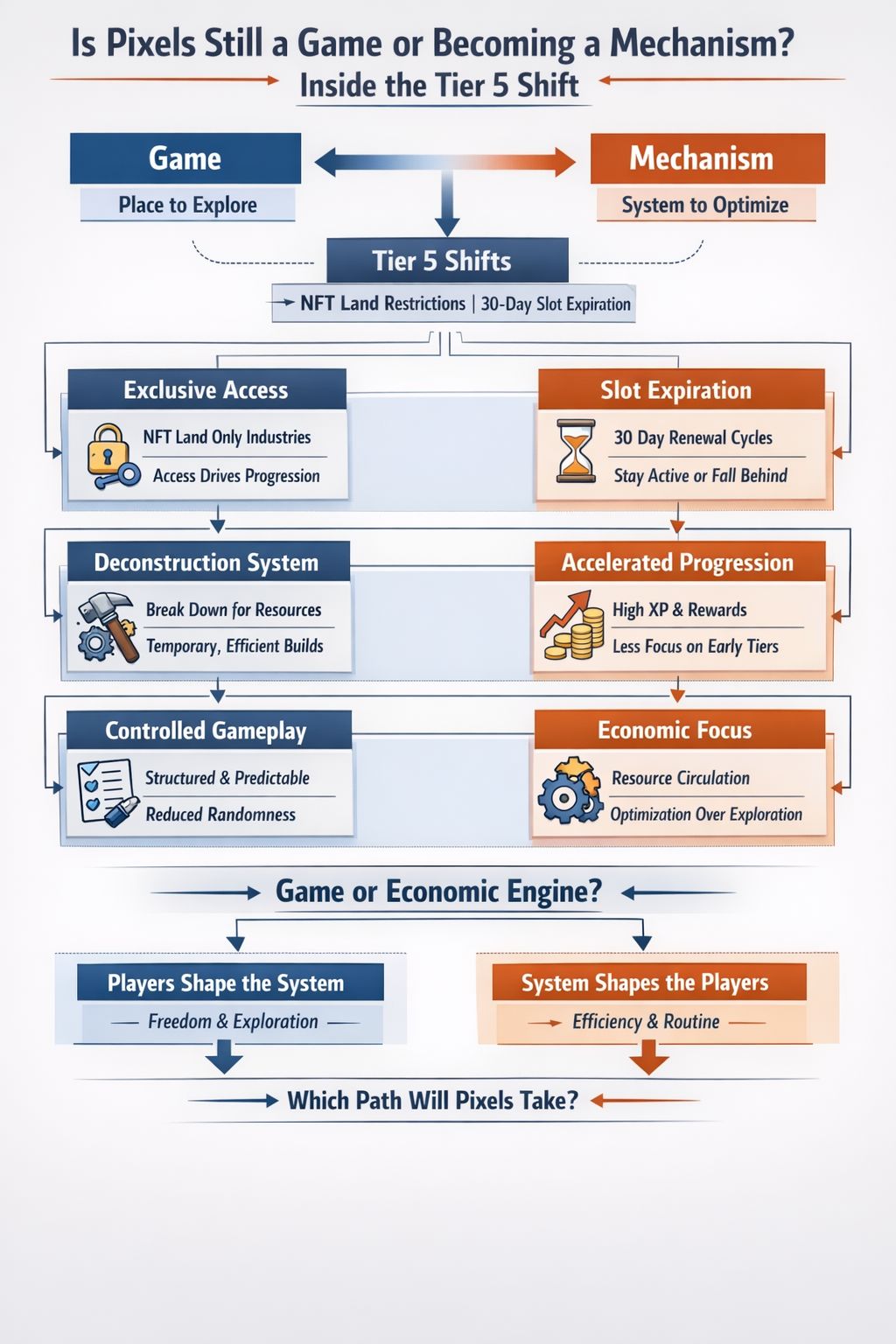
Take the NFT land restriction for Tier 5 industries.
It’s a small rule on paper—but it changes everything.
Suddenly, not everyone is playing the same game anymore. Access itself becomes part of progression. It’s not just about time or effort… it’s about where you exist in the system.
And then there’s the 30-day slot expiration.
No loud pressure. No forced action.
But there’s a quiet message behind it: stay active, or fall behind.
It doesn’t push you… but it nudges you just enough to keep you moving.
And that’s where it gets interesting.
You’re no longer just playing for rewards—you’re maintaining your position.
The deconstruction system is where things really start to feel different.
Before, the loop was simple: build, upgrade, grow.
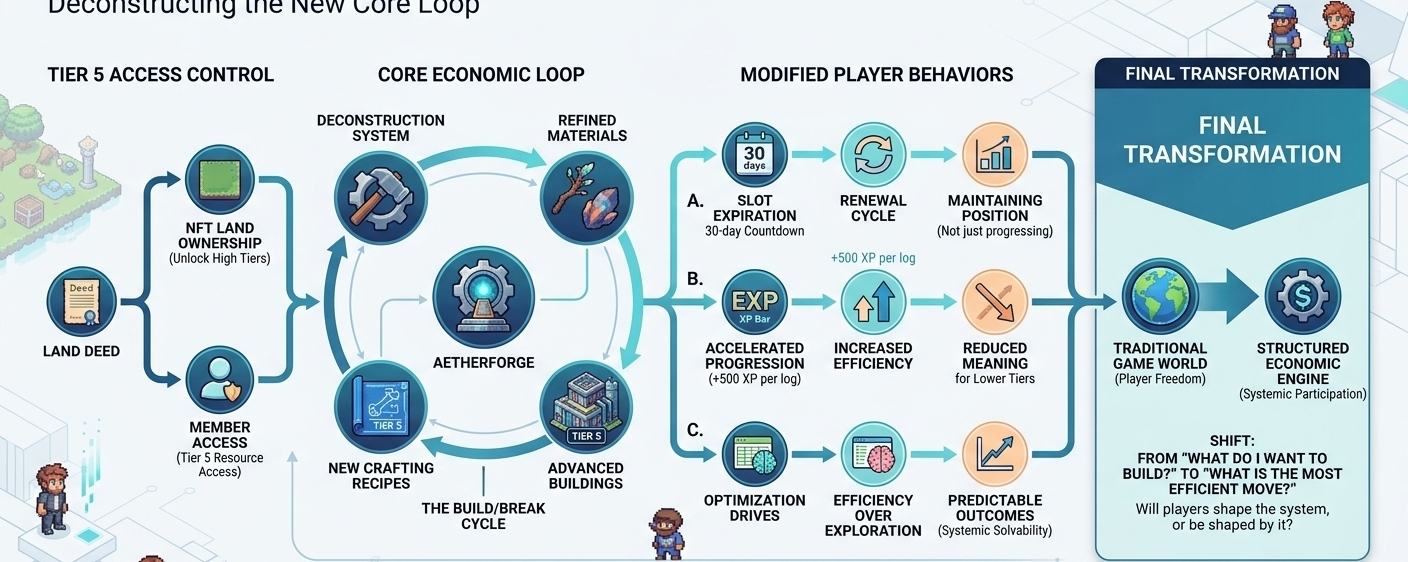
Now it’s: build… break… extract… rebuild.
Progress doesn’t just come from creating—it comes from destroying what you already made.
And I can’t help but wonder…
If everything you build is eventually meant to be broken, do you still feel attached to it?
Or does it all start to feel temporary?
From an economic perspective, it actually makes a lot of sense.
Resources like Aether Twig or Aetherforge Ore don’t just appear—they come from deconstruction. That means materials circulate instead of being artificially limited.
It’s smart. It keeps the economy alive.
But emotionally?
It changes how you think.
You stop asking, “What do I want to build?”
And start asking, “What’s the most efficient move?”
That shift shows up everywhere.
Fishing is more structured now—tiers, durability, access control. It’s clean, predictable.
Forestry XP at higher tiers jumps massively—500 XP per log.
That’s not just progression… that’s acceleration.
And when higher tiers become that rewarding, something else quietly happens…
Lower tiers start to feel less meaningful.
So what does a new player experience?
A journey?
Or just a long climb to where the real game begins?
Another thing I noticed… the randomness feels reduced.
Everything is more controlled. More designed.
And while that helps stability, it also raises a question:
When everything is predictable… does the world still feel alive?
Or does it start to feel like a system you’ve already solved?
Then there’s time.
Slot expiration. Renewal cycles. Efficiency paths.
Nothing forces you to log in—but the system definitely has a rhythm.
And whether you realize it or not… you start syncing with it.
So the question becomes:
Are you playing because you want to?
Or because the system quietly expects you to?
Don’t get me wrong—what Pixels is doing here is impressive.
This isn’t random feature stacking.
It’s deliberate design.
Resources, behaviors, incentives… everything is connected.
It feels less like a traditional game update—and more like building an economic engine.
But that’s also where the tension lives.
Because as the system gets stronger… the “game feeling” becomes more fragile.
Not everyone wants to optimize every move.
Some players just want to exist in the world. To explore. To take things slow.
And right now… it’s not clear how much space is left for that.
Maybe this is just the next step.
Maybe players will adapt, find balance, and shape the system in their own way.
Or maybe the system will keep evolving—getting sharper, tighter, more efficient…
Until one day, you realize you’re not really playing anymore.
You’re just… operating within it.
That’s why Tier 5 feels important.
Not because of what it adds—
But because of what it changes.
Pixels isn’t just building a game anymore.
It might be building something bigger…
Something between a game and an economy.
And the real question is still open—
Will players shape this system?
Or slowly be shaped by it?