
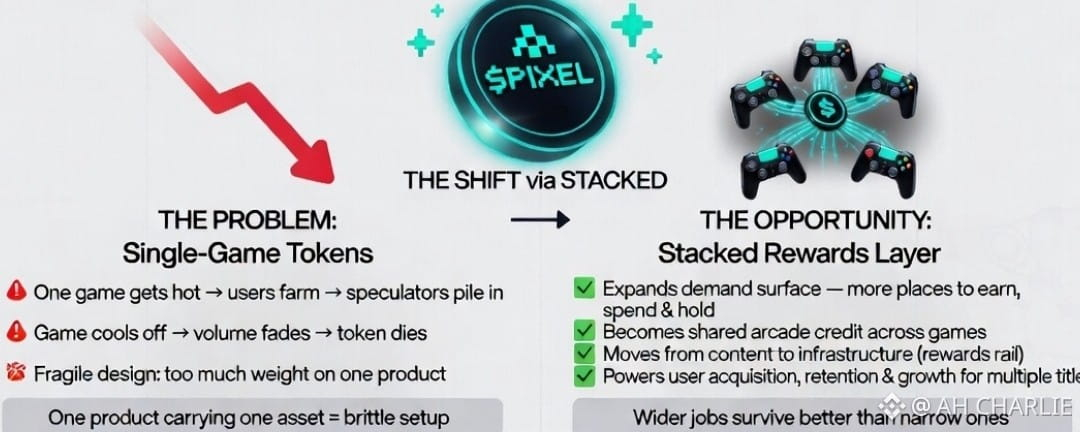
Most game tokens die the same boring death. One game gets hot. Users farm it. Speculators pile in. The token looks useful for five minutes because everything in that tiny world points back to it. Then the game cools off, volume fades, and the token is left sitting there like a mall built for a city that never came. That is the real problem with single-game tokens. Not the charts. The design.
One product carrying one asset is a fragile setup. Too much weight on one pair of legs. That is why the shift around PIXEL matters. Not because “ecosystem” is a magic word. It is not. People slap that label on anything with two partnerships and a logo wall. What matters here is simpler. PIXEL is being pushed beyond one closed loop and into a wider reward layer across more games through Stacked. That changes the utility story. Maybe the investment story too. Quietly. No fireworks needed.
The first thing this does is expand demand surface. It just means more places where the token can be needed, earned, spent, or held. In a one-game model, token demand lives and dies with that one game’s player base. If the game stalls, the token gets lonely fast. But if Stacked helps plug PIXEL into several titles, then demand is no longer tied to a single gameplay loop. It starts acting less like one game’s ticket and more like shared arcade credit.
That matters because shared currency systems usually hold attention longer than isolated ones. A player who loses interest in one title might still stay inside the network if another game catches them. So the token does not need every user to love the same product forever. It just needs the network to keep circulating attention. Big difference. One is fragile loyalty. The other is flow. Still, let’s not get drunk on the theory.
More integrations do not automatically mean real token strength. A lot of projects expand sideways and call it growth. If new games bring low-value users, weak retention, or reward tourists who only show up for free stuff, then wider usage can just mean wider leakage. More doors. Same empty room.
The second piece is where the model gets more interesting. And a bit more serious. If Stacked becomes the layer that handles reward logic across multiple games, then PIXEL is no longer just attached to content. It starts attaching to infrastructure. That is stronger. Content is emotional. Players are fickle. Infrastructure, when it works, can outlast mood swings. It becomes the plumbing.
Nobody posts heroic threads about plumbing, but buildings collapse without it. That is the cleaner bull case here, if one exists. Not “this token powers fun.” That line is soft. Too soft. The sharper case is that PIXEL could become the rewards rail for a network of games that want user acquisition, retention, and behavior shaping without building their own full incentive stack from scratch. In plain words, the token may move from being a game item to being part of the operating system behind growth.
That gives it a wider job. And wider jobs tend to survive better than narrow ones. But this is where I get skeptical, because humans love pretending that expanded utility and durable demand are the same thing. They are not. A token can be used in ten places and still be weak if nobody truly needs to hold it, if rewards get dumped fast, or if the whole system depends on constant emissions to keep moving.
You can spread a thin layer of butter across more bread. You still do not have a feast. So the real investment question is not just whether PIXEL appears in more games. It is whether those integrations create sticky behavior. Do players stay inside the network longer? Do games actually want to keep using the reward rail?
Does value circulate back instead of leaking out the second rewards hit wallets? Can PIXEL become part of a repeating loop, not just a temporary incentive? That is the test. Everything else is decoration. My Observation? Expanding PIXEL beyond a single game is the right move. Honestly, it may be the only move that gives the token a chance to mature.
Single-game assets are usually too brittle. One content miss and the whole structure wobbles. A cross-game reward currency has a better shot because it spreads risk, widens usage, and gives the token more than one reason to exist. But I would not call it proven. Not yet. I see the logic. I respect the direction. I also think the market should stay cold-eyed here. Cross-ecosystem tokens sound smart on paper.
The hard part is making that network produce real recurring demand instead of recycled reward farming with better branding. That is where this either becomes a real asset layer or just another busy token with a nice story. So, well, that is the setup. PIXEL is trying to leave the one-game cage. Good. Now it has to prove it can survive in the open.
@Pixels $PIXEL #pixel #Web3Gaming
