
@Pixels What makes Pixels interesting to me is that it does not feel like it is following the same lazy GameFi formula we have seen fail over and over again. At a distance, it is easy to dismiss it. The visuals look familiar, the farming theme feels safe, and at first glance it seems like another colorful play-to-earn setup dressed up to attract attention before the usual cycle begins. We have all seen that version before: a token launches first, rewards start flowing, people arrive for extraction instead of gameplay, and sooner or later the whole system starts collapsing under the weight of its own emissions. That is exactly why Pixels stands out a little more than people expect, because underneath the simple surface, it feels like they are at least trying to solve the right problem instead of repeating the same broken template.
What separates it from most projects in this space is that Pixels seems to understand a very basic truth that many GameFi teams ignored for too long: if the game is not interesting on its own, no token model can save it. A lot of projects built economies before they built reasons to care. Pixels, on the other hand, seems to have started by creating something people might actually spend time in without being forced to calculate yield every five minutes. That matters. It changes the foundation. Instead of building a token and then desperately searching for activity to justify it, they built an environment first and layered the economy on top of that. It does not make the model perfect, but it does make it more credible than most of what came before it.
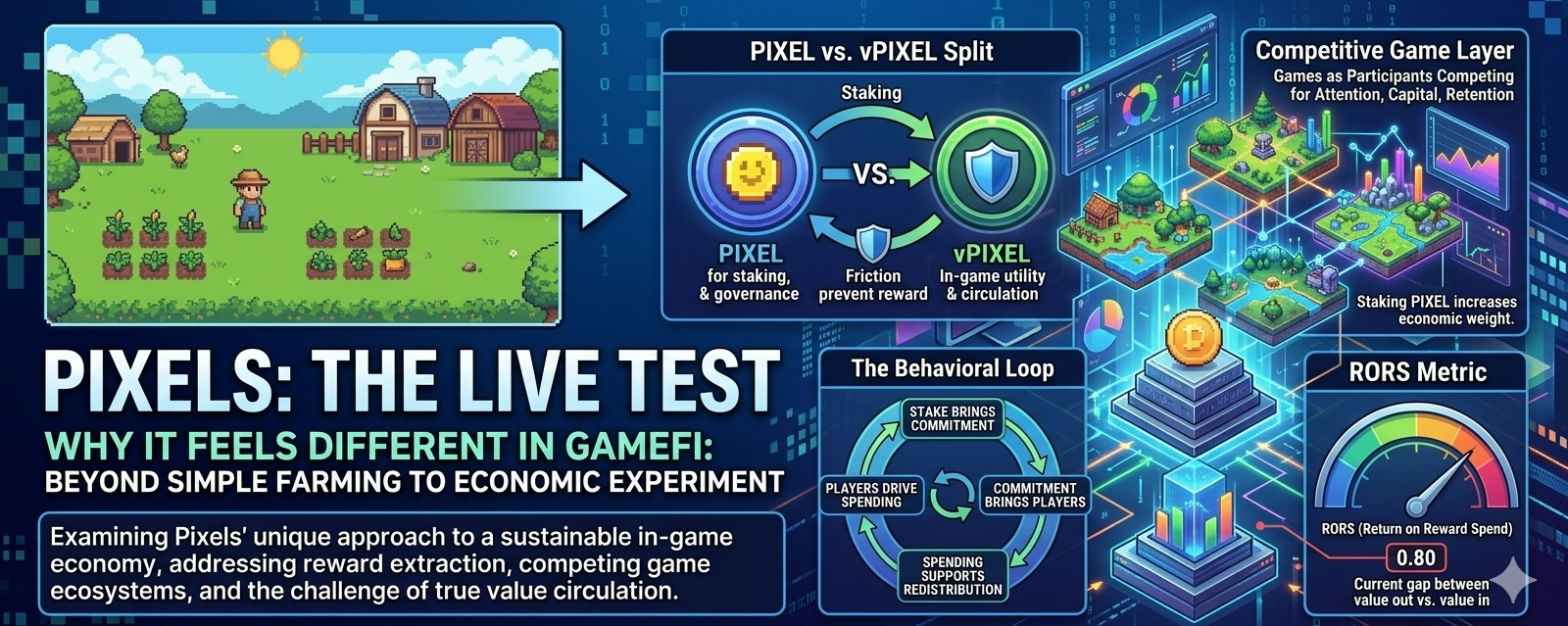
The deeper you look, the more it starts to feel like Pixels is experimenting with something bigger than just a game. The platform is slowly turning gameplay into a competitive economic layer where games are not simply content anymore, but active participants inside a system competing for attention, capital, and retention. When PIXEL gets staked into a game, that game is no longer just an experience sitting there waiting to be played. It gains economic weight. It has pressure on it. It has to prove that it can attract real users, keep them engaged, and create actual spending behavior instead of temporary farming traffic. If a game fails to hold attention, stake leaves. If it succeeds, it begins pulling in players, activity, and value, almost like a small economy trying to survive inside a larger one. That shift is what makes Pixels feel more ambitious than the average GameFi project, because it is no longer just asking whether rewards attract users, but whether competition between games can create stronger ecosystems over time.
The token structure also shows that they are at least thinking more carefully about the usual failure points. The split between PIXEL and vPIXEL might sound like the kind of thing people are tired of hearing, but in this case it serves a real purpose. One of the biggest problems in GameFi has always been immediate reward extraction. Players farm, claim, dump, and move on. That behavior destroys charts, weakens confidence, and kills sustainability before any real economy has time to form. vPIXEL changes that dynamic by keeping earned value circulating inside the ecosystem rather than allowing every reward cycle to become a direct sell event. It does not eliminate the pressure completely, but it slows the damage and creates a better chance for value to be reused instead of instantly removed. In a sector where most systems bleed out because there is no friction between rewards and exits, even that kind of design choice feels more thoughtful than average.
What really makes the project worth watching, though, is that Pixels seems to be testing actual behavioral loops rather than relying on hype and surface-level growth metrics. The core idea is not complicated: stake brings commitment, commitment brings players, players drive spending, spending supports redistribution, and redistribution strengthens the reason to stake again. A lot of teams have described loops like that before, but very few have shown any real interest in measuring whether those loops hold up under pressure. Pixels seems more focused on whether users stay, whether they spend, whether the system produces meaningful retention, and whether the economy can gradually support itself instead of constantly depending on fresh emissions to look healthy. That is a much more serious question than simply asking how many wallets showed up this week.
This is also why the RORS metric matters so much. It cuts through the noise and gets closer to the real health of the system. The simplest way to understand it is to ask whether the value being handed out is actually returning in any meaningful way. If incentives bring people in but those people do nothing except claim rewards and disappear, then the system is leaking. If they arrive, play, spend, and contribute to the in-game economy, then the rewards are doing their job. Pixels sitting around 0.8 means the machine is not fully working yet. For every dollar going out, only about eighty cents is making its way back. That is not a disaster, but it is not sustainable either. It tells you there is still a gap between user acquisition and real economic conversion. And honestly, that kind of transparency is refreshing, because it shows the project is not pretending everything is solved when it clearly is not.
To their credit, Pixels does seem aware of where things went wrong early on. Inflation was too loose, too much value was being extracted by opportunistic participants, and the system behaved exactly how most GameFi systems behave when rewards outrun real demand. That part is not unique. What makes Pixels more interesting is that they did not just sit there and let the model keep decaying. They started adjusting. They pushed staking into more competitive game dynamics, reworked reward structures, and began treating mobile expansion like a necessity rather than an optional growth angle. That suggests a project that understands survival in this category is not about short-term excitement. It is about refining the loop until the economy starts supporting the gameplay instead of suffocating it.
That is why I do not think Pixels should be framed as some guaranteed winner or some miracle project that has already solved GameFi. It has not. It is still early, still messy, and still carrying the same risks that hang over almost every tokenized gaming experiment. But at the same time, it feels unfair to place it in the same bucket as projects that never even tried to address the core problem. Pixels is asking better questions. It is experimenting with stronger mechanisms. And most importantly, it seems to understand that real sustainability will not come from emissions, branding, or temporary hype. It will come from whether the system can make users want to stay even after the easy rewards lose their shine.
That is what makes Pixels worth paying attention to. Not because it has already won, but because it seems to be one of the few GameFi projects seriously trying to figure out what a working game economy could actually look like. If they can push that value loop into something durable, improve the balance between incentives and real spending, and move key metrics like RORS above break-even, then Pixels could become more than another interesting case study. It could become proof that this model still has a future. And if it fails, it will not be because the project was empty from the start. It will be because even the smarter experiments in this space are still fighting against a structure that is incredibly hard to sustain. Either way, Pixels feels less like another recycled play-to-earn promise and more like a live test of whether GameFi can finally grow up.