
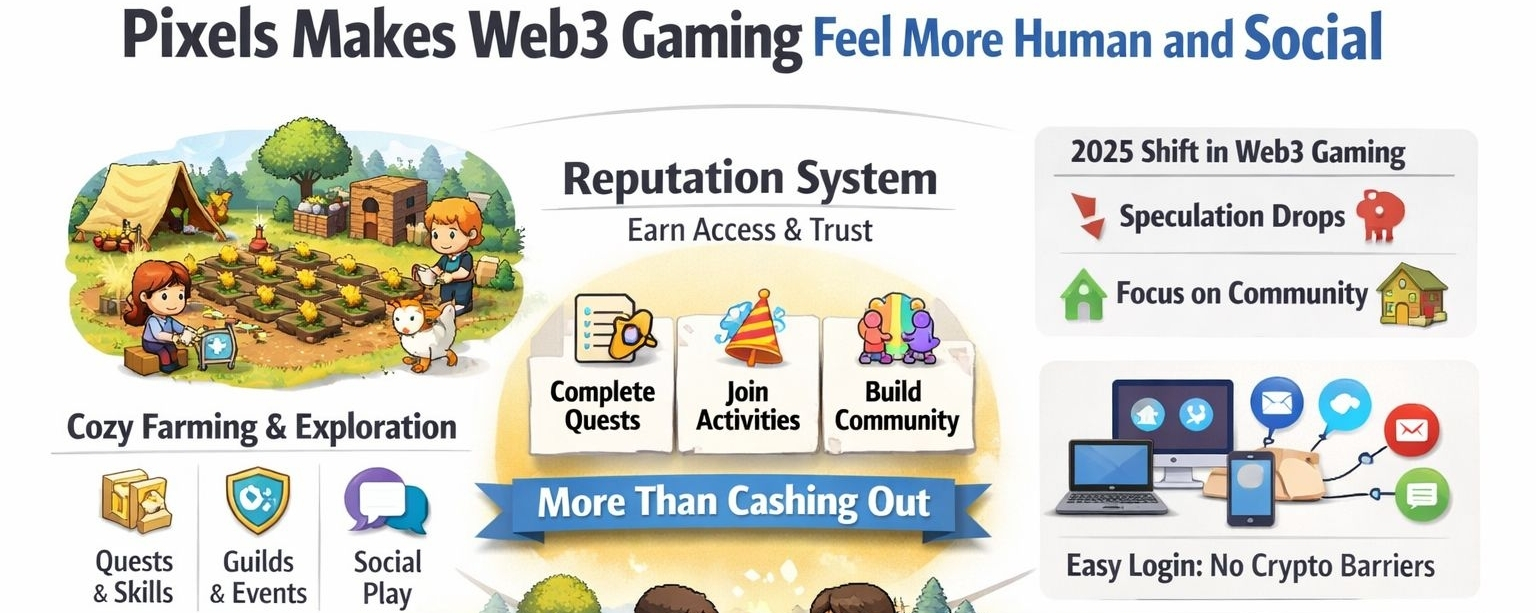

I used to assume web3 gaming was mostly a layer of wallets and tokens with marketplace menus pasted on top of ordinary game design. The more I look at Pixels the more I think the interesting thing about it is actually the opposite because what stands out to me is not that it uses blockchain but that it tries to make the whole experience feel like a place where people can settle in and recognize each other while building small routines together. Pixels describes itself as an open-ended world of farming and exploration shaped by gathering and skill-building along with relationships and story and quests which matters because it begins from a social rhythm instead of a trade screen. It is also free to play and works on mobile while allowing regular browser access with social login as well as email or phone connections which lowers the feeling that a person has to enter crypto before they can simply show up and play.
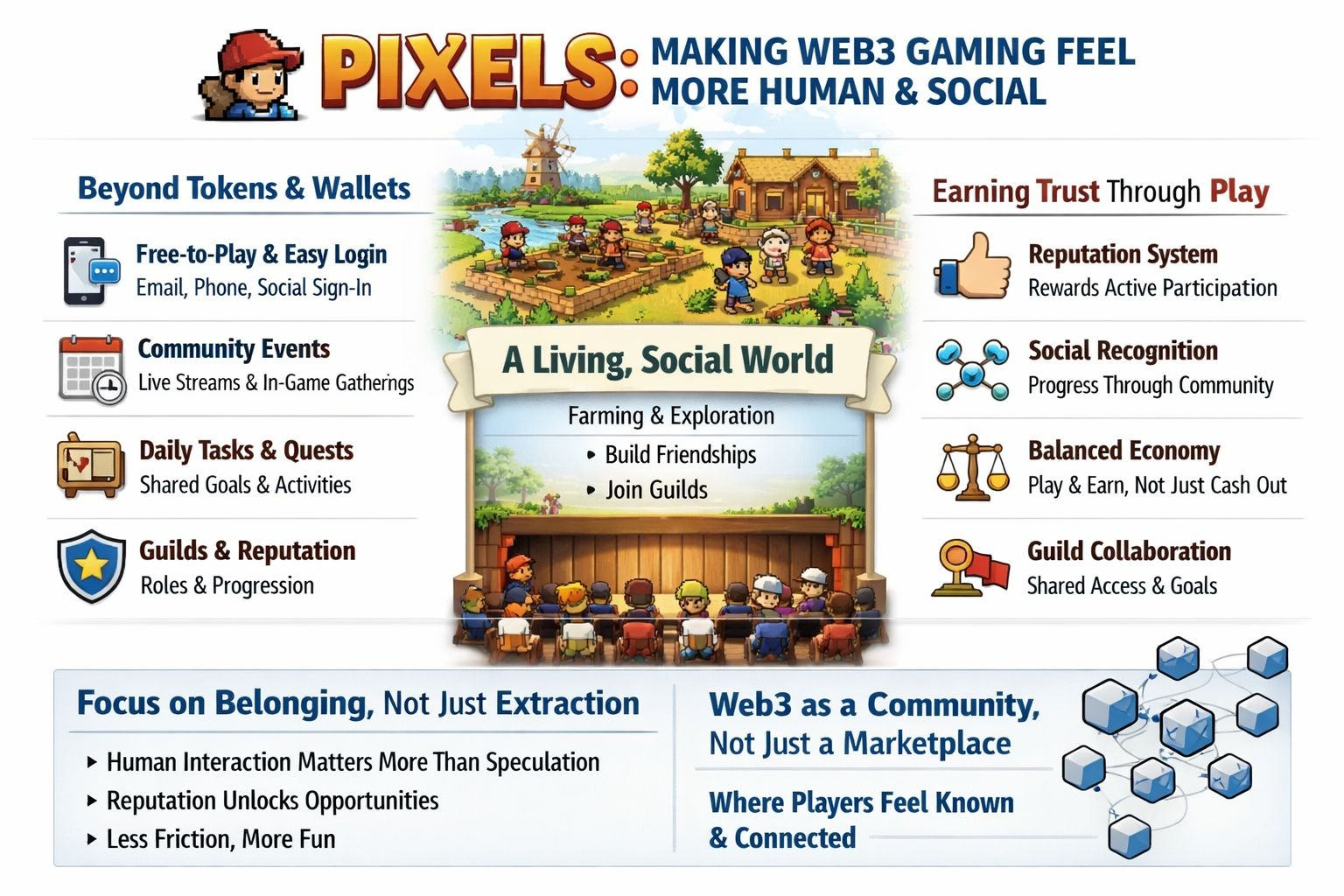
I find it helpful to look at Pixels less as a tokenized farm game and more as an attempt to make online presence feel visible in a human way. A lot of its design choices move in that direction because the game has leaned on daily task boards and community events along with live streams and weekly live sessions inside its in-game theater. That may sound modest at first but modest is exactly the point since these are not grand promises about the future so much as reasons for people to come back and notice each other while developing a shared sense of what is happening today. Even the smaller details matter here because older updates brought back floating chat bubbles and added email and phone login while continuing to refine the spaces where players gather. Guilds also play a big role since free-to-play players can join them to reach higher-tier resources while the broader guild system includes roles and land access along with shards and verified guilds that come with some oversight from the team. None of that guarantees a healthy community but it does suggest that the game is built around organized group life rather than isolated extraction.
What surprises me is that Pixels also seems to understand a basic problem that web3 games kept running into which is that when every system points people back toward cashing out the social fabric gets thin very quickly. Pixels’ reputation system feels like an imperfect but revealing answer to that problem because reputation rises through things like completing quests and joining live events while connecting socials and participating in guilds and simply playing the game. Higher scores then unlock more access across trading and marketplace use as well as withdrawals and guild creation. I do not think that automatically makes the system warm or fair because reputation systems can become bureaucratic and they can reward the wrong kind of behavior if designers are not careful. Still I can see the intention because the game is trying to distinguish between a player who is actually part of the world and one who only appears when there is value to extract. In web3 that distinction has become much more important than it used to sound.
That is also why this angle gets more attention now than it would have five years ago because the easy speculative story has weakened. By April 2025 Decrypt reported that gaming tokens had disappeared from CoinGecko’s top 100 and that the category’s market capitalization had fallen sharply from a year earlier. Later in 2025 the same outlet described a brutal funding pullback that forced games to shut down and communities to lose their homes. Around the same time industry commentary started sounding less dazzled and more practical with a clearer focus on gameplay first and revenue second while tokens moved further into the background. The wider mood also shifted toward web2-like onboarding with social logins and wallet abstraction taking the place of seed phrases and avoidable friction. The Blockchain Game Alliance’s 2025 report framed the space in terms of challenges and opportunities while pointing to a changing trajectory heading into 2026. When I put those pieces together Pixels makes more sense to me because it is arriving in a period when web3 games no longer get much credit just for being on-chain and instead have to feel livable.
I would not pretend Pixels solves the deeper tension in web3 gaming because it still has tokens and still experiments with adjacent products like Pixel Dungeons while tying some benefits to systems that can drift toward grind if they are pushed too hard. Its staking model even requires activity in some cases which shows how closely participation and reward are still linked. So I do not come away thinking the financial layer has disappeared and my feeling is narrower than that. Pixels seems to have recognized that people stay where they feel known and where returning makes emotional sense before it makes economic sense while ownership becomes secondary to belonging. In a space that spent years sounding mechanical and transactional that is a meaningful change. I think that is why Pixels can make web3 gaming feel more human and more social because it does not abandon the old systems completely but keeps trying to place them behind the ordinary and recognizable texture of community life.
