
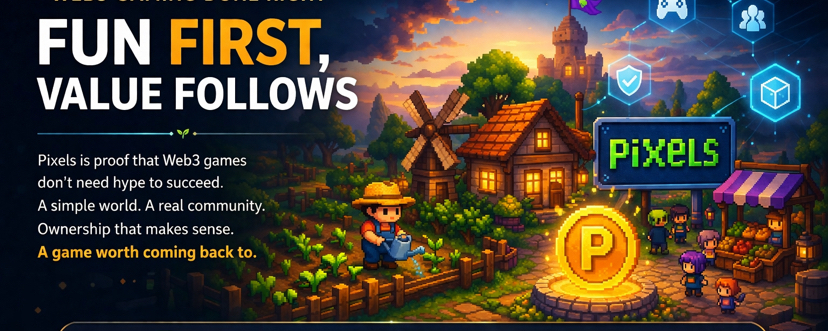
Pixels arrives with a rare kind of confidence. It does not try to overwhelm the room with noise, and it does not depend on constant spectacle to prove its relevance. Instead, it offers something more lasting: a world that feels alive, welcoming, and emotionally easy to return to. In a crypto landscape often shaped by speculation, friction, and short attention spans, that kind of experience matters more than it first appears.
At its core, Pixels is a social casual Web3 game built on the Ronin Network, but that description only captures its structure, not its feeling. The game is centered on farming, exploration, and creation, which gives it a rhythm that is calmer than many blockchain projects and more human than many financial narratives. It is the type of environment where progress feels personal. You are not only collecting assets or watching numbers move across a screen. You are building a small life inside a digital world, and that distinction changes everything.
That emotional quality is one of Pixels’ strongest strengths. Farming is simple on the surface, but simplicity is often what makes a world feel believable. Planting, harvesting, upgrading, and expanding create a steady cycle that gives players a sense of routine. In a market where so many products are designed around urgency, routine becomes a luxury. It creates attachment. It encourages return visits not because the player fears missing out, but because the world begins to feel familiar. That familiarity is the beginning of loyalty, and loyalty is one of the most valuable forms of engagement any Web3 project can earn.
Exploration adds another layer to that experience. A good open-world game does not merely provide space; it provides curiosity. Pixels understands that curiosity is a quiet but powerful force. When players move through a world that rewards discovery, they begin to feel ownership over their journey, even before they think about tokens or incentives. The world becomes memorable because it is lived in, not simply used. This matters in crypto because lasting ecosystems are rarely built by mechanics alone. They are built by emotion, habit, and meaning.
Creation may be the most important part of all. In a digital economy, creation is where participation becomes identity. When people can shape, build, customize, and contribute, they are no longer passive users. They become participants in the culture of the game. That is where Web3 has always promised something different from traditional gaming: the possibility that digital ownership can feel real, social, and expressive all at once. Pixels leans into that promise with a format that feels approachable rather than intimidating. It does not ask the user to understand the entire crypto world before they can enjoy the experience. It simply invites them into a world where they can do something meaningful.
The Ronin Network gives this experience an important foundation. In Web3 gaming, the chain beneath the game is not just technical infrastructure. It influences speed, accessibility, and the overall feeling of use. A game like Pixels depends on smooth interaction, because a casual world loses its charm quickly if the experience becomes clunky or exhausting. Ronin’s association with gaming makes it a natural fit for a project that depends on frequent, low-friction interaction. When the technical layer stays out of the way, the world itself can shine more clearly.
From an investment and market perspective, Pixels is interesting because it represents a larger shift in what people expect from blockchain projects. The early crypto imagination was often dominated by financial abstractions. Tokens, yield, charts, and governance carried most of the attention. But the next phase of Web3 may depend less on abstract narratives and more on real-time user experience. Games like Pixels matter because they translate blockchain into something people can feel. They make ownership social. They make participation playful. They make digital economies less like spreadsheets and more like communities.
That is not a small difference. Communities built around play often become more durable than communities built around hype. Hype burns quickly. Habit lasts longer. A game that gives users a reason to return, collaborate, and care has a better chance of surviving changes in market sentiment. Pixels seems to understand that survival in Web3 will not come from technical novelty alone. It will come from emotional relevance. People need to want to be there even when token prices are quiet. They need to feel that the world is worth visiting because it offers enjoyment, not just potential.
There is also something attractive about the tone of Pixels. It does not feel aggressive. It feels open. That may sound like a small detail, but tone shapes perception. Many crypto projects speak in a language of urgency, certainty, and prediction. Pixels feels more grounded. It invites rather than pressures. It suggests that fun and utility can coexist without either one being sacrificed. In a market saturated with promises, that restraint can make a project feel more trustworthy.
The broader significance of Pixels lies in how it reflects the maturing identity of Web3 gaming. The industry is slowly learning that users are not only investors. They are players, builders, collectors, and social beings. They want worlds that feel worth spending time in. They want systems that reward participation without draining enjoyment. Pixels sits comfortably inside that evolution. It shows that a blockchain game can still be emotionally warm, visually inviting, and structurally meaningful.
Of course, the challenge for any project in this space is longevity. A pleasant first impression is not enough. A game must keep its world alive through updates, community energy, and a reason for players to stay engaged over time. Yet Pixels already has something many projects never develop: a natural sense of place. That is a powerful starting point. When a game feels like a place rather than a product, it has a better chance of becoming part of a user’s routine, and routine is where ecosystems begin to strengthen.
Pixels is not trying to redefine crypto through volume or confrontation. It is doing something subtler and, in some ways, more ambitious. It is trying to make Web3 feel livable. It is trying to prove that blockchain can support not only financial systems, but gentle experiences, social rituals, and creative expression. That vision may not be loud, but it is compelling. In fact, its softness may be its greatest strength.
In the end, Pixels stands as a reminder that the future of crypto does not have to feel cold or mechanical. It can be warm, interactive, and human. It can invite people to farm, explore, and create inside a world that feels less like an experiment and more like a home. And in a landscape where attention is scarce and trust is hard-won, that kind of home may be exactly what Web3 needs next.