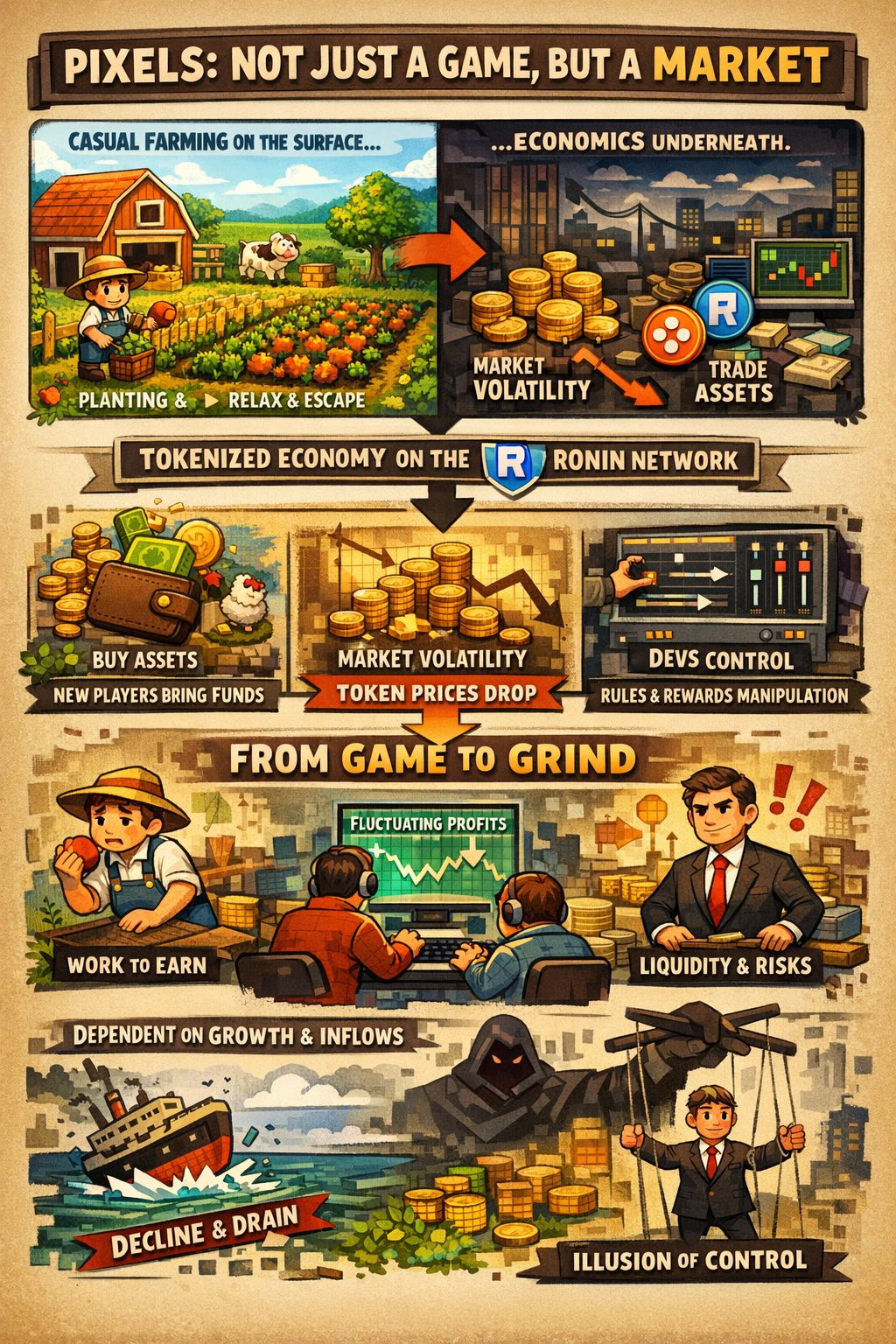
At first glance, Pixels looks like a harmless escape. Soft pixel art, repetitive farming loops, and light social interaction make it feel like something designed for relaxation rather than risk. It resembles the kind of experience people turn to after work, not something that connects them to a live financial system. That perception is intentional. It lowers resistance and makes the transition into something more complex feel natural.
Beneath that surface, the game is integrated with a tokenized economy running on the Ronin Network. This changes the nature of participation. It is no longer just about planting crops or completing tasks. Every action exists within a structure that has measurable financial implications. The game does not simply reward activity. It assigns value to it in a system that behaves like a market.
The broader argument behind this model is familiar. Traditional games are closed systems where players spend time and money without owning their assets. Developers control supply, rules, and value flow. In contrast, Web3 games promise ownership, tradability, and the ability to earn. It sounds like a correction to an outdated model, offering players a more direct stake in the systems they engage with.
However, removing one form of control does not eliminate control entirely. It redistributes it. In traditional games, developers actively manage economies to maintain balance and long term engagement. In tokenized systems, that balance is influenced by market forces. Prices fluctuate, incentives shift, and stability becomes dependent on external conditions rather than internal design. Markets are efficient at assigning value, but they are not designed to prioritize enjoyment or stability.
This shift has a direct effect on player behavior. When financial incentives are introduced, the way people engage changes. The question gradually moves from is this enjoyable to is this efficient. Farming becomes a way to generate returns. Crafting becomes production. Trading becomes participation in a liquidity system. The experience starts to move away from exploration and toward optimization. Over time, it begins to resemble work more than play, especially as players adapt to maximize outcomes.
The simplicity presented on the surface does not reflect the complexity underneath. Systems involving wallets, tokenized assets, and hybrid on chain and off chain interactions remain mostly invisible to casual players. That abstraction works until something breaks. When token prices drop, when transaction flows slow, or when network conditions change, the underlying structure becomes visible. At that point, the player is no longer just dealing with a game but with the limitations and risks of the infrastructure supporting it.
A more fundamental issue lies in the source of rewards. The idea of earning while playing suggests value is being created and distributed, but in practice, that value often depends on continued participation from new users. New entrants bring capital into the system by purchasing tokens and assets, supporting prices and enabling earlier participants to extract value. This creates the appearance of a healthy, self sustaining loop, but it is highly sensitive to growth.
When that growth slows, the dynamics change quickly. Demand weakens, rewards shrink, and participation declines. The system becomes less liquid and less attractive, particularly for those who entered with expectations of consistent returns. Pixels attempts to mitigate this by not over financializing every interaction, making it more restrained than earlier examples. Still, the presence of a token economy means it remains exposed to the same underlying pressures.
There is also a common misconception around decentralization. While assets can be owned and transferred independently, the structure of the game itself remains centrally controlled. The developers retain authority over rules, reward distribution, and economic adjustments. If those parameters change, players have little influence beyond choosing whether to continue participating. This creates a hybrid model where ownership is decentralized, but control over value remains concentrated.
Seen in a broader context, this model follows a pattern observed in earlier play to earn ecosystems. Initial enthusiasm drives adoption, early participants benefit from growth, and behavior gradually shifts toward profit seeking. Over time, maintaining that balance becomes more difficult as rewards depend increasingly on continued inflows. When participation slows, the system contracts, and the focus shifts from opportunity to sustainability.
Pixels distinguishes itself by being more measured and accessible than previous iterations. It avoids some of the excesses that defined earlier projects and places greater emphasis on usability. That may extend its lifespan and make the experience more stable in the short term. However, it does not fundamentally change the structure it operates within.
What Pixels ultimately presents is not just a game with added incentives, but an economic system designed to feel like a game. The mechanics are familiar, the interface is approachable, and the entry point is intentionally simple. But beneath that, participation is tied to a market where value depends on demand, activity, and timing. The experience may begin as entertainment, but it gradually reveals itself as something more transactional, shaped less by design and more by the behavior of the system it is built on.