
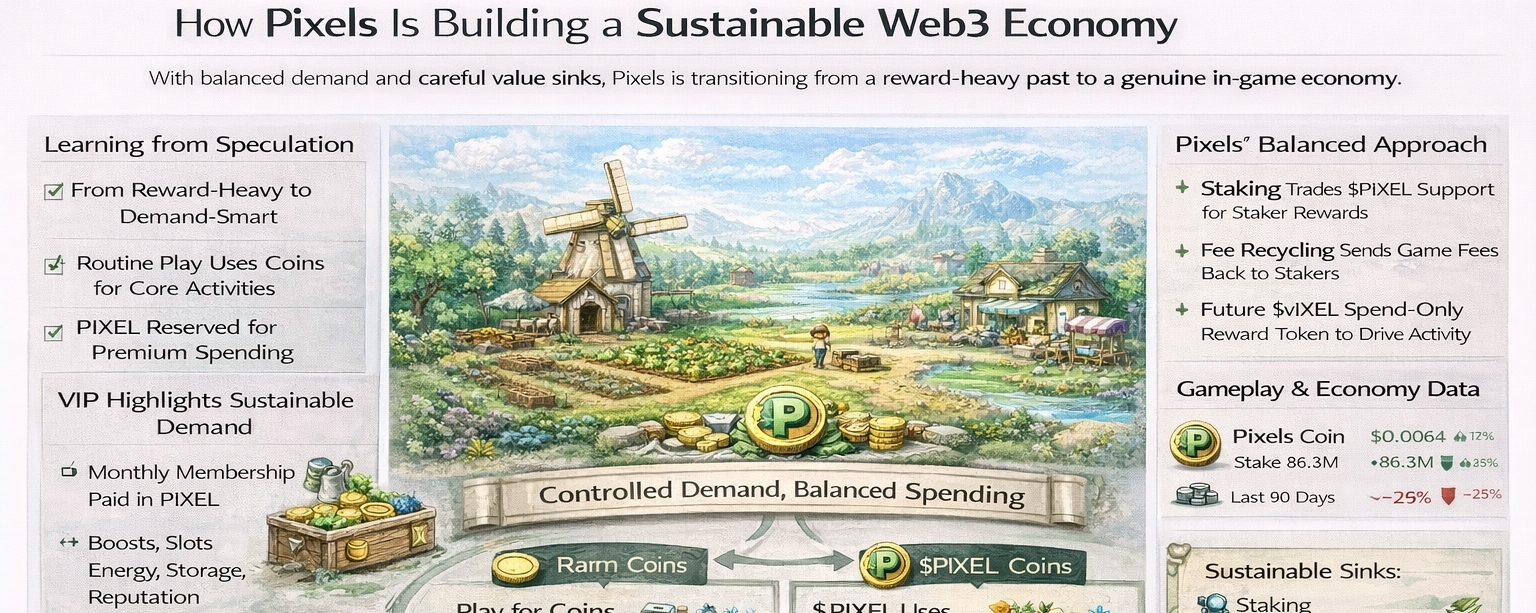

@Pixels I think Pixels is one of the few Web3 games that has finally learned the right lesson from the last cycle because a token by itself is not an economy. For too long the market treated user growth token listings and reward volume as proof that a project was working, but I never found that convincing. A game economy becomes sustainable when players keep coming back because the experience feels worth their time and when spending inside that world starts to support the value being distributed out of it. That is why Pixels matters now, and to me its own framing has become noticeably more grounded in gameplay value than in speculation or inflated monetization hopes.
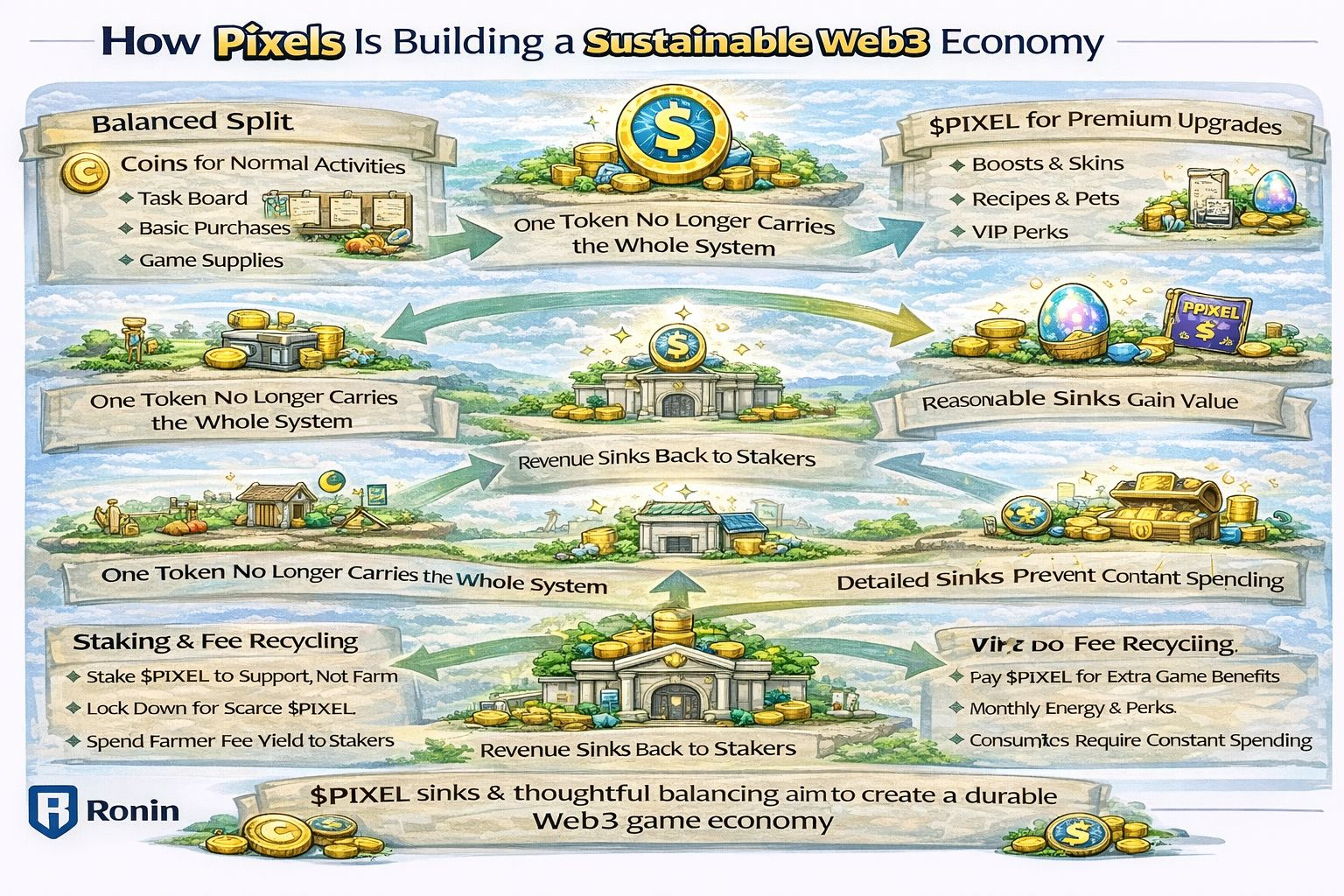
What stands out is that Pixels no longer seems to be building around the fantasy of endless extraction and is instead leaning into a more practical idea where gameplay comes first and token utility only matters when it genuinely improves the experience. That sounds obvious yet in Web3 gaming it has been surprisingly rare. The project has gradually separated routine progression from premium value, and I think that move gives it a much better chance of lasting because everyday play now leans on Coins and task-based engagement while $PIXEL is positioned around upgrades convenience cosmetics and other higher-value uses. That split matters because it reduces the pressure on one token to carry the entire system by itself.
I see that as one of the clearest signs of maturity. Pixels has been trying to move away from the older reward-heavy structure and toward an economy with more controlled demand and more deliberate sinks. In simple terms it no longer treats constant outward flow as harmless. Good economies are usually less flashy than people expect because they create friction where friction is needed and they force players to make real choices instead of letting value leak out too easily. In Pixels that shows up in the way Coins handle normal activity while $PIXEL is reserved for premium spending across things like boosts skins recipes pets and other forms of optional enhancement, which makes the system feel less like a speculative loop and more like a live-service game trying to protect its internal balance.
VIP is a useful example because it shows the difference between artificial demand and healthy demand in a way that is easy to understand. I do not find it compelling when players spend only because they hope to earn more later since that logic usually breaks as soon as sentiment weakens. Pixels seems to understand this and frames VIP as a monthly membership that makes the experience smoother and more rewarding through extra task access more marketplace slots additional inventory space reputation points and recurring energy from the VIP Lounge. None of that is revolutionary and that is exactly why it matters because it reflects the kind of spending logic that has worked in normal live-service games for years. If players buy because the experience improves then spending can become recurring, but if they buy only to farm harder then the whole structure becomes fragile.
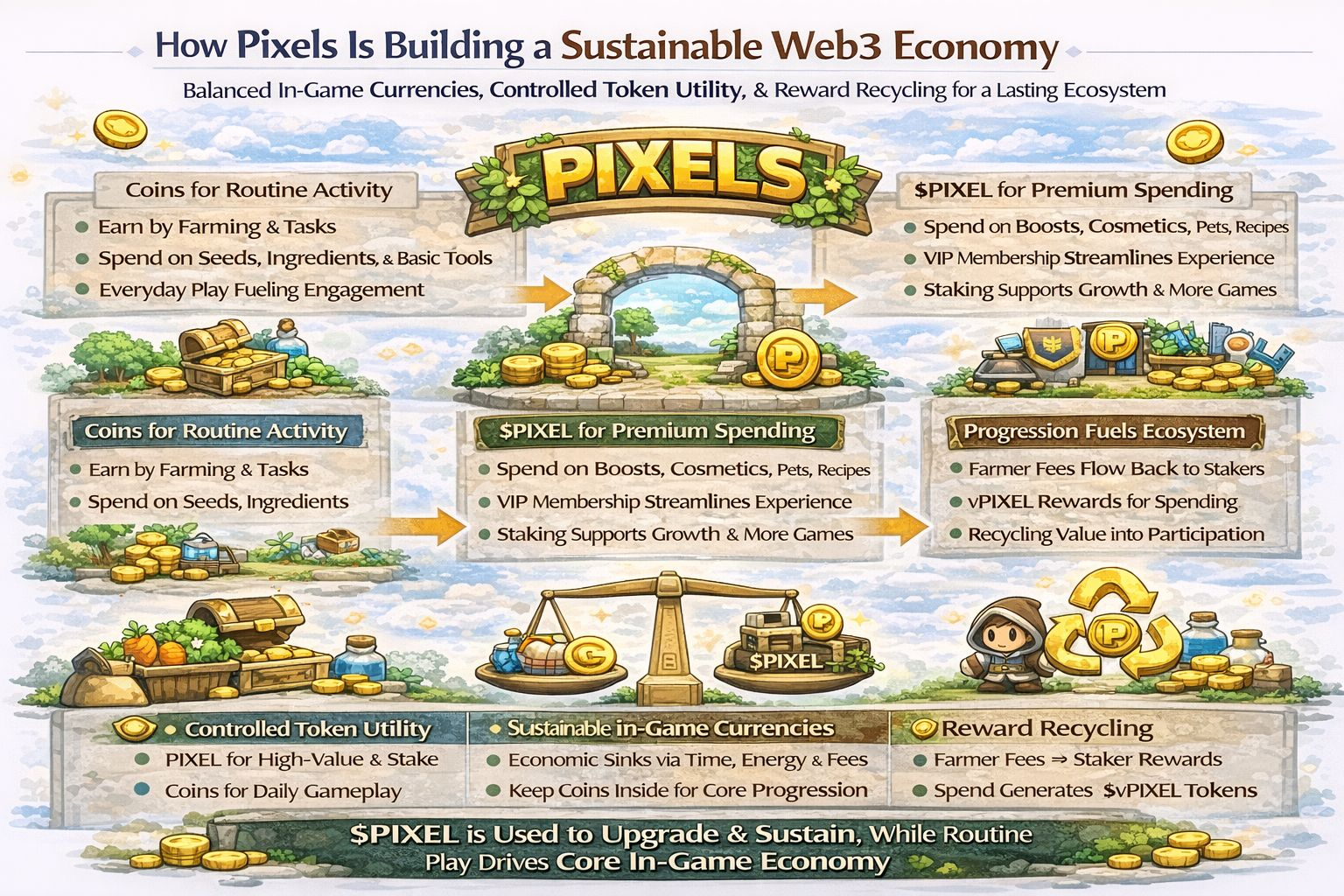
The more ambitious part of the design in my view is the way Pixels is trying to redirect value back into participation instead of leaving the economy built around extraction. Staking fee recycling and the planned spend-only reward token all point in that direction. I understand why some traders may dislike that approach because friction is never popular when markets are strong, but from an operator’s perspective the logic makes sense. Pixels says staking lets players lock up $PIXEL to support games in the ecosystem, that farmer fees are based on reputation and that all farmer fee revenue goes back to reward stakers, while $vPIXEL is intended as a spend-only reward token. There is also no guaranteed APR, which tells me the design is trying to reward contribution and keep more value circulating inside the system instead of presenting staking as a simple yield promise.
What gives me more confidence is that the team has not acted as if the economy can run on autopilot. The official update logs show steady balancing changes that include task board revisions production-time increases timer changes energy-cost adjustments higher upgrade prices boost limits and tool durability, which suggests an active operator rather than a passive token issuer. Just as important the team has also been relatively open about what did not work. In the January 2026 AMA recap, Pixels said that at its high point in June 2024, it had around 1 million daily active users and was handing out over 100,000 rewards every day. But with daily revenue sitting at only about $50,000 to $60,000, it said that model just was not sustainable. I actually trust the project more for saying that plainly because it shows they are looking at the same core problem serious players and investors should be watching.
That does not mean Pixels is solved. I still see real risks in onboarding friction reputation barriers fee sensitivity and the constant challenge of keeping rewards attractive without overpaying for growth. In the short term the market can still get ahead of the product, but over a longer horizon I think Pixels deserves to be judged less like a fast token trade and more like a live economy operator. If it keeps turning token demand into repeat spending tighter sinks and better-targeted incentives then it has a real chance to build something more durable than most of the sector. For me the right question is no longer whether Pixels can attract farmers but whether it can keep players spending because they genuinely want to stay, because that is the difference between a temporary rally and a sustainable Web3 economy.