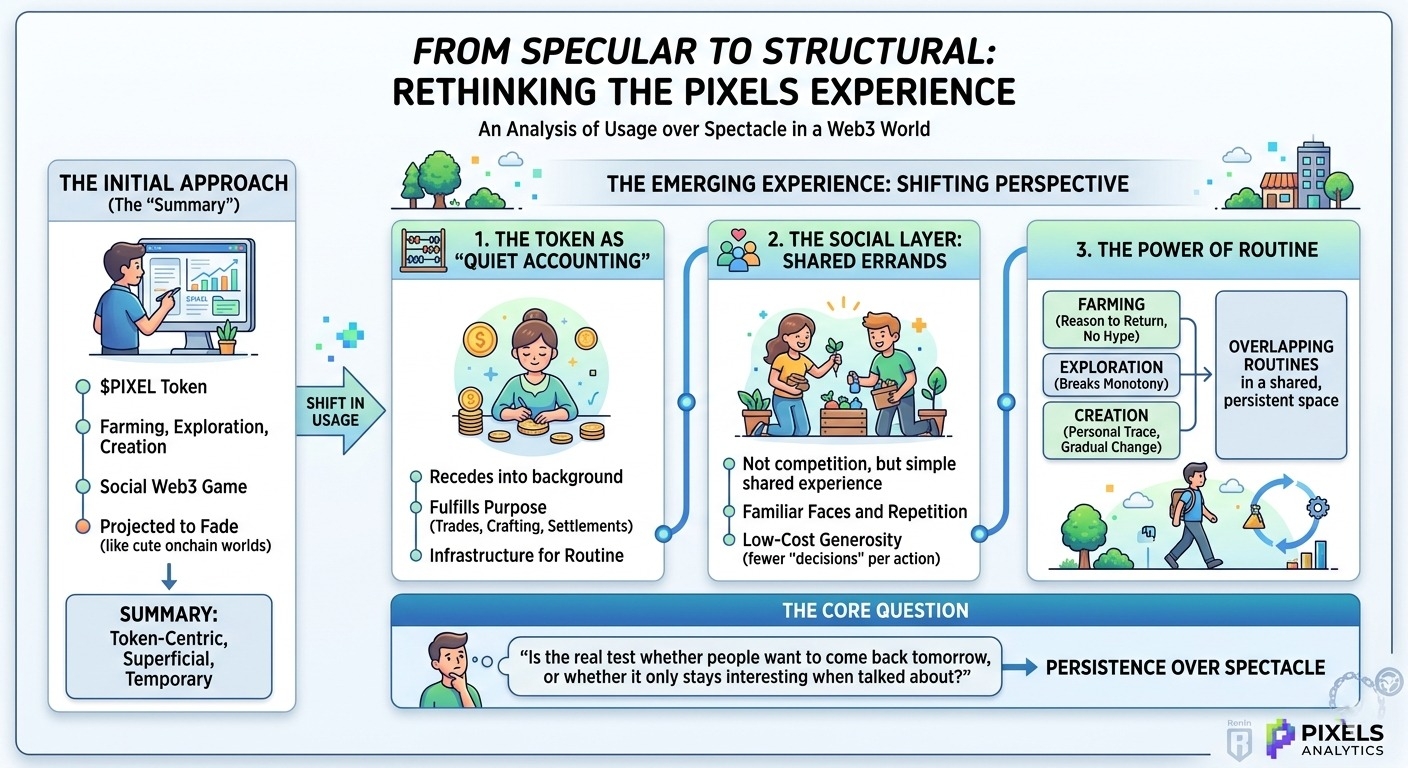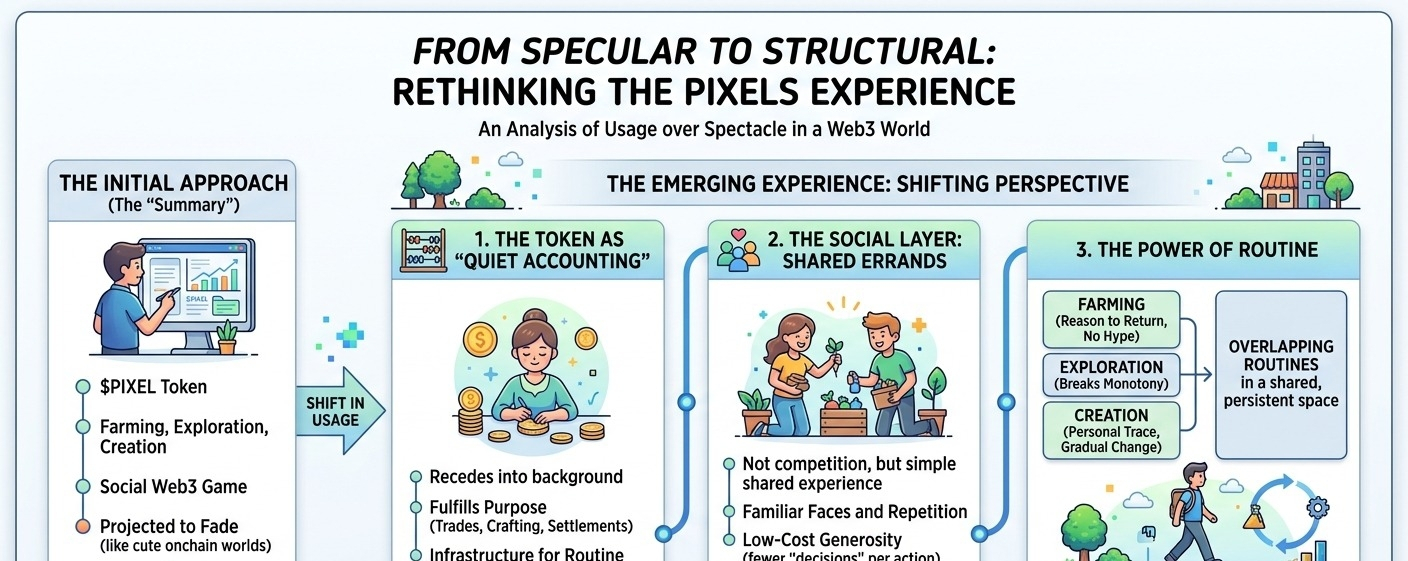
The first time I looked at Pixels, I honestly felt like I could summarize it without much effort. A social casual Web3 game on Ronin. Farming, exploration, creation. And of course the token, $PIXEL, sitting there like a hint that value would matter more than story. The open world looked pretty, but my brain did that thing it always does with projects like this: it reached for the familiar pattern. If there’s a token, it’s probably the center of gravity. Everything else is just the scene dressing.
I didn’t even hate that assumption. It made the project easy to file away. I expected the experience to be legible in one sitting, and then to fade the way other “cute onchain worlds” have faded for me. I figured I would check it out, enjoy the surface level a bit, and then return to more meaningful things.
But the shift didn’t arrive as a dramatic revelation. It arrived as a slow change in how I used my attention. I kept returning in short bursts, not because I planned to grind, but because the game didn’t interrupt my day. I would log in, do a small set of tasks, and then step away without feeling like I’d broken a spell. The world remained consistent. That sounds obvious, yet in this space it’s not always true. Sometimes the feeling of “the game” depends on you being present at the right moment. With Pixels, my presence felt less time-sensitive.
After a while, I started noticing people in a different way. The social part wasn’t just a chat overlay, and it wasn’t a competitive atmosphere either. It was more like shared errands. Someone would ask where a resource appears. Another player would answer, not with performance, but with simple experience. People showed their layouts, but the way they did it felt closer to personal preference than proof of success. I would see the same names more often than I expected, and the repetition made the world feel less like a crowd and more like a place where you might run into familiar faces.
That’s when my perspective on $PIXEL began to shift. I expected to feel the token as a constant emotional driver, the thing I was supposed to track and interpret. Instead, it often acted like quiet accounting. It mattered when I needed it to matter—trades, crafting, settlements—but it didn’t constantly pull the camera of my attention toward value. It didn’t turn every interaction into a financial event. In my head, the token stopped being a headline and started being background infrastructure for the ordinary interactions of play.
Ronin played into this invisibly, too. I rarely caught myself thinking about the network. Actions felt quick enough that I didn’t turn each one into a “decision.” When friction is low, the game doesn’t encourage constant strategizing. It allows small experimentation. It also makes generosity easier to feel natural. If helping someone costs me little in time and attention, it stops feeling like a transaction disguised as kindness.
Beneath the farming, exploration, and creation, Pixels seems to be about building routine in a shared space. Farming provides a reason to return that doesn’t depend on hype. Exploration gives you a way to move through that routine without it becoming monotonous. Creation provides a personal trace that changes over time, even when nothing “big” happens. The open world isn’t mainly there to impress; it’s there so routines can overlap.
And that difference matters, I think, because Web3 projects often compete for visibility. They are designed to be explained quickly, summarized loudly, and remembered through moments that travel well. Pixels feels like it’s more interested in usage that doesn’t need a spotlight. The infrastructure fades from thought, the token doesn’t constantly interrupt the mood, and what remains is whether the space can hold you when you’re not looking for a spectacle.
I’m still not certain what this means for the future. Attention can change a community’s temperature faster than expected, and tokens have gravity whether you invite it or not. But lately I’ve been wondering something quieter than my usual questions: is the real test of a project whether people want to come back tomorrow, or whether it can only stay interesting when it’s being talked about?