
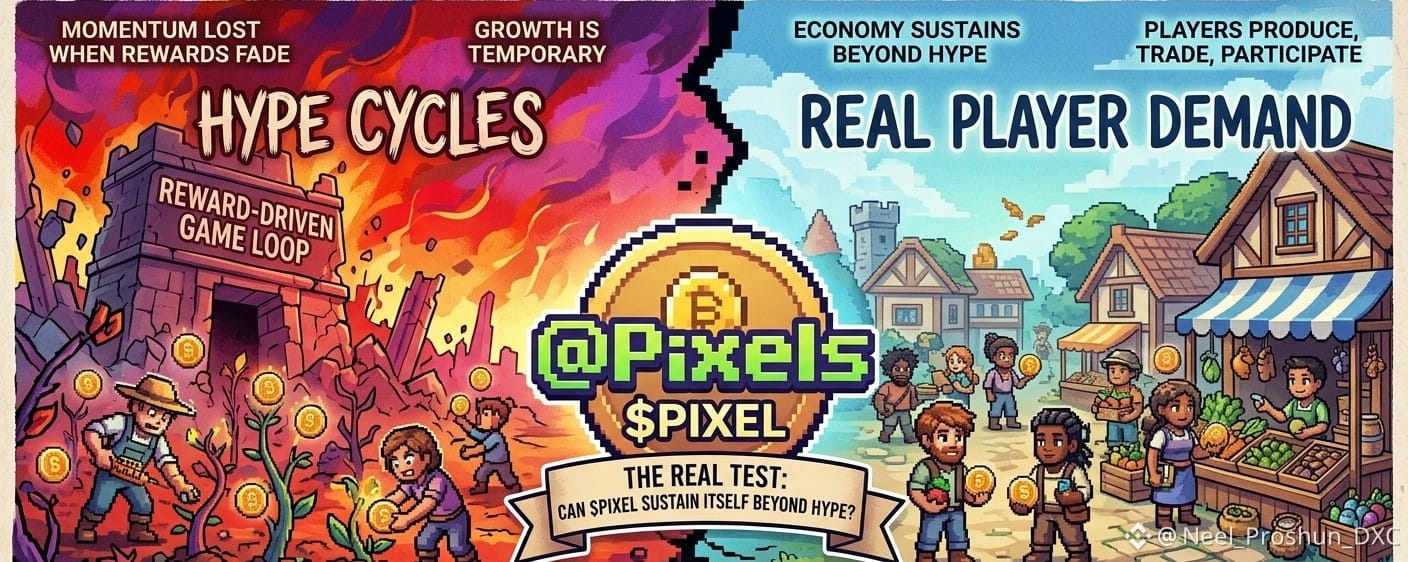
I want to talk about something that shifted quietly inside Pixels and I think most people playing right now haven't fully processed what it means.
For a long time, the winning strategy in Pixels was simple. Farm more. Optimize harder. Extract faster. Solo grind, maximize output, repeat.
Chapter 3 just broke that model completely.
I don't mean "added new content." I mean the entire definition of winning changed.
Here's what I mean.
Before Bountyfall, your progress was yours. What you built, you kept. What you farmed, you earned. The loop was self-contained your effort, your reward, your exit.
Now? Your progress can be actively dismantled by another player.
Sabotage isn't a side mechanic in Chapter 3. It's a core winning strategy. You can walk into a rival Union's Hearth and directly slow their progress. Meanwhile, they can do the same to you. The most optimized solo farmer in the game can now be outmaneuvered by a coordinated team that never farms at all they just sabotage everyone else.
That's a fundamental shift. It changes everything about how PIXEL flows through the economy.
Think about what this does to player behavior.
Before: $PIXEL spending was individual. You spent on your upgrades, your land, your progression.
Now: $PIXEL spending becomes collective and strategic. Your Union needs Yieldstones across 5 different tiers — Verdant, Flint, Hollow and beyond. Getting to the higher tiers requires rare materials like Mirage Eggs, Ashnuts and Gloomshards. These don't come from solo farming. They come from coordinated effort, from trade, from players specializing and depending on each other.
The economy just got dramatically more interconnected.
But here's the part that genuinely surprised me.
You can switch Unions. Every 48 hours, using a Harvest Union Changer from the Hearth Halls.
On the surface that sounds like flexibility. But think about what it actually creates a meta-game around Union loyalty. Strong Unions will want committed players. Players will evaluate which Union has the best shot at winning before committing. There's now a reputation layer on top of the reputation layer not just your individual score, but which team you're associated with and whether you stayed or jumped ship when things got hard.
Pixels just introduced social trust as a competitive variable.Then Reputation Points 2.0 sits underneath all of this.
The system quietly updated. Social activity and task completion rate now directly affect your reward eligibility not just land ownership. Which means the player who owns land but plays passively gets squeezed. The player who engages, cooperates, completes, contributes they get rewarded more.
Combined with Stacked App's AI-powered LiveOps that customizes missions based on your playstyle and offers extra $PIXEL bonuses for active engagement the entire reward architecture is now pointing in one direction.
Pixels is systematically devaluing solo extraction and rewarding collective participation.
That's not a small update. That's a philosophical shift in what kind of player the game wants to exist inside it.
Whether that shift succeeds depends on one thing the team can't fully control whether enough players actually want to cooperate rather than extract.
In my experience watching Web3 games, that's never guaranteed. Coordination is hard. Trust is expensive. The moment sabotage becomes more profitable than farming, some players will never farm again.
But if it works? The PIXEL economy becomes something genuinely rare in this space a system where your token's value is tied not just to what you do, but to the relationships you build while doing it.
That's either the future of GameFi.
A very ambitious experiment about to find its limits.
I'm watching which one it turns out to be.
Which are you in Pixels right now a farmer, a saboteur or still figuring it out? Drop it below.