
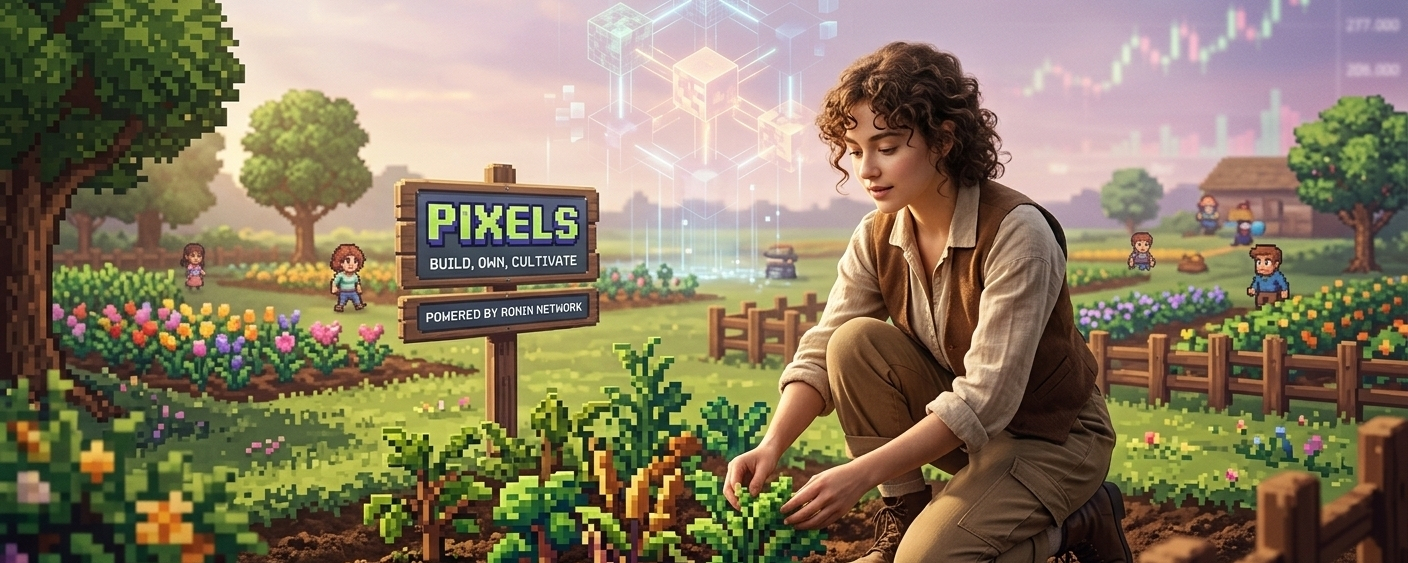
I wasn’t looking for anything serious when I first stumbled across Pixels. It was one of those quiet scroll moments, where everything starts blending together—charts, tokens, hype threads—and then suddenly something different appears. A farming game? On the blockchain? I almost skipped it. But something about it felt oddly calm, almost out of place in a space that’s usually loud and aggressive.
So I paused. And I clicked.
At first glance, it didn’t feel like a “Web3 project” at all. No complicated dashboards thrown in my face, no immediate pressure to connect a wallet or chase rewards. Just a soft, open world where characters move slowly, where crops grow at their own pace, and where everything feels… intentional. I remember thinking, “Wait, is this really built on blockchain?” Because it didn’t try to prove it every second.
And that’s what pulled me in.
As I spent more time exploring, I started to understand what Pixels is actually trying to do. It’s not just a game—it’s trying to make ownership feel natural. You’re not grinding for some abstract reward; you’re building something that, in theory, belongs to you. Land, items, progress—these aren’t locked inside a company’s server in the usual way. They live on-chain, which sounds complex, but in practice, it just feels like your time might actually mean something beyond the game itself.
But here’s where my mind started splitting in two.
On one side, I felt this genuine curiosity. What if this is how Web3 finally becomes usable? Not through finance dashboards or trading terminals, but through something simple, like farming. Something almost nostalgic. It reminded me of older games where the goal wasn’t to win fast, but to stay longer. And maybe that’s the point—if people enjoy being there, they don’t even notice the blockchain underneath.
But the other side of me couldn’t ignore the bigger picture.
I’ve seen this cycle before. A new project appears, it feels different, more “human,” less extractive. Early users get excited, communities start forming, and suddenly the market shows up. Tokens start moving, speculation kicks in, and the entire experience begins to shift. What was once about exploration slowly turns into optimization. People stop asking “Is this fun?” and start asking “Is this profitable?”
And I wonder—can Pixels resist that?
Because the moment a token like PIXEL becomes central to the experience, psychology changes. Players become investors. Investors become impatient. And patience is something a slow, farming-based world depends on. You can’t rush crops in real life, and you probably shouldn’t be able to here either. But markets don’t like waiting. They want growth, momentum, numbers that go up.
That tension feels like the real story behind Pixels.
Technically, being built on the Ronin Network makes sense. It’s faster, cheaper, and already connected to a gaming-focused ecosystem. That reduces friction, which is critical if you want non-crypto users to even try something like this. But technology alone doesn’t solve the deeper question: will people stay when the novelty fades?
Because let’s be honest—most Web3 games struggle with this. They attract attention quickly, but holding that attention is a completely different challenge. Gameplay has to stand on its own. It can’t rely on tokens as a crutch forever.
And yet, I can’t dismiss what I felt while exploring Pixels.
There’s something quietly powerful about a space that doesn’t rush you. A place where interaction feels organic, where players aren’t just competing but coexisting. It almost feels like a social experiment disguised as a game. What happens when you give people ownership, but remove the urgency? Do they build, or do they speculate anyway?
I think about investor psychology a lot, especially in crypto. We’re wired to chase the next thing, to move fast, to exit before others do. But Pixels seems to be asking the opposite: what if you stayed? What if value wasn’t just something you extracted, but something you cultivated over time?
It sounds idealistic. Maybe even unrealistic.
Because sooner or later, external pressure always arrives. New users come in, not because they love farming, but because they heard there’s money to be made. And once that mindset spreads, it’s hard to contain. The game risks becoming another economy first, experience second.
Still, I can’t shake the feeling that Pixels is trying to push against that current, even if gently.
Maybe that’s why it stuck with me longer than most projects. It didn’t demand anything from me. It just existed, quietly, inviting me to explore at my own pace. And in a space obsessed with speed, that felt almost radical.
But I keep circling back to one question.
Is this the beginning of something genuinely different—where blockchain fades into the background and people simply enjoy being part of a living, evolving world? Or is it just another calm surface hiding the same underlying cycle, waiting for speculation to take over?
I’m not sure yet.
And maybe that uncertainty is exactly what makes it worth watching.
