
There was a time when games were simple. You log in you play you leave. Nothing you did really mattered outside that moment. But Pixels feels different from the start. It is not just a game you play. It is a world you slowly build your place in.
Pixels is an open world where farming exploration and progress all come together. You gather resources you improve your skills you meet other players and you move through quests that slowly reveal a bigger story. It feels calm on the surface but underneath there is a system constantly evolving based on how players behave.
What makes Pixels stand out is how it connects your time in the game with real ownership. Every action you take has weight. Your progress is not just saved data. It becomes part of a blockchain system where your effort has real value. This creates a different kind of motivation. You are not just playing for fun. You are also building something that belongs to you.
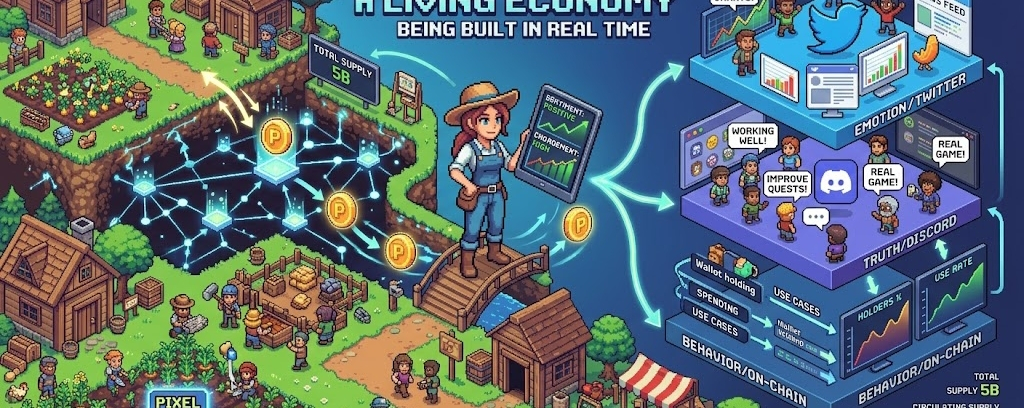
At the center of this system is the PIXEL token. This is where things get interesting. Because unlike traditional games where rewards are fixed Pixels is designed to observe players. It studies how people play how they spend how they hold and even how they leave. Then it adjusts the reward system based on that behavior.
This means the game is not static. It is learning. If too many rewards are being given without real engagement the system can tighten. If players are actively contributing and building the ecosystem the system can support that. It creates a feedback loop between players and the economy.
Looking at the market side gives more context. The total supply of PIXEL is 5 billion tokens. Around 3.38 billion are already circulating. The market cap sits around 25 million dollars with a 24 hour volume of over 34 million. That is a very high activity level compared to its size. It shows that people are not just holding the token. They are actively trading and using it.
But numbers alone do not tell the full story. In Web3 especially you have to understand sentiment. Not just price movement but how people feel think and act inside the ecosystem. That is where a deeper analysis becomes important.
I look at Pixels using a three layer sentiment model. This helps separate hype from reality.
The first layer is Twitter. This is where emotion lives. When the price moves up people get excited. When updates drop narratives start forming. You see optimism fear and speculation all in one place. It is fast and loud but not always accurate.
The second layer is Discord. This is where truth shows up. Real players talk here. They share what is working what is broken and what needs improvement. There is less noise and more honesty. If something is wrong you will feel it here before it shows in price.
The third layer is on chain data. This is behavior. Not what people say but what they actually do. Are they holding tokens or selling. Are they spending inside the game or just extracting rewards. This layer is the most important because it cannot be faked.
When all three layers align something powerful happens. It means people feel positive they are actively engaged and their behavior supports the system. That is when an ecosystem becomes strong.
But when these layers start to move in different directions it becomes a warning sign. If Twitter is excited but on chain activity is dropping it may be just hype. If Discord shows frustration while price is stable it could be early stress building under the surface.
Pixels right now sits somewhere in between. It is not pure hype but it is also not fully stable yet. It is in a transition phase where the system is trying to find balance.
This brings us to the bigger picture. Pixels is not just trying to grow. It is trying to sustain that growth. And that is where most Web3 games struggle.
On the opportunity side Pixels is doing something many projects fail to do. It is building a structure not just a reward loop. The combination of gameplay ownership and adaptive token mechanics shows that it is aiming for a long term economy. Not a short term pump.
If more players join and actually stay engaged the system can strengthen. If different parts of the game continue to create real use cases for the token then PIXEL can become more than just a reward. It can become a core layer in a wider gaming network.
But there are risks that cannot be ignored. Any system that rewards players with tokens has to manage supply carefully. If too many tokens enter the system without enough being used or removed the value can drop. This is a common problem in play to earn models.
There is also the question of player intention. Are people playing because they enjoy the game or because they want to extract value. If the focus shifts too much toward extraction the system can weaken. Because the economy depends on participation not just rewards.
Another factor is the broader Web3 market. Liquidity changes fast. Attention moves quickly. A project can be strong internally but still affected by external cycles. Pixels is not isolated from that reality.
So where does that leave us
Somewhere in the middle
Pixels is not guaranteed success. But it is also not something you can easily ignore anymore. It is one of the few projects actively experimenting with how a game economy can adapt and survive.
The real test is not happening right now during active interest. The real test will come later. When the excitement slows down. When rewards are no longer the main attraction. When only the system itself remains.
If players continue to stay if they find meaning beyond rewards if the economy keeps balancing itself then Pixels could become a model for future Web3 games.
If not it will join the long list of experiments that showed promise but could not hold together under pressure.
In the end the question is simple but difficult
Can a game grow without breaking its own economy
Pixels is trying to answer that in real time
And that is what makes it worth watching.