
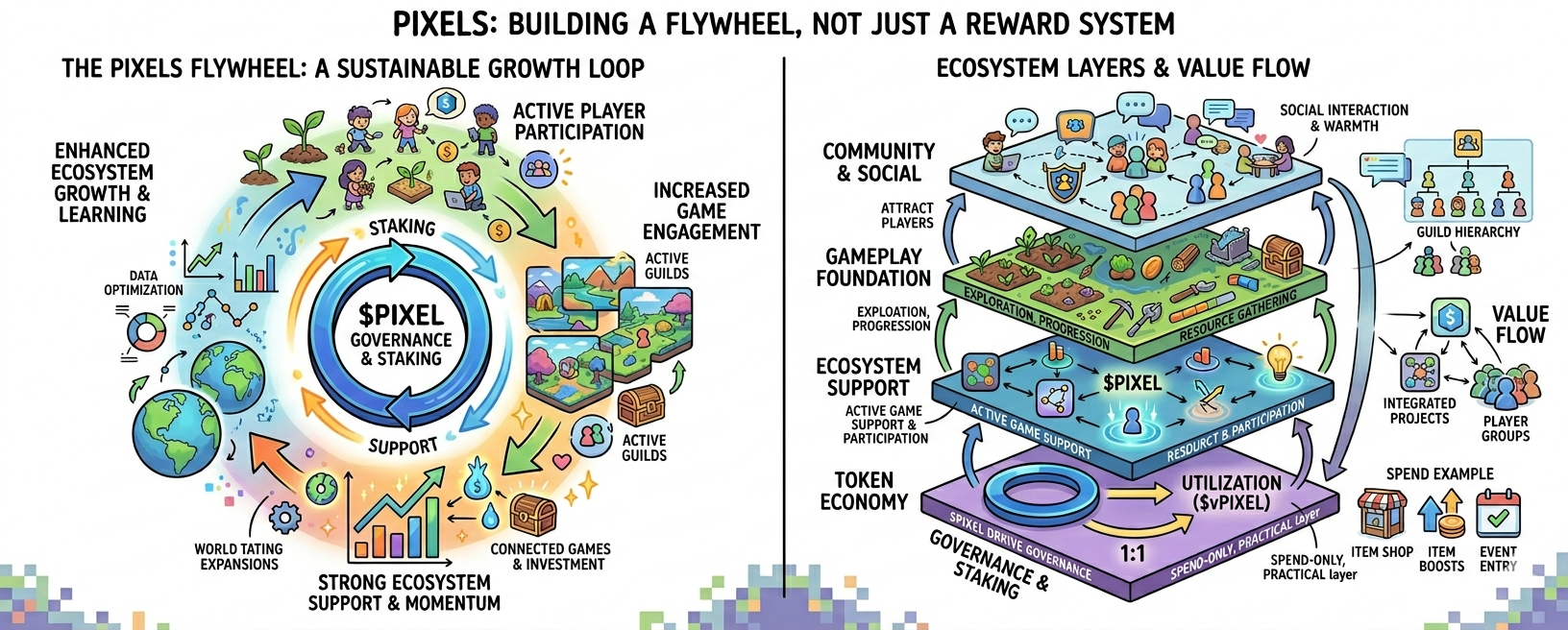

At first, Pixels looks easy to understand.
You see a colorful game world, familiar farming mechanics, exploration, progression, and a strong social layer. It feels welcoming. It feels active. And it feels like a game that gives players room to grow at their own pace.
But the more you look at Pixels, the more you notice that it is not only building a game world.
It is also building a wider system around how games grow, how players participate, and how ecosystem support moves in a more connected way.
That is what makes the idea of a flywheel so interesting here.
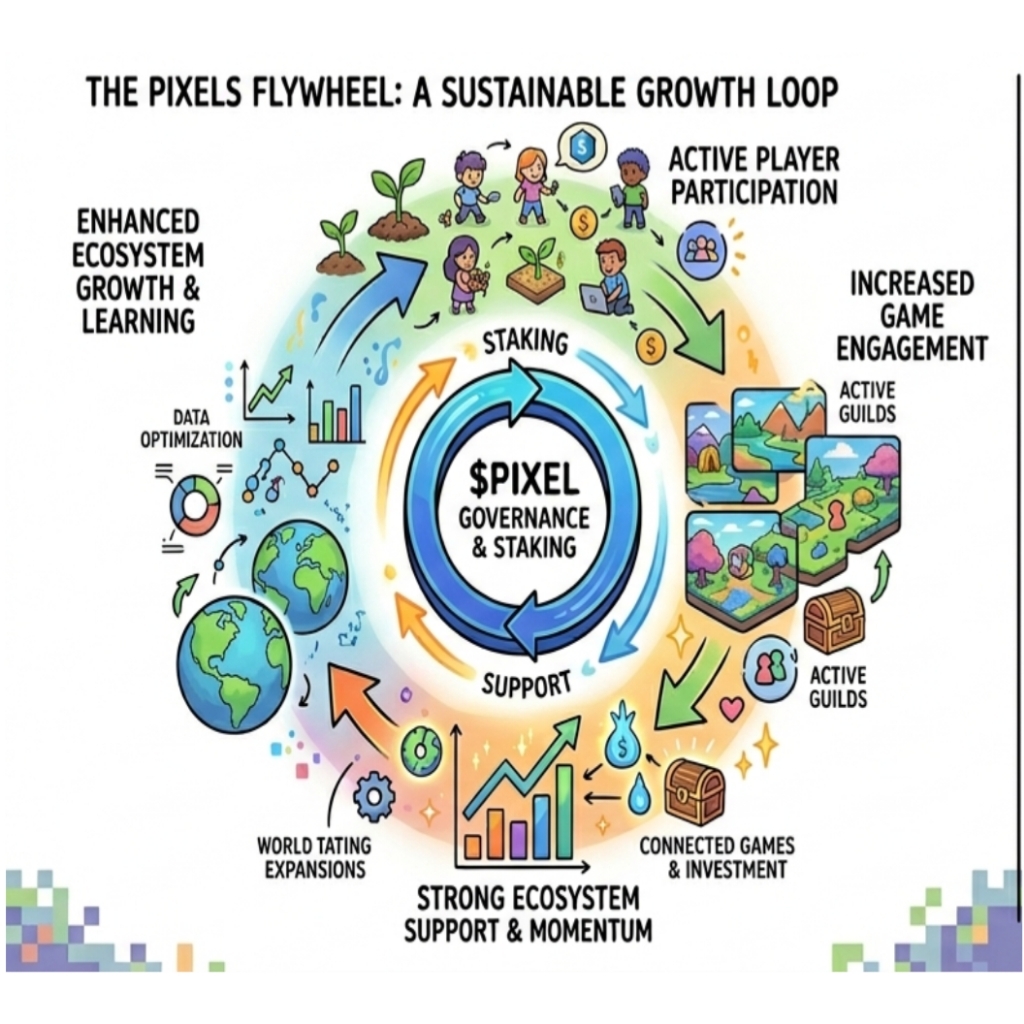
At the center of the Pixels ecosystem is $PIXEL, which works as the main governance and staking asset. Players can use it to support games inside the ecosystem. That means participation is not only about logging in and playing. It can also be about helping direct support toward the games that are creating real engagement and value.
This gives the ecosystem a more active shape.
Instead of support moving randomly, Pixels is designing a system where participation, game performance, and ecosystem growth all connect. A game that attracts players, keeps them engaged, and creates meaningful activity can build stronger support around itself. That creates a loop where better performance leads to stronger momentum, and stronger momentum can help the ecosystem keep improving over time.
That is why it feels bigger than a simple reward structure.
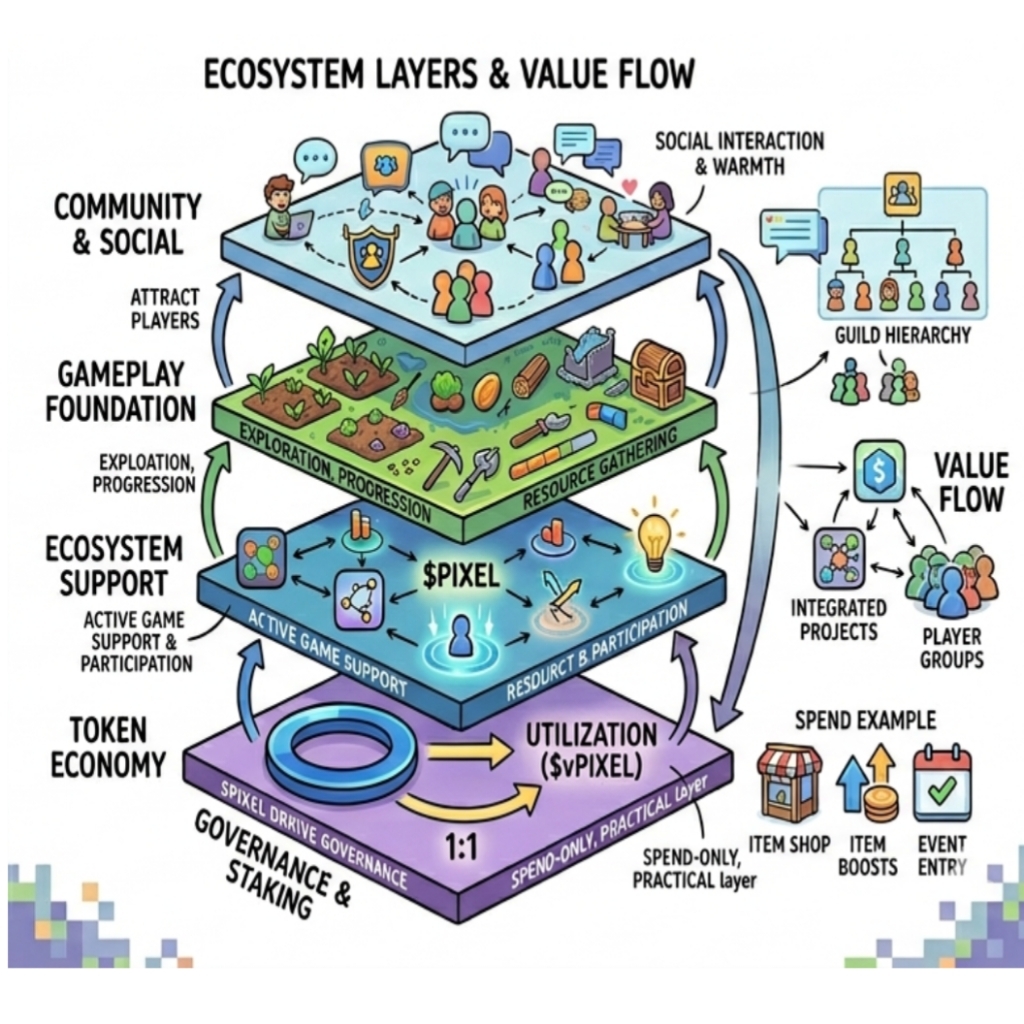
Another important part of this system is $vPIXEL, a spend-only token backed 1:1 by $PIXEL. This adds a practical layer to the ecosystem, because it helps rewards stay useful inside the platform. From a product point of view, that matters. It shows that Pixels is thinking carefully about how value moves through the ecosystem and how players interact with that value in a smoother way.
The game side still matters just as much.
Pixels is built around farming, exploration, creation, and progression. These are the parts that make the experience easy to enter. Players can gather resources, build routines, improve over time, and enjoy a world that feels social and alive. The gameplay gives the ecosystem its foundation. Without a world players enjoy spending time in, the rest would not matter in the same way.
That is why the game and the ecosystem need each other.
The community layer makes this even stronger. Pixels is not designed as a purely solo experience. Features like social interaction, shared participation, and guild-based activity help turn the world into something players can enjoy together. That gives the platform more warmth and personality. It also makes progress feel more meaningful, because players are not only moving forward on their own. They are doing it inside a living community.
Another thing that stands out is how Pixels connects data and growth.
As players interact with games across the ecosystem, that activity helps create a clearer picture of what works well, what keeps people engaged, and where support can be used more effectively. Over time, that can help the ecosystem become smarter, more focused, and more useful for both players and games.
That is the real strength of the flywheel idea.
It is not just about giving rewards and ending the cycle there. It is about creating a connected system where gameplay, participation, support, and ecosystem learning all continue feeding into one another.
What makes Pixels interesting is how naturally these pieces fit together.
The gameplay brings players in.
The social layer helps them stay connected.
The ecosystem gives their participation more meaning.
And the wider flywheel helps the whole platform keep growing in a more structured way.
That is why Pixels feels like more than a simple game economy.
It feels like a game world built with a longer-term vision - one where players can play, participate, and grow inside a system that keeps becoming stronger around them.
