

Habibies! Do you know? When I first looked at the idea of a “rewarded LiveOps engine,” it didn’t feel like a product pitch, it felt like someone quietly trying to fix a system that never really worked in the first place.
Because the real problem in games, especially anything touching play-to-earn, was never rewards themselves. It was distribution. Who gets what, when, and why. Most systems treated rewards like a faucet, always on, barely controlled. And what happened was predictable. A small group extracted most of the value, often bots or highly optimized farmers, while the average player drifted away. If 20 percent of players were capturing 80 percent of rewards, that wasn’t a coincidence, it was a structural flaw.
Stacked reframes that entirely by turning rewards into something more deliberate. On the surface, it looks simple. Players complete tasks and earn rewards across games. Underneath, there’s something more calculated happening. An AI layer is deciding not just what tasks exist, but who should see them and when they should appear. That timing piece is easy to overlook, but it’s doing most of the work.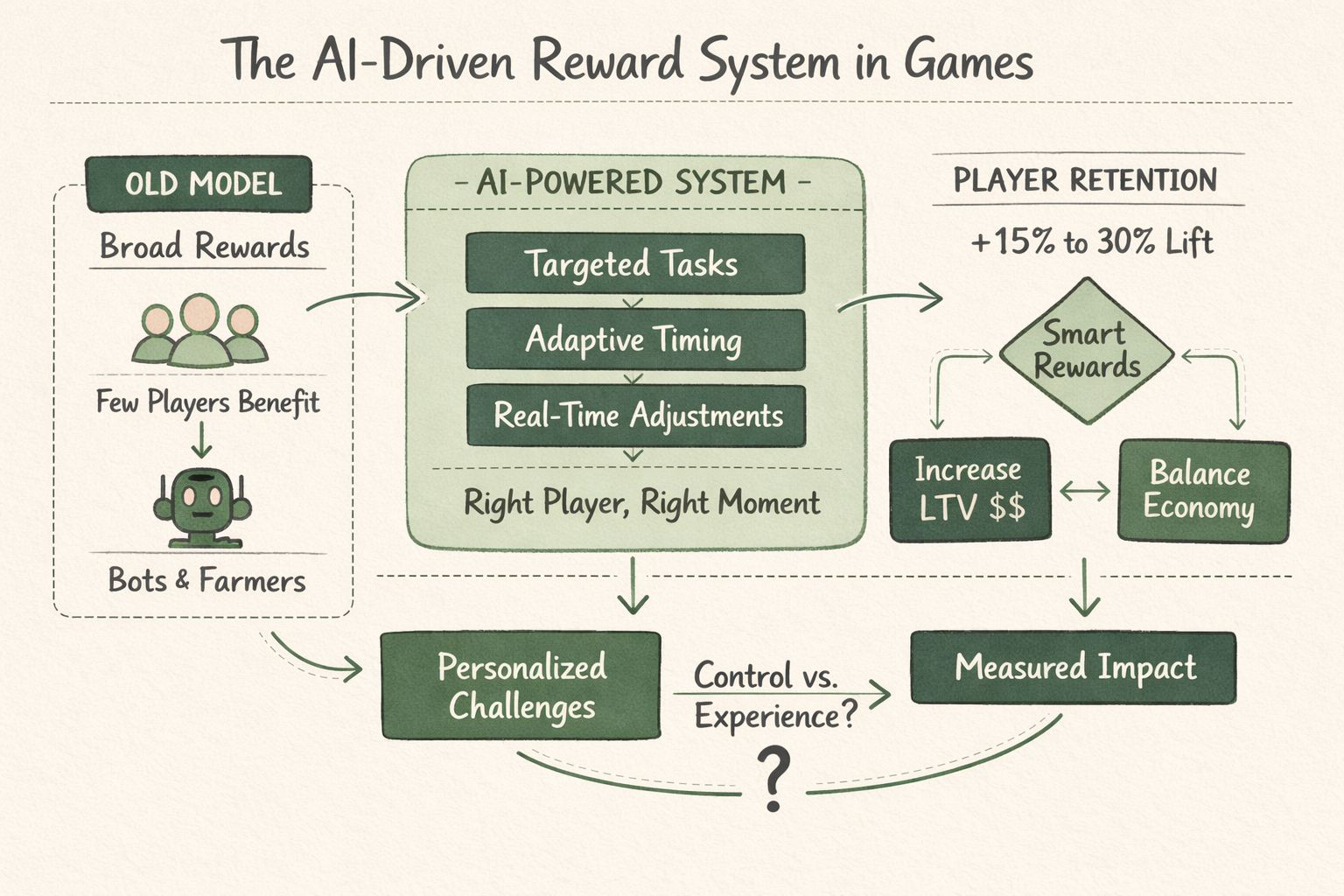
Because if a player is about to churn, a reward isn’t just a bonus anymore. It becomes a retention lever. And if a player is already highly engaged, over-rewarding them can actually flatten long-term value. So instead of blasting incentives across the entire player base, the system narrows its focus. Right player, right moment. That phrase sounds clean, but what it really means is constant adjustment based on behavior.
Early data from systems like this tends to show lifts in retention somewhere between 15 to 30 percent when rewards are targeted instead of uniform. That range matters. At 15 percent, you’re stabilizing a game. At 30 percent, you’re reshaping its entire growth curve. And the difference between those two outcomes often comes down to how well the system understands player intent.
That’s where the “AI game economist” framing starts to make sense. Not as a buzzword, but as a role. Traditionally, a game economist would manually design reward loops, monitor inflation, tweak drop rates, and react to imbalances. That process is slow. Maybe updates happen weekly, sometimes monthly. Meanwhile, player behavior shifts daily.
Stacked compresses that loop. Instead of reacting after the fact, it adjusts in real time. If a certain task is being over-farmed, it can quietly reduce exposure. If a new feature isn’t getting traction, it can attach rewards to nudge exploration. What looks like a simple task board is actually a moving surface, constantly reshaped underneath.
That creates a second-order effect. Content scale. Luke mentioned 200 plus unique offers per day, and that number sounds excessive until you consider the alternative. Manually, a team might design 10 to 20 meaningful tasks in the same timeframe. Beyond that, quality drops or repetition creeps in. But with automation, the ceiling lifts. Not just more tasks, but more variation.
Still, more isn’t always better. If this holds, the real advantage isn’t volume, it’s relevance. A system generating 200 tasks only works if each one feels like it belongs to the player seeing it. Otherwise, it turns into noise. And players are good at filtering noise.
Meanwhile, there’s the economic layer. Real-money rewards introduce a different kind of pressure. In-game currency inflation is one thing. Real-world value leakage is another. If rewards are too generous, the system becomes unsustainable. If they’re too conservative, players disengage. That balance has killed most play-to-earn experiments.
Stacked tries to solve this by tying rewards directly to measurable outcomes. Retention, revenue, lifetime value. That means rewards aren’t just costs, they’re investments. If a $1reward increases expected player lifetime value by $3, it makes sense. If it doesn’t, the system adjusts. Quietly, continuously.
But that also introduces a risk. When everything is optimized for measurable lift, there’s a tendency to prioritize short-term metrics over long-term experience. Players might stay longer, spend more, but feel less of the game’s original texture. The danger isn’t collapse, it’s flattening. Everything becomes efficient, but not necessarily meaningful.
Understanding that helps explain why the Pixels team matters here. They’ve already gone through one full cycle of play-to-earn hype, growth, and correction. Pixels reached over 1 million daily active users at its peak, which sounds impressive until you realize how quickly that kind of scale can unravel if incentives aren’t aligned. The fact that they’re building Stacked on top of that experience suggests this isn’t theoretical. It’s reactive. Learned.
At the same time, the broader market is shifting. Traditional game studios are cautiously re-entering conversations around player incentives, while Web3-native projects are moving away from open reward farming toward tighter systems. You can see it in token models becoming more constrained, in reward pools becoming more conditional. There’s a quiet convergence happening.
Stacked sits right in the middle of that. Not purely Web3, not purely traditional. It borrows the economic awareness from one side and the LiveOps discipline from the other. If it works, it doesn’t just fix play-to-earn. It changes how incentives are used in games more generally.
Because once you can measure the impact of a reward with some degree of precision, it stops being a gamble. It becomes a tool. And tools tend to spread.
Still, there’s an open question. How much control should a system have over player behavior before it starts feeling engineered rather than earned. If every action is subtly guided by incentives, does the experience lose something human underneath. Or does it simply become more responsive.
Early signs suggest players don’t mind as long as the rewards feel fair and the progression feels steady. But that balance is fragile. Push too far, and the system becomes visible. And once players see the system too clearly, they start playing it instead of the game.
If this holds, the future of game economies won’t be defined by how much they give away, but by how precisely they give it. And that shift is quieter than it sounds.
The real change here isn’t rewards. It’s control.