
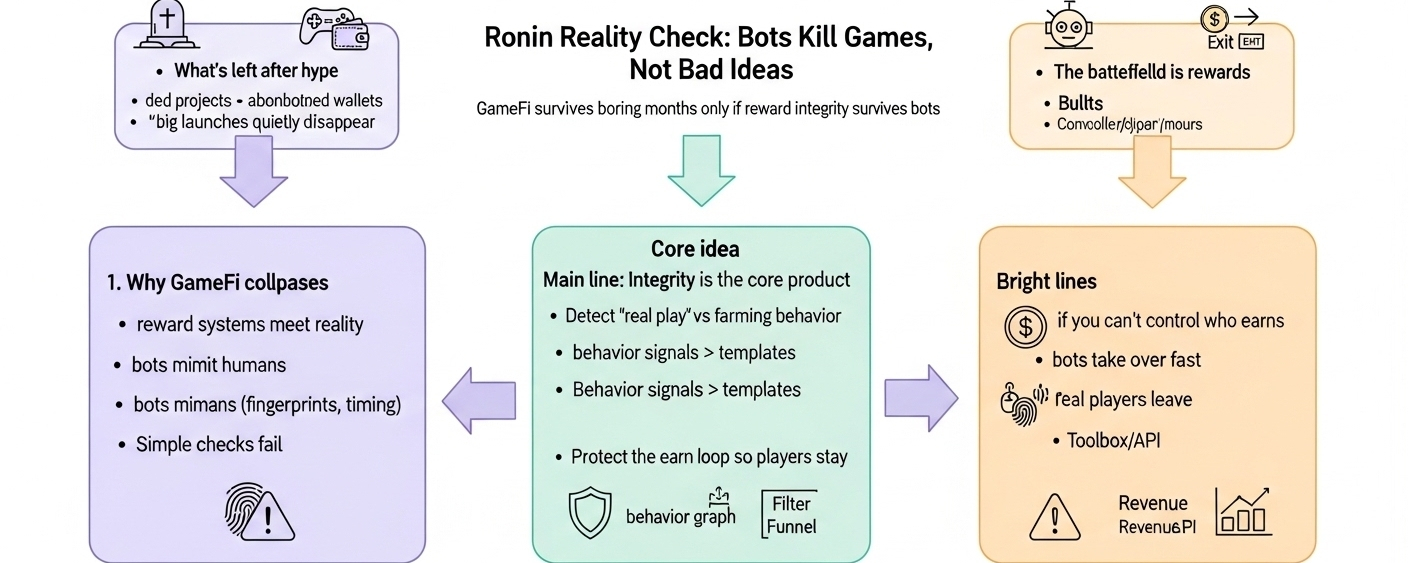


i start with what’s left after the hype leaves. because in GameFi, the loud part is easy. the hard part is surviving the boring months when nobody is cheering and the market is half asleep. that’s why i ended up digging through Ronin activity in the first place. not for fun, honestly it’s kind of depressing, but because i wanted to see what actually holds up.
and yeah, it felt like scrolling through a graveyard.
so many dead projects. so many abandoned wallets. you scroll long enough and you start remembering all those “big launches” people swore would change gaming. the promises from 2022, the cinematic trailers, the AAA talk, the big funding headlines. most of it is just… gone now. not even crashing, just quietly disappearing. and that’s the part that should scare builders more than price candles.
what kept coming up for me is that a lot of these projects didn’t die because the idea was stupid. many had decent ideas. they died because their reward systems couldn’t survive contact with reality. because in GameFi, rewards are the battlefield. if you can’t control who earns, bots will take over. fast. and once bots win, real players leave. why wouldn’t they? nobody wants to grind in a system where machines are farming nonstop with perfect execution.
the bots today aren’t even the obvious ones. they mimic human behavior, fake browser fingerprints, simulate actions, and blend in. some of them look more “normal” than actual players. so the old solutions don’t really work. you can’t just slap a simple check and call it solved.
that’s where Pixels came back into focus for me. i’ve watched it since early days, when it looked outdated and easy to ignore. but the team kept focusing on one thing: bots. and they didn’t go the lazy route of throwing CAPTCHAs everywhere. they went deeper. behavior tracking. click patterns, movement timing, resource usage. basically learning what real players look like, and what farming behavior looks like.
and that’s important: this didn’t come from a theory deck. Pixels got hit hard, almost broke, and adapted. you can feel the difference between “we planned this” and “we survived this.” Stacked comes out of that survival lesson. it’s the anti-bot, behavior-based reward system turned into something other games can use. not flashy. not trying to fix the universe. just solving one problem that keeps killing games: who actually deserves rewards and why.
it also made me think about other tools people mention. some help bring users in. some make wallet experience smooth. some give reward templates. useful, sure. but predictable templates are cheap for bots to exploit, and smooth onboarding doesn’t protect what happens after the player enters. Stacked is focused on the core: reward integrity.
Pixels reportedly pulled around 10 to 20 million in revenue last year using this retention + filtering logic. that doesn’t guarantee anything, but it’s hard to ignore in a space where even huge projects collapse overnight. so i’m watching the only way that makes sense: through data. do bots get pushed out? do players stick around longer? does revenue sustain? if yes, it matters. if not, it’s just another name heading into the Ronin graveyard.
