
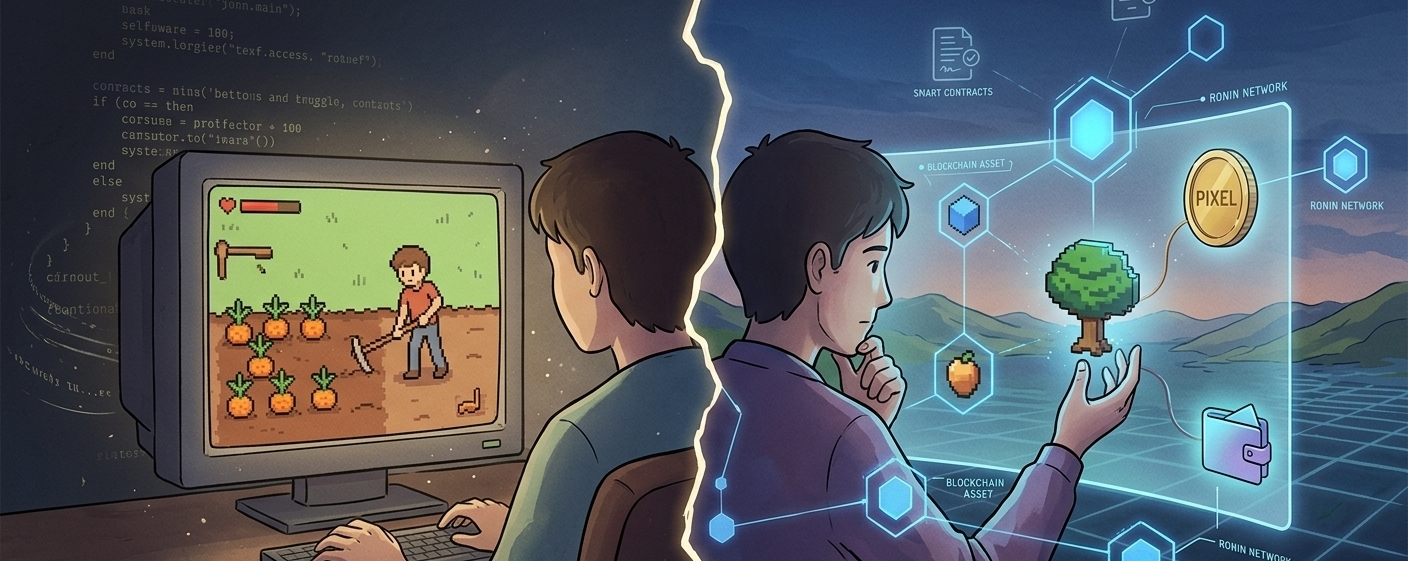
I don’t remember the exact moment I stopped assuming games were just “temporary fun,” but at some point I began noticing how much time I could lose inside them without anything actually staying with me outside.
I would grind for days, build progress, trade items, and get attached to small achievements that felt important in the moment. But if the game changed or shut down, all of it would simply end. No trace outside the system. I never really questioned it back then because that’s just how games worked.
That model was stable for a long time. Developers controlled everything, and players accepted it in exchange for entertainment. It was simple, even if a bit unfair when I think about it now.
Then I started seeing a different idea appear in gaming spaces: what if the things I earn in a game don’t have to stay trapped inside it? What if some part of my effort could exist beyond the game itself?
At first, it sounded like a technical experiment more than something practical. And honestly, many early blockchain games didn’t feel like games in the usual sense. They leaned too much into rewards and systems, and less into the feeling of actually playing. That shift made things feel slightly unnatural, like the game was watching itself too closely.
Pixels feels like a more careful version of that idea. It doesn’t try to rebuild gaming from scratch. Instead, it keeps things familiar—farming, crafting, simple social interaction—and quietly adds ownership on top of it.
When I actually play it, it doesn’t feel complicated. I’m still doing normal game things: planting crops, collecting resources, improving land, interacting with others. It feels light, almost like older online games that didn’t try too hard to be anything more than enjoyable.
But underneath that simplicity, some parts of the game are structured differently. Certain assets, like land and resources, exist as blockchain-based items. That means they’re not only inside the game—they can exist outside it in a technical way.
The game runs on the Ronin network, which is designed specifically to make blockchain gaming smoother and less frustrating to use. That matters more than it sounds, because without that kind of setup, the experience would feel heavier and more distracting.
There’s also the PIXEL token, which connects different parts of the system. It appears in progression, participation, and other mechanics depending on how the ecosystem evolves. It’s there in the background, but it doesn’t constantly interrupt gameplay.
What stands out to me is that Pixels doesn’t force everything into “earn mode.” I can still treat it like a normal game most of the time. That choice matters, because once everything becomes about value, the experience changes in a way that’s hard to ignore.
Still, even if I try to treat it casually, the idea of ownership changes how I think. If something I earn can exist outside the game, I become more aware of what I’m spending my time on. Even simple actions feel slightly more meaningful, or sometimes more calculated.
But that ownership isn’t as independent as it first sounds. Even if assets exist on-chain, they still depend on the game itself to actually matter. Without the world and systems around them, they lose most of their practical use.
There’s also a constant need for balance. These systems don’t stay stable on their own. Incentives, rewards, and participation all need ongoing adjustment, otherwise the structure starts to drift.
Not everyone experiences the game the same way either. Some players go deep into its systems and treat it almost like an economy they need to understand. Others just play casually and never really touch the blockchain side at all.
And there’s still a barrier that’s hard to ignore. Wallets, tokens, and asset management are not natural parts of traditional gaming. Even if the game itself feels simple, the setup behind it can feel like extra work.
So what ends up existing is really two experiences at once. One is a relaxed farming game that feels familiar and easy. The other is a layered ownership system sitting underneath it, shaping how value and progress are structured.
Pixels doesn’t fully solve the tension between those two layers. It just lets them coexist and leaves it up to me how far I want to engage with each side.
And I keep thinking about this: if games start quietly adding ownership into everything I do, do they become more meaningful to me or do they slowly stop feeling like a place where I can just play without carrying anything with me afterward?
