
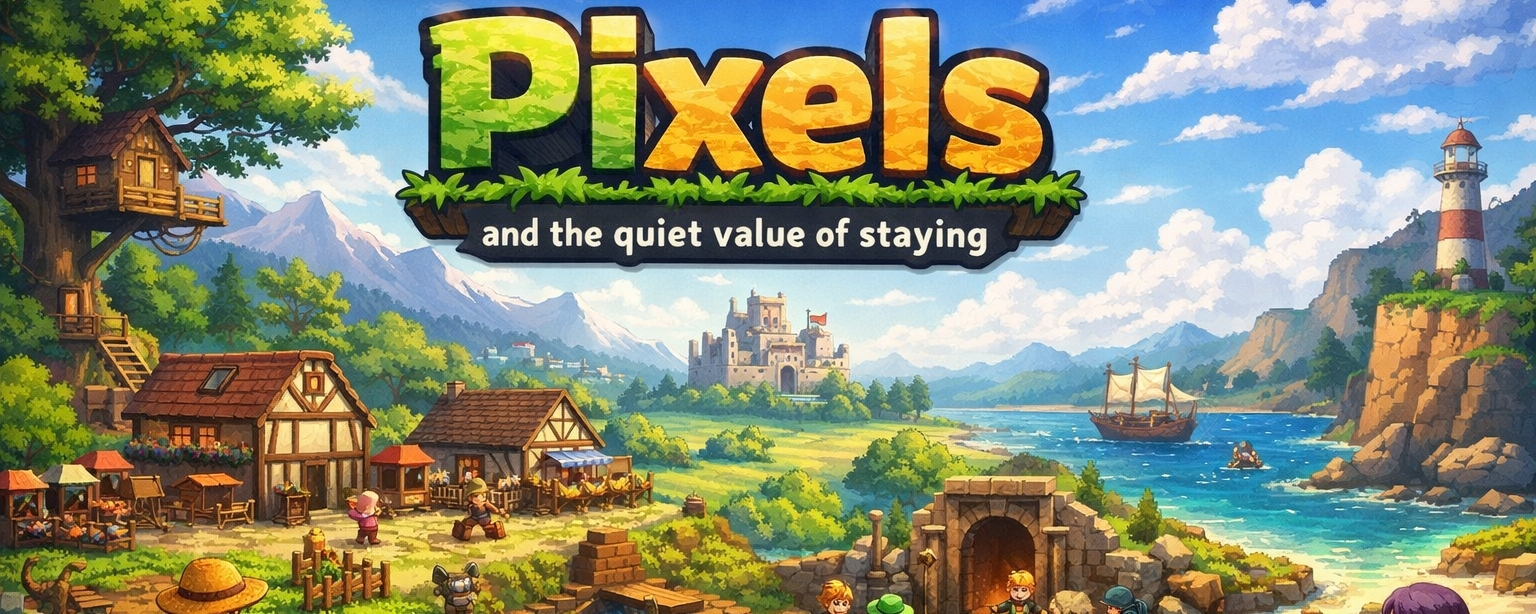
At first, Pixels did not feel like something I would keep thinking about.
It looked simple enough to understand quickly and move past. A casual Web3 game, farming, exploring, building, social layer, running on Ronin. In this market, that kind of description usually tells you almost everything and almost nothing at the same time. You can place it in a category almost immediately, and once that happens, your attention usually drifts. That is what crypto does after a while. It makes a lot of things feel familiar too early. You stop reacting to what something is supposed to be and start watching for whether it leaves any real mark on your mind after the first impression fades.
That is what made Pixels different for me, or at least different enough to stay there a little longer than I expected.
Not because it arrived looking bigger or smarter than everything else. Actually the opposite. It did not feel like one of those projects trying too hard to explain its own importance before anyone had the chance to feel it. It looked almost too easy to overlook. And maybe that is why it stayed with me. Sometimes the things that return to your attention are not the loudest ones. They are the ones that quietly touch a question you have seen before, but not in quite the same way.
What kept pulling me back was not really the game itself in the direct sense. It was the kind of problem sitting underneath it. Pixels looks like a game, but the thing it seems to circle feels older than gaming and definitely older than crypto. It touches that familiar tension around time, participation, value, and whether people are doing something because it means something to them or because they are hoping the system will eventually reward them for showing up.
That tension never really leaves this space.
Crypto talks a lot about participation, but a lot of the time it ends up building systems where participation is hard to separate from speculation. It talks about community, but often what it actually captures is temporary attention. It talks about activity, but activity can be misleading. A lot can be happening on the surface while very little is actually forming underneath. That is one of the main reasons so much of the market starts to feel repetitive after enough years. New language, same pattern. New packaging, same uncertainty. A project can look alive and still feel hollow once the excitement cools down.
That is why I keep coming back to a different question when I look at something like Pixels. Not whether it works as a product on paper. Not whether it has enough features. Not whether it fits the current narrative. I keep thinking about whether it understands something basic that a lot of crypto projects miss, which is that people do not only want incentives. They want a reason to return that feels natural, not forced. They want time spent somewhere to leave some kind of trace. They want effort to feel like more than motion.
That sounds small when written out like that, but it really is not.
A lot of digital systems are very good at generating behavior and very bad at generating meaning. They can make people click, claim, check in, react, repeat. But getting someone to return is not the same as giving them a reason to care. That difference matters more than most metrics are willing to admit. It matters even more in crypto because everything here gets pulled toward visibility and price so quickly. The minute value becomes measurable, people start acting differently around it. The system changes. The mood changes. What looked organic starts becoming strategic. What looked social starts becoming transactional. That shift is so common now that I almost expect it by default.
And that is exactly why Pixels stayed in my head.
Because it made me think about whether a project can still hold onto something human inside a market that keeps flattening everything into incentives. Not perfectly. Not purely. Just enough to matter.
When a game is built around farming, exploration, and creation, those words can sound light at first, but they point toward something deeper than they seem to. They suggest routine. They suggest repeated presence. They suggest a world that is not only visited once, but lived in gradually. And the moment a project enters that territory, the real test changes. It is no longer about attracting attention once. It becomes about whether repetition builds attachment or exposes emptiness. That is a much harder test. A lot of things can survive curiosity. Very few survive routine.
Routine is where shallow systems get exposed.
If a world asks people to come back again and again, then eventually the question becomes simple. What is actually here. What are people really returning to. Is it just reward. Just momentum. Just habit. Or is there something more difficult to measure, something quieter, where time itself starts to gather meaning because people feel like they are part of a place instead of just passing through it.
That is the part of Pixels that feels worth paying attention to.
Not because I think it has solved that problem completely. I do not think anyone in this space has. But it seems to be standing closer to the real problem than a lot of projects do. It is not only asking how to make activity visible. It is brushing against the harder question of how to make activity feel worthwhile. That is a very different thing. Record is not the same as trust. Ownership is not the same as attachment. A tracked economy is not the same as a living environment. Crypto likes to blur those lines because it makes everything easier to market, but people can feel the difference even when they do not explain it directly.
That is why so many projects lose their shape over time.
They confuse measurable participation with meaningful participation. They assume that if people are there, then the system must already be working. But presence alone does not say much. Sometimes people stay because there is still something to extract. Sometimes they stay because they are hoping to leave at the right time. Sometimes the activity is real, but the connection underneath it is weak. That is why I have become less interested in what looks busy and more interested in what keeps its weight when the easy excitement wears off.
Pixels did not strike me as special in the beginning. That part matters. I did not start with admiration. I started with distance. It looked like something I had seen before, and maybe in some ways I had. But then it kept returning, and the more it returned, the less I cared about the category and the more I cared about the project itself. Not because it was louder than everything else, but because it seemed to be circling a real and persistent issue that keeps showing up across crypto in different forms.
How do you create a place where people spend time without making that time feel extracted from them.
That is the kind of question that matters more to me now than most market narratives do. Because it reaches beyond one project. It reaches beyond gaming. It even reaches beyond crypto. The internet as a whole has been struggling with this for years. Everywhere you look, there are systems competing for attention, building habits, encouraging return, measuring engagement. But very few of them actually give people a strong sense that their repeated presence means something. Most are better at keeping people active than making them feel connected. They produce motion. They do not always produce belonging.
That is why I think Pixels stayed with me. It seems to be moving around that same unresolved space. Not offering some grand answer, not pretending to fix everything, but still touching a deeper need that keeps reappearing no matter how much technology changes. People want spaces where their effort accumulates into something they can feel. They want small actions to matter. They want continuity. They want some proof that showing up again was not pointless.
Maybe that is what I notice here more than anything else. A project trying, in its own way, to sit near that need.
And I think that is also why I do not want to talk about it like a pitch. The moment you push too hard, you lose the truth of it. This is not really about declaring Pixels as an answer. It is more about recognizing why it keeps surfacing in my mind when so many other things disappear almost instantly. There is something about it that resists being reduced to a quick label. Not because it is mysterious, but because the question underneath it is not simple. It asks what real participation looks like when everyone involved is still aware of incentives, still aware of exit, still shaped by a market that turns almost every action into a possible trade.
That makes things harder. Maybe more honest too.
Because then the challenge is not just building a system people can use. It is building something that can hold attention without being fully consumed by the logic of extraction. Something that can let action become more than proof of activity. Something that can let trust form without assuming the ledger alone creates it. Something that can turn return into something warmer than repetition.
I do not know if Pixels fully gets there. I am not sure anyone can know that quickly. Some things only reveal themselves over time, and time is usually the one thing this market refuses to respect. It wants conclusions early. It wants sharp opinions and simple outcomes. But the projects that stay in your mind are usually not the ones that hand you a neat conclusion. They are the ones that keep making you return to the same tension from slightly different angles.
That is what this project has done for me.
It did not impress me instantly. It did not arrive with the kind of force that makes you stop and stare. It looked familiar, maybe even too familiar. But the more I sat with it, the more it started to feel like it was pointing toward something larger than its surface description. Not a trend. Not a narrative. A problem. A very old one. The problem of how people find meaning in repeated action, and how hard that becomes once every system around them starts measuring value too loudly.
That is why Pixels feels worth watching to me.
Not because I think it should be exaggerated into something bigger than it is, but because it seems to be close to a real question, and in crypto that alone already sets it apart more than people realize.