

I wasn’t even looking for another Web3 game tonight. I was just scrolling, half-focused, half-burnt out, watching the same recycled threads about “next big narratives” and “AI x crypto integrations” like it’s some kind of ritual at this point. Then Pixels showed up again, casually sitting there in between all the noise, not screaming for attention, which honestly made me pause more than anything loud ever does.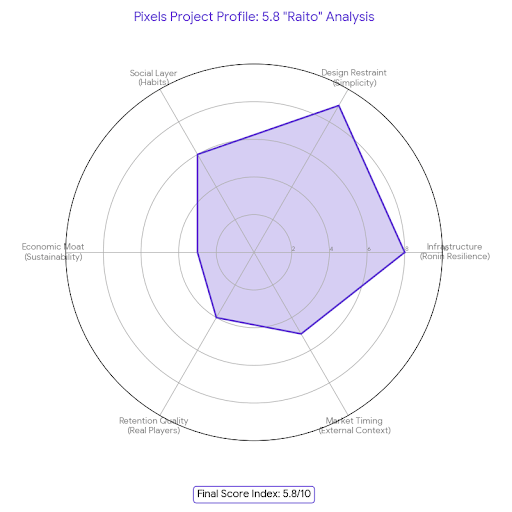
So yeah, Pixels. On paper, it sounds harmless. A social, casual Web3 game built on Ronin Network. Farming, exploring, crafting. Not trying to be the next AAA monster. Not screaming “metaverse” every five seconds. And honestly, that alone makes it stand out more than it should.
Because right now the crypto space is exhausted but pretending it’s not. Everyone’s acting like we’re still early 2021, but the vibe is different. Liquidity is thinner, patience is gone, and users are way more cynical. You can feel it in the way people interact with projects now. Nobody wants to “believe” anymore. They want quick returns, quick exits, and something they can flex for a week before moving on.
And that’s where most Web3 games die. Not because the tech is broken. Not because the idea is bad. But because nobody actually stays.
I’ve seen better infrastructure get crushed simply because users didn’t care enough to log back in. People love to blame gas fees, scalability, or “UX issues,” but the truth is simpler and more uncomfortable. Most users are just… lazy. Or distracted. Or chasing the next shiny thing.
Pixels kind of leans into that reality instead of fighting it. It’s slow. Intentionally slow. You’re not grinding for insane APYs or flipping NFTs every hour. You’re just… there. Planting stuff, walking around, interacting. It almost feels like it doesn’t belong in crypto, which is weirdly its strongest trait.
The Ronin angle matters more than people admit. Ronin already survived one of the biggest hype cycles with Axie Infinity, and yeah, it also survived one of the biggest crashes. That matters. Not because it’s perfect, but because it’s been stress-tested in a way most chains haven’t. When you’ve already handled millions of users at peak insanity, you understand something most “new” chains don’t: adoption breaks systems faster than bugs do.
That’s the part people keep ignoring. Everyone is obsessed with “can it scale?” but almost nobody asks “will people actually come?” And even fewer ask “will they stay?”
Pixels has seen real traffic spikes recently, especially after migrating to Ronin and pushing its ecosystem incentives. Daily active users jumped hard at one point, which sounds impressive until you zoom out. Are those players… or are they farmers chasing token rewards? Because those are two very different types of users, and crypto keeps pretending they’re the same.
The PIXEL token itself had its moment. Listing hype, volume spikes, social buzz. Same script we’ve all watched a hundred times. Price pumps, influencers appear out of nowhere, everyone suddenly “believes in the vision,” and then… reality kicks in. Liquidity rotates, attention fades, and the real test begins.
And that test is boring. It’s always boring.
Can this thing hold users without constantly paying them to show up?
That’s the question no whitepaper ever answers directly.
I’ll give Pixels credit though. It doesn’t feel like it’s trying to trick me. There’s no aggressive overpromising. No “this will replace traditional gaming” nonsense. It sits in this weird middle ground where it knows it’s not Fortnite, and it’s not pretending to be.
That restraint is rare.
But restraint doesn’t guarantee survival.
The real issue is still the same: crypto users don’t behave like gamers, and gamers don’t trust crypto. So you end up building for a hybrid audience that barely overlaps. Pixels tries to bridge that by being simple enough for casual players while still integrating ownership and token incentives for crypto natives. It’s a decent approach, but it’s also fragile.
Because both sides can leave for completely different reasons.
Gamers leave if it’s not fun enough.
Crypto users leave if it’s not profitable enough.
And keeping both happy at the same time is… not easy.
I’ve noticed something else too. The moment activity spikes, infrastructure starts to feel pressure. Not necessarily breaking, but you can sense the strain. Transactions slow down slightly, interactions feel heavier. It’s not a disaster, but it’s a reminder. Scale isn’t theoretical. It shows up in tiny annoyances that add up over time.
And those tiny annoyances kill retention faster than people realize.
We love to talk about “next-gen scalability solutions,” but real users don’t care about your architecture diagrams. If something feels slow or clunky, they leave. They don’t write a thesis about it. They just disappear.
Pixels hasn’t broken under pressure yet, which is a good sign. But it also hasn’t faced the kind of insane, sustained demand that truly tests a system. Short bursts of activity are one thing. Long-term engagement is another.
Then there’s the social layer. This is where Pixels might actually have an edge. It’s not just about farming or crafting. It’s about presence. People hanging out, interacting, building routines. That’s the part that could stick, if it sticks at all.
Because once users form habits, things change.
The problem is getting to that point without bribing them the whole way.
And right now, incentives are still doing a lot of heavy lifting. Quests, rewards, ecosystem pushes. Necessary, sure. But also temporary. At some point, those incentives fade or normalize, and what’s left is the actual experience.
That’s the moment of truth for every Web3 game.
I keep thinking about how many “innovative” projects I’ve watched disappear. Not because they failed loudly, but because they slowly became irrelevant. No drama. No collapse. Just… silence.
Pixels doesn’t feel like it’s heading there immediately, but it’s not immune either.
The broader market isn’t helping. Everything is fragmented. Liquidity is scattered across chains, narratives rotate weekly, and attention spans are basically nonexistent. You can build something genuinely solid and still get overshadowed by a random meme coin with better timing.
That’s the environment this game is trying to survive in.
And yet, there’s something oddly grounded about it.
Maybe it’s the simplicity. Maybe it’s the fact that it’s not trying to sell me a futuristic fantasy that requires ten layers of belief to make sense. It just exists. A small world, doing its thing, hoping people care enough to come back.
I respect that more than I expected to.
But respect doesn’t equal conviction.
I’m still unsure where this goes. If adoption keeps growing organically, if users actually stick around without constant incentives, if Ronin continues to handle the load smoothly… then yeah, maybe this becomes one of those quiet successes that outlasts louder projects.
Or maybe it just becomes another case study.
Another reminder that good ideas aren’t enough in crypto.
You need timing, behavior alignment, liquidity, and a bit of luck. And even then, it’s not guaranteed.
Right now, Pixels feels like it’s somewhere in the middle. Not overhyped, not invisible. Not revolutionary, not pointless. Just… trying.
And honestly, that’s more honest than most things I’ve seen lately.
I don’t love it. I don’t hate it. I’m watching it.
Because at the end of the day, it doesn’t matter how clean the design is or how smooth the chain runs. If people don’t show up, nothing happens.
And if they do show up… that’s when the real problems begin.
It might slowly grow into something meaningful.
Or it might fade the moment rewards stop carrying it.
Hard to say.
I’ve been wrong before.
It might work.
Or nobody shows up.
Maybe this is one of those quiet builds that doesn’t look like much… until it suddenly is.
Or maybe it’s just another world people visit for rewards, then forget existed.
I keep watching, half hopeful, half expecting nothing.
Because in crypto, survival isn’t about ideas — it’s about who stays when the noise dies.
And when everything goes silent… we’ll finally see if anyone’s still there.