
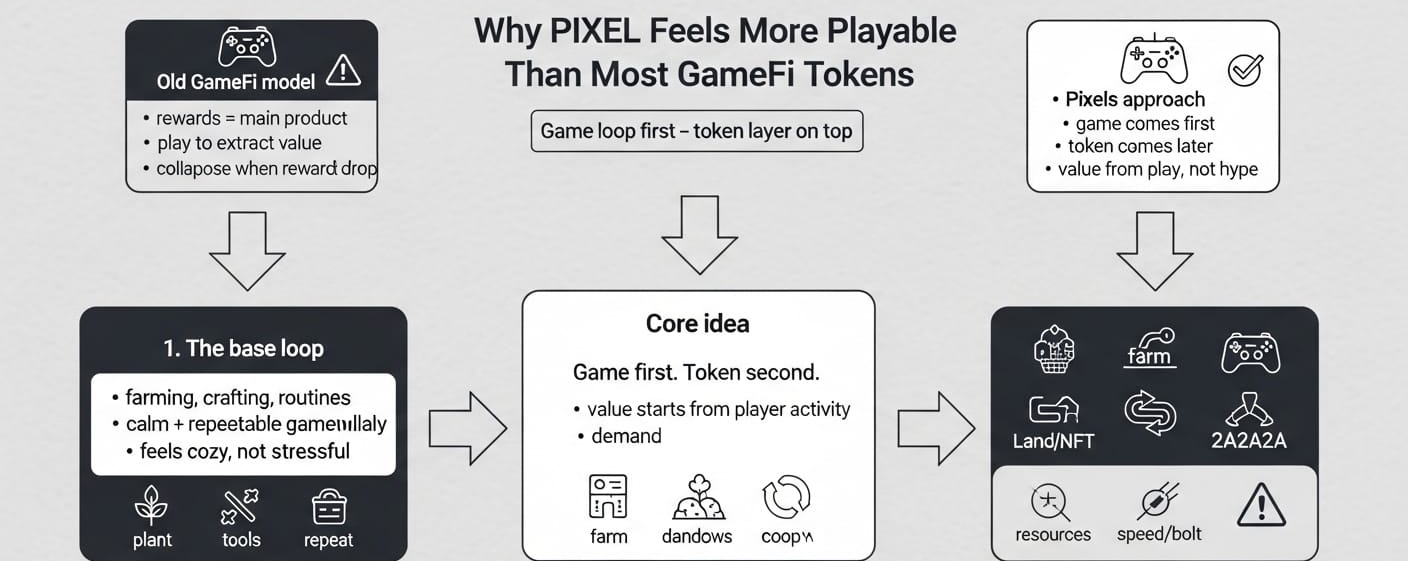
most gamefi tokens feel like the “product” is the payout. you’re not really playing, you’re extracting. that’s why so many play-to-earn projects from the earlier wave collapsed in the same boring way: rewards were the main attraction, so when liquidity dried up and charts started falling, the whole thing fell apart with it. the gameplay was just a wrapper around emissions, APY vibes, and selling pressure. once the music slowed, people left.
Pixels feels like it’s trying to rebuild the order of operations. not “token first, game later,” but game loop first, token sitting on top. that sounds like a small change, but it changes the whole risk profile. because now the real question becomes: would anyone still spend time here if the rewards weren’t screaming at them every minute?
Pixels at least tries to answer that with a baseline loop that’s calm and repeatable. farming, crafting, wandering around, optimizing small routines. it’s not trying to shock you with constant urgency. it’s simple, a bit grindy, kinda cozy. and ironically, that makes it easier to stick with. you don’t feel like you’re clocking in for a second job. you feel like you’re doing a routine because it’s relaxing.
and this matters because value doesn’t come from tokens by default. tokens mostly measure where value is already flowing. in Pixels, that flow starts with time and engagement. players planting, harvesting, crafting, improving their little loops. that creates demand for resources, for land, for small advantages. once that demand exists, the token layer can make sense as a premium layer, instead of trying to bootstrap value out of thin air.
you can still see the familiar pieces under the hood, but they behave differently when the loop is the center. land ownership acts like infrastructure, not just a flex asset. land only has output if activity exists. no players showing up, no output. no output, no value. so landowners are tied to the health of the ecosystem whether they like it or not. they can’t just extract and disappear forever, because the system needs ongoing participation to keep producing.
resources also feel more “game-like” in this framing. you’re not hoarding them because you think they’ll 10x. you’re using them, converting them, burning them through progression loops. that constant cycle—create, consume, repeat—does more for stability than a fancy emission schedule, because it keeps value circulating inside the world instead of leaking out instantly.
and $PIXEL itself sits above that as a premium layer. it speeds things up, unlocks certain paths, gives access to higher-tier interactions. but in this model, it’s not framed as mandatory just to exist in the game. that’s a big deal. because the moment a token becomes required for basic play, friction shows up. and friction kills retention. players don’t stick around to fight an economy.
none of this means Pixels is guaranteed to win. the biggest risk is still the same one every game faces: people might just stop caring. attention can bleed out quietly, without a dramatic crash. but if Pixels can hold even modest engagement, its economy looks less like a reward machine and more like a game economy where value circulates instead of constantly leaking. and in gamefi, that shift—game first, token second—is rare enough to be worth taking seriously.